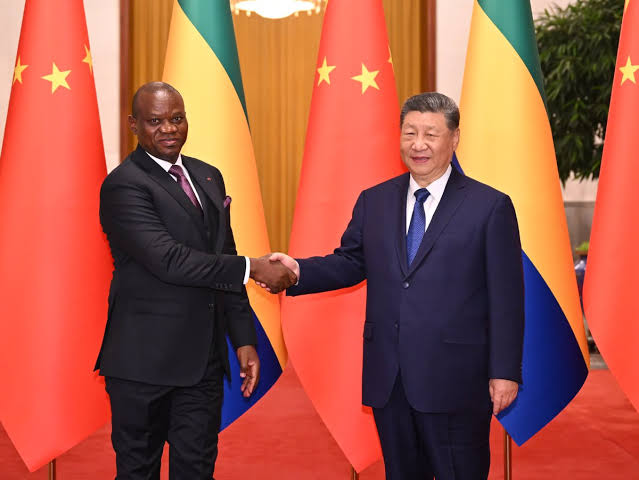

China and Gabon have agreed to strengthen cooperation in mining, trade, security and governance following President Brice Clotaire Oligui Nguema’s state visit to Beijing, signalling efforts to expand economic ties and accelerate the development of Gabon’s natural resources.
The agreement places mining at the centre of the renewed partnership, with China pledging to support Gabon in transforming its mineral wealth into greater economic value, industrial development and sustainable economic growth.
A joint statement issued following the talks said the two countries would increase political and institutional exchanges at all levels of government to strengthen coordination and deepen bilateral relations.
The two leaders also announced the elevation of bilateral relations to a China-Gabon Community with a Shared Future for the New Era, building on the comprehensive strategic cooperation partnership established in 2023.
The new framework is expected to support Gabon’s National Growth and Development Plan 2026–2030, with particular emphasis on mineral exploration, local processing, infrastructure development and skills transfer.
Six memorandums of understanding were signed during the visit, covering geological and mining cooperation, geosciences training, industrial supply chains, economic development, construction of a multipurpose building for Gabon’s Foreign Affairs Ministry and cooperation between the two countries’ television broadcasters.
For Gabon, the mining partnership presents an opportunity to move beyond exporting raw minerals towards developing domestic processing industries that can generate employment, attract investment and retain more economic value within the country.
The Central African nation is endowed with significant mineral resources, particularly manganese, iron ore and gold. Manganese is among its most important exports, making the development of processing capacity a strategic priority for the government.
Gabon has been seeking greater investment in mineral exploration, infrastructure and local industrialisation as part of efforts to diversify its economy and reduce dependence on raw commodity exports.
China’s proposed support will cover different stages of the mining value chain, including exploration, processing, infrastructure and technical training. The two governments have also identified geological research and industrial supply chains as priority areas for cooperation.
Beyond mining, the agreement expands cooperation in peace and security, with both countries committing to strengthen exchanges between their armed forces, law enforcement bodies and security agencies.
The two sides also intend to deepen cooperation in trade, education and public health, while expanding institutional exchanges involving government departments, political parties, legislatures and local authorities.
Trade is another important pillar of the renewed relationship. China has granted Gabonese products zero-tariff access to its market since May 1, 2026, under its expanded preferential trade arrangements for African countries.
The two governments agreed to accelerate negotiations on an economic partnership agreement to establish a longer-term framework for the arrangement. They also plan to modernise their agreement on the promotion and protection of investments to encourage greater business activity between the two countries.
Chinese President Xi Jinping said Beijing was ready to be a reliable partner in Gabon’s independent development, while encouraging closer alignment of the two countries’ development strategies.
Nguema welcomed increased Chinese investment, saying Gabon was seeking partnerships that could accelerate industrialisation and sustainable development.
The visit comes as China continues to strengthen economic and diplomatic engagement with African countries through investment, infrastructure development, trade facilitation and industrial cooperation.
For Gabon, the expanded partnership provides an opportunity to attract capital and technical expertise as it seeks to transform its natural resource base into a broader industrial economy.
The success of the agreements will depend on their implementation, particularly whether increased mining investment translates into local processing capacity, employment and greater participation by Gabonese businesses in the mineral value chain.