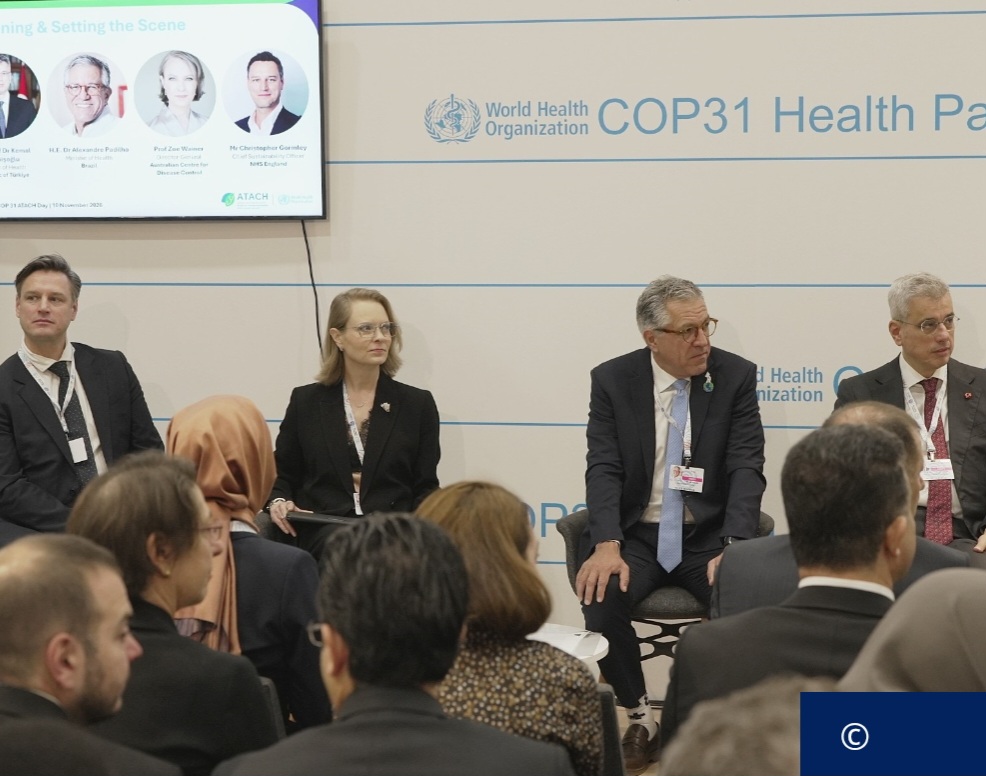

The question took centre stage during the fourth Alliance for Transformative Action on Climate and Health (ATACH) Day at the COP31 Health Pavilion in Antalya, Türkiye, where health ministers, climate experts and development partners called for a shift from political pledges to country-led implementation.
Held under the theme “From commitments to implementation: Country solutions for climate and health,” the gathering brought together representatives from different income groups and regions to share practical approaches to building healthcare systems capable of withstanding climate-related pressures.
A major outcome was the introduction of the Antalya Initiative for Health Resilience (AIR), launched by Türkiye under its COP31 Presidency to strengthen cooperation and knowledge-sharing among countries working to build climate-resilient health systems.
Türkiye’s Minister of Health, Professor Dr Kemal Memişoğlu, described the initiative as one of the country’s significant contributions to its COP31 Presidency, emphasising the need to translate political commitments into tangible interventions at country level.
“AIR is an initiative aimed at translating global political will in climate and health into concrete country-level implementations,” he said.
The initiative will be coordinated and technically facilitated through ATACH, providing a mechanism for countries to exchange experiences and strengthen their capacity to respond to the growing intersection between climate change and public health.
For African countries, where healthcare systems face persistent resource constraints and uneven access to essential services, the transition from climate commitments to implementation raises questions about financing, infrastructure, preparedness and equitable access to healthcare.
The discussions also highlighted the importance of ensuring that climate resilience is integrated into national health planning rather than treated as a separate environmental priority.
ATACH Secretariat Lead Elena Villalobos Prats presented the Alliance’s 2026–2028 priorities, highlighting country-led approaches and stronger capacity-building mechanisms.
The Alliance also introduced new engagement opportunities through thematic Communities of Practice and an Executive Fellowship. These mechanisms are intended to strengthen collaboration, facilitate knowledge exchange and bring technical support closer to countries implementing climate and health interventions.
The discussions brought together health ministers from across WHO regions, including Brazil, the Bahamas, North Macedonia and Tuvalu, reflecting the international nature of the climate-health challenge.
Despite differences in geography, economic capacity and exposure to climate hazards, country representatives identified common priorities, including stronger health governance, localised solutions, better evidence and collaboration across sectors.
An interactive session using a World Café format allowed participants to exchange experiences and identify practical areas requiring further attention.
One emerging concern was the need for standardised indicators capable of measuring progress in climate and health interventions while accounting for inequalities between countries and communities.
This is particularly important because climate-related health risks are not experienced equally. Communities with limited access to healthcare, infrastructure and financial resources often face greater difficulties responding to climate shocks.
The financing question therefore emerged as another central issue during the discussions.
A panel on equitable climate and health action brought representatives from Small Island Developing States (SIDS) and Least Developed Countries (LDCs) into the conversation, highlighting the distinct challenges facing countries with limited resources and high vulnerability to climate impacts.
Participants emphasised that climate resilience cannot be achieved through national policies and international agreements alone. Communities, patients and young people must also influence the decisions shaping their health and environments.
Abdul-Fatawu Salifu, ATACH Champion for Communities, Patients and Youth, stressed that community voices must remain central to implementation efforts.
His intervention reinforced the importance of involving the people most affected by climate-related health challenges in designing and evaluating solutions.
The gathering concluded with high-level remarks from representatives of the Bahamas, France and North Macedonia, reiterating the need to sustain collaboration beyond international climate negotiations.
For ATACH, the next phase will involve responding to countries’ specific implementation needs and strengthening the support available to translate commitments into interventions that protect public health.
As COP31 continues, the discussions highlight a growing recognition that climate action must also be treated as a healthcare priority. The effectiveness of initiatives such as AIR will ultimately depend on whether countries can mobilise resources, strengthen institutions and deliver measurable improvements in the resilience of health systems and the communities they serve.
The challenge is no longer simply securing commitments on climate and health, but ensuring those commitments produce tangible protection for populations facing increasingly complex health risks.