
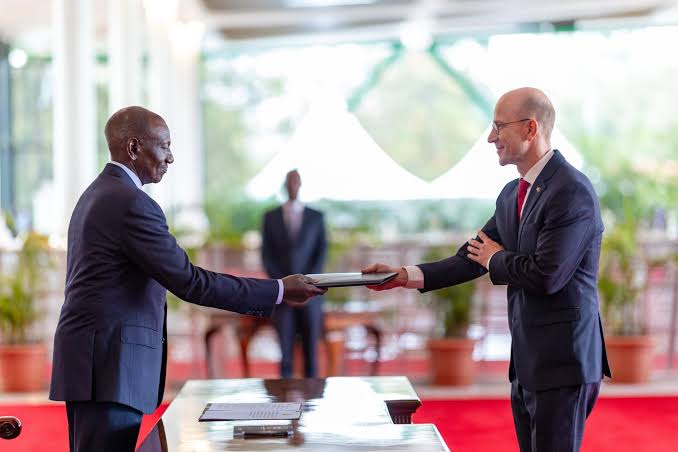

The European Union’s decision to bring together more than 40 of its ambassadors serving across Africa in Nairobi signals a renewed effort by Brussels to strengthen its diplomatic influence, deepen strategic partnerships and reinforce Europe’s position in an increasingly competitive geopolitical landscape.
The high-level regional seminar, announced by EU Ambassador to Kenya Andreas Peschke, comes shortly after the Russia-Africa Summit in Moscow, placing the Nairobi gathering against the backdrop of intensifying diplomatic and economic competition among global powers seeking stronger relationships with African countries.
“For the first time ever, we are bringing together over 40 EU Ambassadors from all over Africa here in Nairobi,” Peschke said ahead of the regional seminar.
Although the timing does not necessarily establish a direct response to Russia’s engagement with Africa, it highlights Europe’s recognition of the continent’s growing importance in international trade, investment, security cooperation and access to strategic resources.
Nairobi emerges as Europe’s diplomatic hub
The choice of Nairobi is significant. Peschke disclosed ahead of the meeting that the EU Delegation in Kenya had recently acquired new regional hub status, accompanied by an expansion of its offices and staffing to support wider engagement across the continent.
He described Kenya as an increasingly important political and economic partner and a regional anchor in a complex geopolitical environment.
The meeting follows Russia’s third Russia-Africa Summit, held in Moscow on October 28–29, which brought together representatives from 48 African countries, including 22 heads of state or government.
President Vladimir Putin used the summit to promote a multipolar international order and expand Russia’s economic, defence, energy and diplomatic partnerships with African countries.
Food security, fertiliser supplies, nuclear energy, military cooperation, technology and trade featured prominently in Moscow’s engagement with African governments.
For Russia, Africa represents an important diplomatic constituency in its efforts to challenge Western dominance in international institutions and expand partnerships beyond traditional Western alliances.
Europe’s Nairobi gathering therefore comes at a time when African governments are receiving intensified attention from competing global powers.
However, Brussels’ strategy extends beyond responding to Moscow’s advances. The EU is seeking to preserve its position as a leading economic partner while adapting to an international order in which African countries increasingly demand balanced, commercially beneficial and mutually respectful relationships.
Competition for trade and investment
The economic dimension is central to Europe’s renewed diplomatic engagement.
The EU remains one of Africa’s largest trading partners and investors. EU-Africa trade reached approximately €360 billion in 2024, accounting for 33 per cent of the continent’s total trade, while European foreign direct investment in Africa stood at approximately €250 billion.
Through its €150 billion Africa-Europe Global Gateway investment package, Brussels is seeking to expand financing for transport infrastructure, renewable energy, digital connectivity, healthcare, education and industrial development.
These investments are strategically important as Africa accelerates implementation of the African Continental Free Trade Area (AfCFTA), which offers opportunities to strengthen regional manufacturing, develop supply chains and attract investment into productive sectors.
The EU is also competing for stronger economic relationships as China, Russia, the United States, Turkey, India and Gulf countries expand their commercial and diplomatic footprints across the continent.
For Europe, the challenge is translating its financial resources and established trade relationships into visible development outcomes, particularly employment, technology transfer, industrialisation and infrastructure development.
The Nairobi seminar provides an opportunity for European diplomats to coordinate their approaches, identify emerging opportunities and strengthen the EU’s engagement with governments across different African regions.
Kenya’s strategic importance
Kenya’s position as host reflects its growing importance in European foreign policy, particularly in East Africa and the Horn of Africa.
Nairobi is a major diplomatic centre, hosting the United Nations Environment Programme (UNEP), UN-Habitat and numerous international organisations. It offers Europe an important platform for engaging regional institutions, governments and multilateral partners.
Peschke highlighted the expanding EU-Kenya relationship, pointing to cooperation in security and defence, maritime protection, trade, climate diplomacy, digital innovation and green development.
The two sides marked 50 years of diplomatic relations in 2026 and are seeking to deepen economic cooperation through the Economic Partnership Agreement signed in 2024.
Kenya’s role in addressing regional challenges, including insecurity in Somalia, food insecurity and climate-related shocks, further strengthens its strategic importance to European policymakers.
For Nairobi, hosting more than 40 European ambassadors provides an opportunity to reinforce its position as a regional diplomatic and economic hub while attracting greater European investment and political engagement.
Africa’s growing geopolitical bargaining power
The broader significance of the Nairobi meeting lies in what it reveals about Africa’s changing position in global geopolitics.
The continent is increasingly central to discussions about energy security, critical minerals, food systems, maritime routes, digital infrastructure and reform of international institutions.
African governments are also becoming more assertive in diversifying their international partnerships rather than relying exclusively on traditional Western relationships.
Russia’s diplomatic engagement, China’s infrastructure and industrial investments, Europe’s trade and development financing, and the growing presence of Gulf countries demonstrate the breadth of international interest in Africa.
This competition creates opportunities for African countries to negotiate better investment terms, attract technology partnerships, expand export markets and strengthen their influence in international decision-making.
However, diplomatic meetings and investment announcements alone will not determine which global powers secure lasting influence on the continent.
Europe’s real test will be whether its engagement translates into tangible economic benefits, including industrial development, local employment, technology transfer, infrastructure financing and improved access to European markets.
For African governments, the priority should be ensuring that international competition produces meaningful economic transformation rather than simply shifting geopolitical allegiances.
Coming shortly after Moscow’s Russia-Africa Summit, the Nairobi conference underscores Europe’s recognition that Africa’s strategic importance is growing and that maintaining influence requires stronger coordination, investment and political engagement.
The question is no longer whether Europe, Russia, China or other global powers want Africa. It is what each is prepared to offer a continent increasingly determined to shape its own economic and geopolitical future.



