
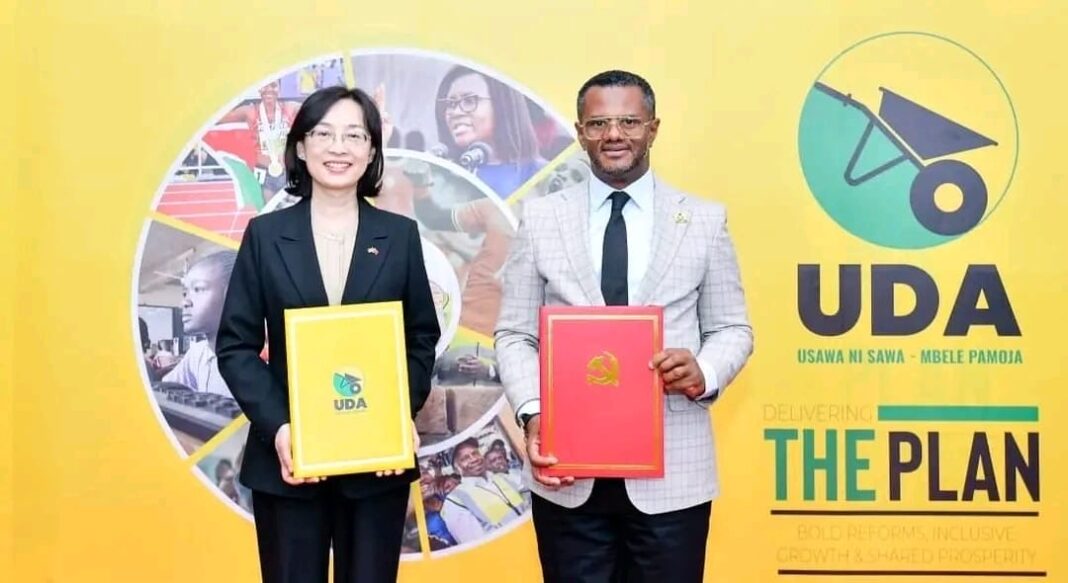

The United Democratic Alliance (UDA) and the Communist Party of China (CPC) have signed a Memorandum of Understanding (MoU) to deepen political cooperation, strengthen institutional relations and promote the exchange of governance and development experiences, opening a new chapter in engagement between Kenya’s ruling party and China’s governing party.
The agreement establishes a structured framework for sustained collaboration in party building, policy development, governance and institutional capacity-building, reflecting growing recognition of party-to-party diplomacy as an important channel for strengthening relations between countries.
Beyond political goodwill, the partnership provides both parties with an opportunity to learn from different governance models, exchange policy experiences and build institutional capacities while strengthening their contribution to discussions on development challenges facing the Global South.
Speaking during the signing ceremony, UDA Secretary General Senator Hassan Omar Hassan described the MoU as more than a formal document, saying it represented a lasting commitment to cooperation, mutual learning and institutional development.
Omar said the agreement would serve as a living framework for sustained engagement and enduring friendship between the two political organisations.
He emphasised that the partnership would create opportunities for both sides to share experiences, strengthen their organisational structures and learn from each other’s approaches to political leadership, policy formulation and governance.
For UDA, the agreement offers an opportunity to engage with the CPC’s extensive experience in political organisation, leadership development, long-term planning and governance. Such exchanges could provide insights into institutional management, grassroots mobilisation and the relationship between political leadership and national development priorities.
On its part, the CPC sees the partnership as an opportunity to expand its engagement with Kenyan political institutions and strengthen its understanding of Kenya’s political landscape, democratic processes and development priorities.
Minister Liu Haixing of the International Department of the Central Committee of the CPC welcomed the agreement, noting that both parties were committed to elevating their relationship to a strategic level in the New Era.
Liu underscored the importance of strengthening political exchanges and institutional cooperation, highlighting the potential for both sides to build a deeper understanding through sustained interaction and the sharing of experiences.
The CPC’s International Department, which manages the party’s international relations, plays a central role in building partnerships with political organisations across the world. Its involvement in the agreement signals China’s continued use of party-to-party diplomacy to strengthen international relationships alongside conventional government-to-government engagements.
The partnership also reflects the growing importance of political cooperation in Kenya-China relations, which have traditionally been driven by trade, infrastructure investment, industrial development, education and technology.
While bilateral government agreements establish the framework for economic and diplomatic cooperation, party-to-party relations provide another avenue for discussions on political organisation, leadership, development philosophies and public policy.
For Kenya, engagement with the CPC could offer additional exposure to China’s development experience, particularly in economic transformation, poverty reduction, infrastructure development and long-term planning. It could also create opportunities for exchanges involving party officials, policy experts and institutional representatives.
For China, closer relations with UDA strengthen its political engagement with Kenya, one of East Africa’s largest economies and an important diplomatic and commercial partner. The arrangement also provides the CPC with a platform to share its development perspectives while gaining insights into the priorities of political organisations in Africa’s multiparty systems.
The agreement carries significance beyond the two parties, particularly as African and Asian countries seek stronger cooperation on industrialisation, technology transfer, trade, development financing and reforms to global governance institutions.
Both parties reaffirmed their commitment to contributing to international discourse and promoting greater solidarity in addressing common development challenges, particularly across the Global South.
This commitment comes at a time when developing economies are seeking greater influence in international decision-making and exploring alternative partnerships to accelerate economic growth, strengthen domestic industries and address persistent development inequalities.
For UDA and the CPC, institutionalising their relationship could create a platform for sustained political dialogue and practical cooperation, with the potential to strengthen understanding between the two countries beyond their existing diplomatic and economic ties.
However, the long-term value of the MoU will depend on how effectively the parties translate its commitments into regular exchanges, joint programmes, policy discussions and capacity-building initiatives.
Minister Liu attended the signing ceremony accompanied by Ms Rao Huihua, Director-General of the African Affairs Bureau, and other senior CPC officials.
Senator Hassan was accompanied by UDA National Executive Committee member and Turkana Woman Representative Cecilia Ng’itit, Senior Advisor to the President Professor Edward Kisiangani, UDA Executive Director Nicodemus Bore, party directors and other senior officials.
The agreement marks a further step in strengthening institutional links between Kenya and China, positioning political cooperation as an additional pillar of their broader bilateral relationship.
Editorial improvement: The revised version gives the agreement a stronger geopolitical and economic angle, explains the benefits to both parties separately and distinguishes party-to-party diplomacy from formal government relations. It also avoids presenting China’s governance model as directly transferable to Kenya.



