

Russia and African countries are seeking to strengthen financial cooperation and reduce dependence on external payment systems, with Russian President Vladimir Putin calling for the development of mechanisms that would allow businesses to settle transactions in their national currencies.
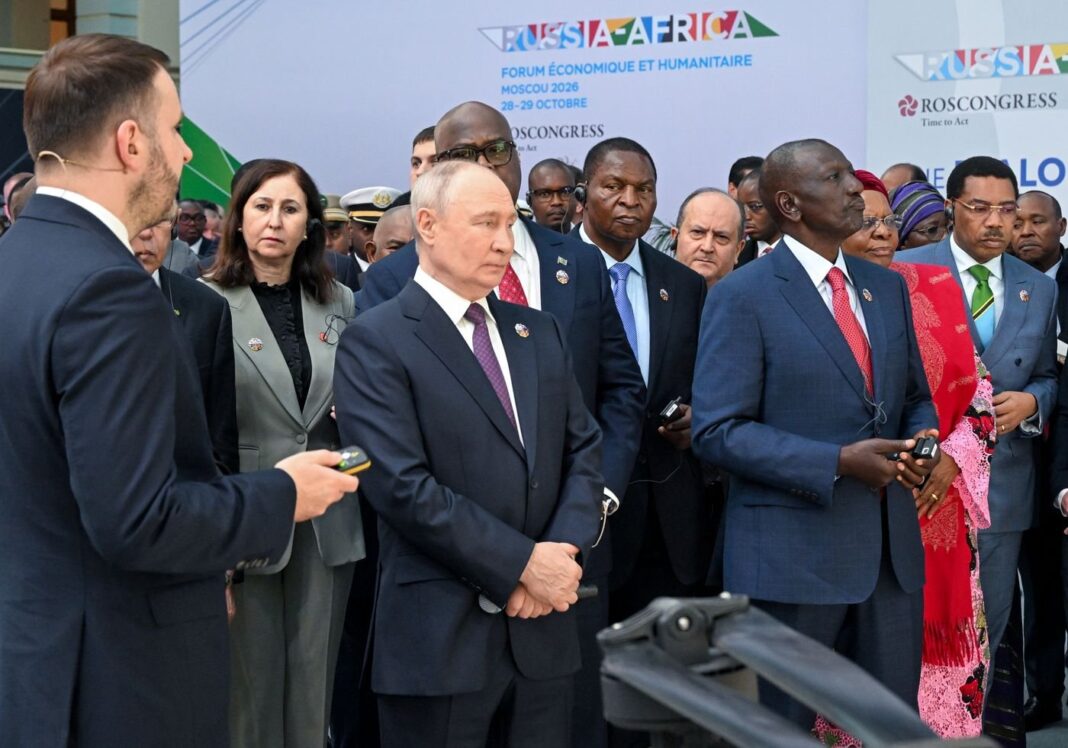
Putin made the remarks during the Russia–Africa Summit, where he joined Kenyan President William Ruto and other African leaders on a tour of the exhibition titled Sovereign Development Platform: Advanced Russian Solutions in Key Economic and Social Sectors.
The discussions underscore Moscow’s efforts to deepen economic engagement with African countries through financial integration, trade diversification, technology transfer and investment in strategic sectors.
“Russia and African countries need to develop a system for settling payments in national currencies,” Putin said, highlighting the importance of building financial arrangements that can support growing commercial exchanges between Russia and the continent.
The proposal comes as African economies seek to diversify international trade partnerships, strengthen regional financial systems and reduce the cost of cross-border transactions. For Russia, expanding the use of national currencies could also help sustain trade with African partners amid restrictions affecting its access to parts of the international financial system.
A functioning payment framework would allow exporters, importers and investors to conduct more transactions directly in currencies such as the Russian rouble and those of participating African countries, potentially reducing reliance on third-country currencies.
However, the effectiveness of such arrangements would depend on currency convertibility, exchange-rate stability, banking infrastructure and the availability of liquid markets for exchanging African currencies against the Rouble.
The exhibition tour provided a platform for African leaders to examine Russian technologies and industrial solutions across key economic and social sectors. Such engagement reflects Moscow’s broader ambition to position itself as a partner in Africa’s industrialisation, infrastructure development, energy security and technological advancement.
For African governments, the priority will be translating diplomatic engagement into commercially viable partnerships that generate investment, create jobs and expand domestic production capacity.
Russia has long maintained economic relationships with African countries in areas including energy, mining, agriculture, fertiliser supply, engineering, military equipment and technical education. Moscow has also sought to expand cooperation in nuclear energy, transport infrastructure and industrial manufacturing as African countries pursue economic diversification.
Agriculture and food security remain important areas of engagement. Russian supplies of wheat, fertilisers and other agricultural inputs are significant to several African markets, while African countries offer opportunities for expanded agricultural trade and investment.
More predictable payment arrangements could help businesses manage transactions in these sectors, particularly where international banking restrictions, high transaction costs or currency shortages complicate trade.
Kenya’s participation in the summit, through President Ruto, comes as Nairobi seeks to broaden its international economic partnerships and attract investment into manufacturing, infrastructure, transport and mineral processing.
Kenya and Russia have opportunities to expand commercial engagement, although deeper cooperation would require stronger business-to-business links, improved market access and practical arrangements to facilitate payments and trade finance.
For African economies, cooperation with Russia also presents a need to balance diversification with financial resilience. National-currency settlement systems can reduce exposure to some external risks, but they are not a substitute for stable macroeconomic policies, reliable banking institutions and transparent investment frameworks.
The summit’s economic agenda therefore extends beyond diplomatic commitments to the practical mechanisms required to make trade work. Businesses need reliable payment channels, competitive financing, clear regulations and confidence that earnings can be converted and repatriated where permitted.
Putin’s call for national-currency settlements signals Moscow’s interest in building a more direct financial relationship with African partners. Whether the initiative gains traction will depend on the willingness of participating governments and central banks to establish workable systems and on the extent to which businesses adopt them.
As Russia and African countries seek to expand economic cooperation, financial connectivity could become an important test of the partnership’s commercial ambitions. The central challenge will be turning political commitments into sustainable trade flows, productive investment and measurable economic benefits for both sides.



