

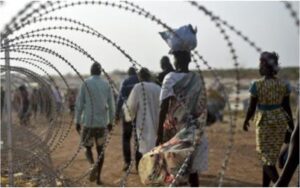
JONGLEI, South Sudan – The UN Commission on Human Rights in South Sudan has issued a warning, stating that the population and the country’s intended democratic transition are still at risk due to recurring violence, political unrest, dwindling civic space, ingrained corruption, and ongoing impunity.
The Commission met a section of representatives from the government, the political and security sectors, civil society, and other stakeholders over the course of the four-day visit.
In preparation for the December 22, 2026 elections, they demanded that the government take immediate action to safeguard civilians, enable humanitarian aid to reach those in need, and foster inclusive political discourse.
South Sudan broke away from Sudan in July 2011, making it the youngest nation in the world. Less than three years later, President Salva Kiir and Vice-President Riek Machar’s power struggle led to the outbreak of civil war. Despite a 2018 peace deal, fighting is still going on.
https://twitter.com/UNCHRSS/status/2098004457862607151
Yasmin Sooka, the chair of the commission, visited Jonglei state and spoke with people who had survived recent warfare in the north.
Survivors of the South Sudan civil war speak out
She heard horrific stories about murders, sexual assault, being uprooted, and being cut off from family. Some survivors, especially those with critical and urgent medical requirements, also talked about being denied access to psychosocial, medical, or other crucial support.
“Visit after visit, we continue to hear from people who bear the consequences of violence, displacement, insecurity and the failures of those with political and security responsibilities to prevent and address those harms,” she said.
“The patterns have changed little, while the human cost continues to grow. South Sudanese people deserve better than to have their lives shaped by recurring cycles of violence and uncertainty.”
https://twitter.com/emmanuel_woja/status/2098047329009869290
Concerns about murders, displacement, attacks on civilians, interference with humanitarian efforts, and increasing insecurity for relief workers were expressed by the Commission.
Members pointed out that support for humanitarian operations and the UN Mission in South Sudan (UNMISS) is crucial during a period of extreme humanitarian needs and persistent funding shortages.
South Sudanese nationals warm up to the polls
They called for an investigation and the prosecution of those responsible for the recent attack on a UNMISS patrol in Jonglei that killed two peacekeepers and injured others.
The visit takes place at a critical juncture as South Sudan prepares for its first elections since independence.
The Commission recently issued a warning that elections lacking fundamental protections, such as real inclusive political discourse, could lead to a resurgence of hostilities and raise the possibility of atrocity crimes.
https://twitter.com/PonnieSheila/status/2069069535362035875
Although the 2018 Revitalised Agreement’s implementation has stagnated, Commissioner Barney Afako stated that it is still necessary for a democratic and peaceful South Sudan.
“Even as the country heads for elections, political and civic space has narrowed, while many of the safeguards and conditions for peaceful and credible polls are still missing,” he said.
UN Commission pushes for sobriety in South Sudan
According to Commissioner Afako, South Sudanese do have a right to vote, and that right must be protected by ensuring they can participate freely, compete fairly, and resolve any electoral disputes through credible adjudication.
“These are the safeguards that will prevent an election from becoming a trigger for violence and disruption,” said the commissioner.
Once more, the Commission urged sincere and inclusive political discourse. This comprises civil society, women, youth, holdout organisations, and Machar’s Sudan People’s Liberation Movement-in-Opposition (SPLM-IO).
https://twitter.com/RadioMiraya/status/2098005255757664291
In the meantime, corruption still poses a threat to security and peace. Since its 2025 report described how entrenched corruption and the misallocation and diversion of public resources affect human rights, the Commission has observed a lack of improvement.
“All these years, the Commission has documented serious violations and identified the same underlying problem: impunity. Too often, those responsible for grave abuses have not been held accountable, while institutions responsible for justice remain weak and under-resourced,” said Commissioner Carlos Castresana Fernández.