

South Sudan is entering a critical phase in its political transition as President Salva Kiir Mayardit moves to bring competing political forces into dialogue ahead of the country’s planned general elections in December 2026.
The upcoming Inter-Party Dialogue, scheduled to begin on September 17, is expected to provide a platform for political leaders to confront some of the most difficult questions surrounding the country’s electoral pathway while reinforcing the need for political tolerance, national integration and peaceful competition.
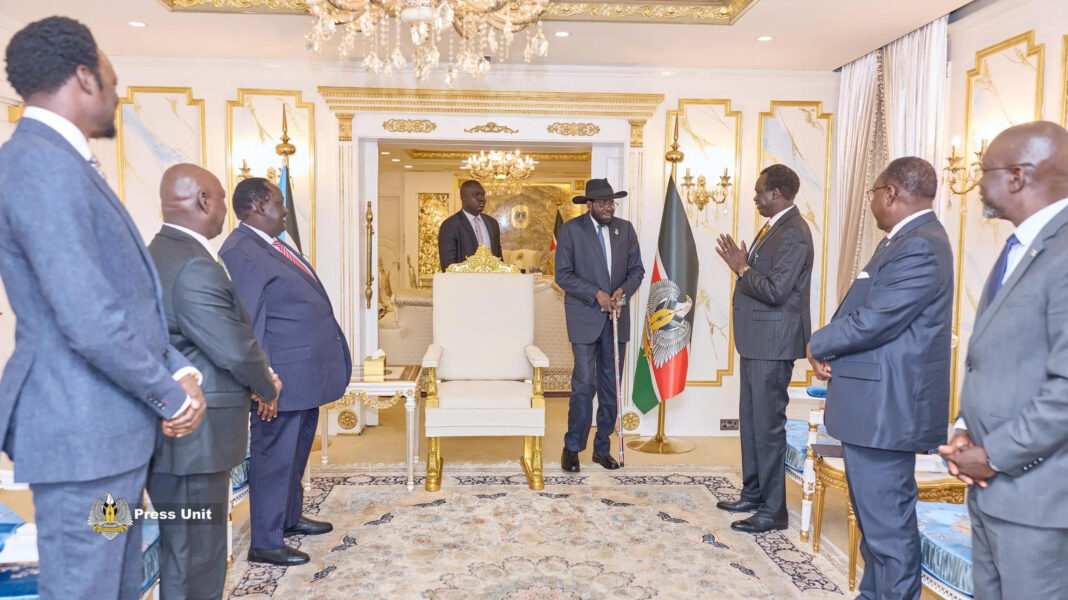
President Kiir on Wednesday met leaders of various political parties as preparations intensified for the dialogue, which is expected to bring together political organisations and groups from across South Sudan’s political spectrum.
The meeting comes at a defining moment for the young nation, where the credibility and peaceful conduct of the December elections will depend not only on technical preparations but also on the willingness of political leaders to embrace dialogue and place national unity above political rivalry.
The Inter-Party Dialogue is intended to allow political parties and other stakeholders to discuss and negotiate key electoral issues that must be resolved before South Sudan goes to the polls.
It will also provide an opportunity to identify major post-election questions requiring national consensus in order to preserve peace, political legitimacy and the continuity of state-building.
Importantly, the process is expected to include political parties and groups that are outside the 2018 Revitalised Peace Agreement, widening participation and potentially creating a more inclusive national political conversation.
For South Sudan, where years of conflict and political divisions have weakened trust among communities and political actors, inclusion will be central to the success of the electoral process.
The December elections therefore represent more than a contest for political office. They will be an important test of whether South Sudan’s leaders and institutions can manage political competition without allowing disagreements to undermine the fragile peace achieved through years of negotiation.
Among the issues expected to dominate the dialogue are constituency boundaries and political representation, independent candidacy, and whether elections should be conducted simultaneously at all levels or introduced in phases.
Political leaders are also expected to discuss election financing and campaign funding, as well as security arrangements for candidates, political rallies, polling centres, election materials and the transmission of results.
These questions will be crucial in determining whether the electoral environment is considered fair and accessible to political actors across the country.
However, the most important foundation for credible elections may be the political environment in which campaigns take place.
The dialogue is expected to address the political space available for campaigning, including freedom of assembly, movement and speech. Such freedoms will be critical in ensuring that parties can present their policies to voters without intimidation or fear.
Political tolerance must therefore become a central principle of South Sudan’s election preparations.
Political opponents should not be viewed as enemies of the state or obstacles to peace. A functioning democracy requires leaders and supporters of different parties to compete vigorously while recognising each other’s right to participate in national affairs.
South Sudan’s political leaders have an opportunity to demonstrate that differences in ideology, leadership and political priorities can be resolved through debate and democratic competition rather than confrontation.
The dialogue is also expected to consider whether digital or manual systems will be used for voter registration, voting, counting and the transmission of results.
Other issues include campaign modalities and access for domestic, regional, continental and international election observers.
Transparent and credible electoral systems will be essential in building confidence among political parties and voters, particularly in a country where trust between rival political groups remains a sensitive issue.
Mechanisms for preventing and resolving electoral disputes will also feature prominently in the discussions.
Political parties are expected to consider procedures for handling complaints and disagreements in a timely and peaceful manner, while developing a political code of conduct that commits all participants to non-violence, lawful political engagement and peaceful competition.
Such commitments must extend beyond political leaders to their supporters.
The language used during campaigns, public rallies and media engagements will play an important role in either promoting national unity or deepening divisions.
South Sudan’s diversity should be viewed as a source of national strength rather than a basis for political mobilisation and exclusion.
Presidential Adviser on National Security Tut Gatluak Manime said the dialogue would go beyond electoral preparations, offering political leaders an opportunity to address broader questions of peace, security and national stability.
This wider approach recognises that elections alone cannot resolve South Sudan’s political challenges. Sustainable peace will require continued dialogue, stronger institutions and greater integration among communities and political forces.
As December approaches, South Sudan faces an opportunity to demonstrate that political competition and national unity can coexist.
The success of the elections will depend on whether political leaders choose tolerance over hostility, dialogue over confrontation and integration over division.
The Inter-Party Dialogue could therefore become one of the most important political processes ahead of the December polls, setting the tone for how South Sudan enters its next chapter.
For a country still building its institutions and national identity, the ultimate victory may not belong to one political party, but to a peaceful and united South Sudan.



