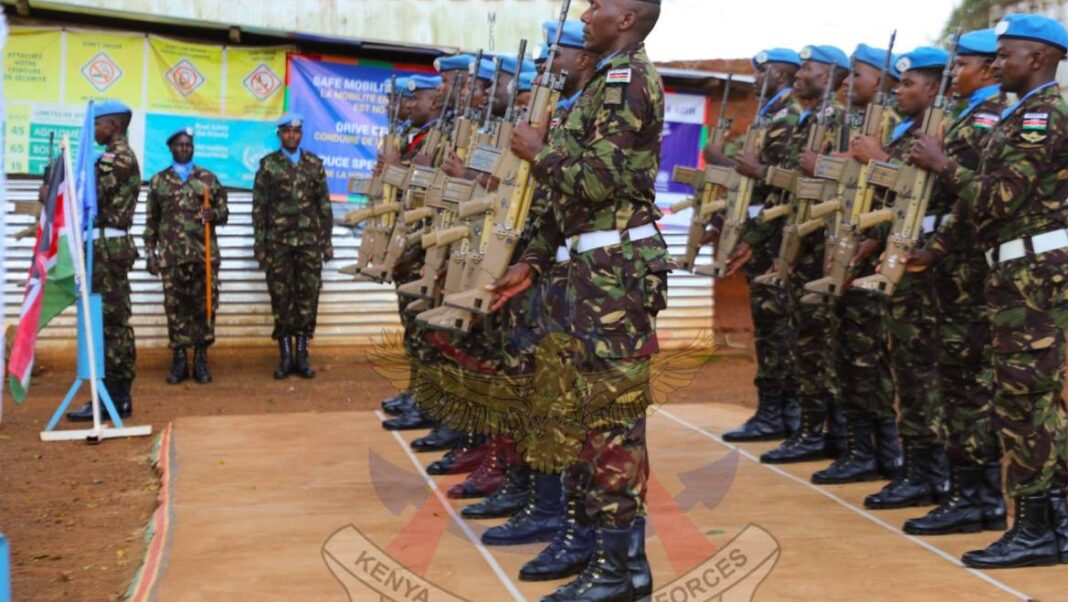

A high-level review delegation from United Nations headquarters in New York has concluded a strategic operational assessment of Kenya’s 5th Quick Reaction Force (KENQRF 5) at the Mavivi Permanent Operating Base in eastern Democratic Republic of the Congo (DRC).
Led by Lieutenant General Mohan Subramanian of the UN’s Office for Peacekeeping Strategic Partnership (OPSP), the inspection forms part of a comprehensive review encompassing both the Force Headquarters and the Force Intervention Brigade (FIB) headquarters under the United Nations Organization Stabilization Mission in the Democratic Republic of the Congo (MONUSCO). The visit underscores the UN’s ongoing commitment to bridging the gap between high-level strategic mandates crafted in New York and the complex, rapidly shifting realities faced by peacekeepers on the frontline.
In volatile conflict theatres like eastern DRC’s North Kivu province, periodic oversight from senior UN leadership serves as a vital operational tool rather than a routine administrative exercise. Modern peacekeeping requires constant calibration to ensure that tactical deployments accurately reflect strategic intent.
During the Mavivi visit, the OPSP team focused on evaluating day-to-day operations to identify potential capability gaps, systemic bottlenecks, and emerging security challenges that could impede the implementation of MONUSCO’s civilian protection mandate. By engaging directly with commanders and personnel on the ground, the delegation sought to verify whether troops are adequately resourced, properly integrated into the broader mission architecture, and structurally positioned to respond to threats before systemic friction can undermine field operations.
A central pillar of the OPSP assessment was examining internal coordination and interoperability among MONUSCO’s various military and civilian components. Within a multidimensional mission, quick reaction forces operate inside a dense chain of command, requiring seamless synchronization with intelligence units, logistics networks, aviation assets, and regional brigade headquarters.
For an agile tactical unit like KENQRF 5, operational effectiveness hinges on speed, continuous readiness, and absolute confidence that supporting mission systems will respond without delay when a crisis erupts. The review team scrutinized how information flows across command tiers and how logistical support is sustained in the field, pinpointing areas where inter-component synergy strengthens mission delivery and identifying friction points that slow down response times.
The assessment comes at a pivotal moment for the Kenyan contingent. Deployed under MONUSCO’s Force Intervention Brigade, KENQRF 5 has played an increasingly active role in stabilizing key transit corridors and protecting vulnerable communities across North Kivu and neighboring Ituri province.
In recent months, Kenyan peacekeepers have consolidated security along previously volatile axes, including the Mavivi–Mbau–Musuku–Mandumbi and Mavivi–Mbau–Oicha corridors—allowing normal civilian movement and local commerce to gradually resume. Following those gains, the contingent expanded its operational footprint to cover the Mavivi–Beni–Mangina–Mandubiena axis, while also executing extended static combat deployments in Mambasa Territory to deter armed group activity. Evaluating how KENQRF 5 manages this expanded area of responsibility provided the UN review team with critical real-world data on tactical mobility and force protection.
Beyond immediate troubleshooting, the OPSP mission is designed to function as an institutional learning mechanism for the global peacekeeping apparatus. By documenting frontline observations from KENQRF 5’s operating environment, Lieutenant General Subramanian’s team aims to distill actionable best practices that can be applied across MONUSCO and exported to other UN peacekeeping missions worldwide.
Converting tactical experiences into refined operational guidance enables UN leadership to prioritize resource allocation, update training standards, and adapt doctrinal approaches to asymmetric threats. Ultimately, the findings from Mavivi will help shape how the United Nations structures and supports rapid-response units in high-risk environments.
The conclusion of the OPSP visit highlights the vital link between institutional accountability and frontline performance. By subjecting command structures, logistical pipelines, and tactical units to rigorous field evaluation, the United Nations aims to maintain operational coherence from headquarters down to the squad level.
For Kenya’s 5th Quick Reaction Force, the review affirms its strategic importance within MONUSCO’s security architecture while providing a direct channel to elevate frontline insights to the highest levels of UN peacekeeping leadership—ensuring that troops on the ground remain equipped, coordinated, and ready to protect civilians in one of the world’s most challenging conflict zones.