
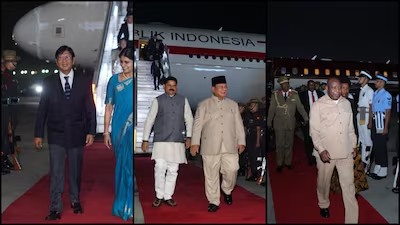

Burundi’s President Évariste Ndayishimiye is attending the 18th BRICS Summit in New Delhi, India, at a moment when Africa’s relationship with the expanding bloc is becoming increasingly strategic.
His presence at the September 12–13 summit is significant not because Burundi is a BRICS member, but because Ndayishimiye is attending in his capacity as Chairperson of the African Union. His invitation reflects the growing importance BRICS places on engaging Africa collectively and the increasing determination of African countries to secure a stronger voice in a rapidly changing global political and economic order.
Hosted by India under the theme “Building for Resilience, Innovation, Cooperation and Sustainability,” the New Delhi summit brings together the expanded BRICS family at a time of geopolitical tensions, trade uncertainty and growing demands for reform of institutions dominated for decades by Western powers. India has placed development, innovation, sustainability and the aspirations of the Global South at the centre of its 2026 presidency.
For Ndayishimiye, the invitation offers an opportunity to articulate Africa’s collective interests beyond the continent’s existing BRICS members.
Africa is already strongly represented within the bloc. South Africa was the first African country to join BRICS in 2010, while Egypt and Ethiopia became members during the group’s major expansion in 2024. Their membership has transformed Africa from being an external partner of BRICS into an increasingly important part of its internal decision-making structure.
The expanded grouping now consists of 11 members and represents nearly half of the world’s population, about 40 per cent of global GDP and roughly 26 per cent of global trade, according to India’s government.
Ndayishimiye’s participation as AU Chairperson therefore gives the summit an additional continental dimension. It allows Africa to engage BRICS not simply country by country, but as a continent seeking greater influence over international finance, trade, infrastructure investment, technology and global governance.
The summit’s agenda is particularly relevant to African governments.One major discussion is expected to focus on reforming global governance institutions and strengthening multilateralism. Many African governments have long argued that institutions such as the United Nations Security Council, the International Monetary Fund and the World Bank do not adequately reflect the political and economic realities of the 21st century.
The BRICS summit is also focusing on trade, investment, energy and food security, technology cooperation and stronger supply chains. Leaders are expected to discuss reforms to the international financial system and ways of reducing excessive dependence on the US dollar, including greater use of national currencies and alternative payment mechanisms.
For African economies facing currency pressures, high borrowing costs and limited access to development finance, these discussions have enormous significance.
The BRICS-created New Development Bank has already emerged as one of the bloc’s most tangible institutions. Reuters reports that the bank has financed billions of dollars in infrastructure and sustainability projects, demonstrating the appeal of creating alternative sources of development finance outside traditional Western-dominated institutions.
This explains why more African states are closely watching the BRICS expansion process.
Membership offers potential access to new markets, investment partnerships and development financing. It also gives countries a platform to participate in discussions shaping a more multipolar world.
For many African governments, BRICS is attractive because its members include some of the continent’s most important economic partners. China has become a leading investor and infrastructure financier across Africa, while India has expanded its trade, pharmaceutical, technology and digital presence. Russia, Brazil and Gulf members of the expanded grouping also offer opportunities for energy, agriculture, mining and industrial cooperation.
Nigeria and Uganda are already among BRICS partner countries, while other African states are expected to continue exploring closer engagement with the grouping. The expansion of the BRICS partnership category has created a new route for countries that may not immediately become full members but want deeper political and economic cooperation.
However, African enthusiasm for BRICS is not simply about joining an alternative geopolitical camp.
The attraction lies increasingly in diversification.African countries are seeking to avoid overdependence on any single global power or financial system. BRICS offers another platform through which they can negotiate trade, investment and political influence while maintaining relationships with Western countries, China, India and other emerging powers.
Yet BRICS also faces serious challenges. Its members have different geopolitical interests, competing regional ambitions and contrasting relationships with the United States and Europe. The wars in Ukraine and the Middle East, as well as tensions between some BRICS members, have tested the bloc’s ability to develop common positions.
For Burundi’s president, the New Delhi summit is therefore about more than his country’s own relationship with BRICS. As African Union Chairperson, Ndayishimiye’s invitation symbolises Africa’s growing strategic importance in the competition to shape the emerging global order.
The real question for African leaders is no longer whether BRICS matters to the continent. It is how Africa can use the expanding bloc to secure more investment, stronger representation and greater influence—without replacing one form of dependency with another.
As the world’s economic and political centre of gravity continues to shift, more African countries are likely to keep their eyes firmly on BRICS, seeing membership not merely as a diplomatic badge, but as a potential seat at the table where the rules of the next global order are being debated.



