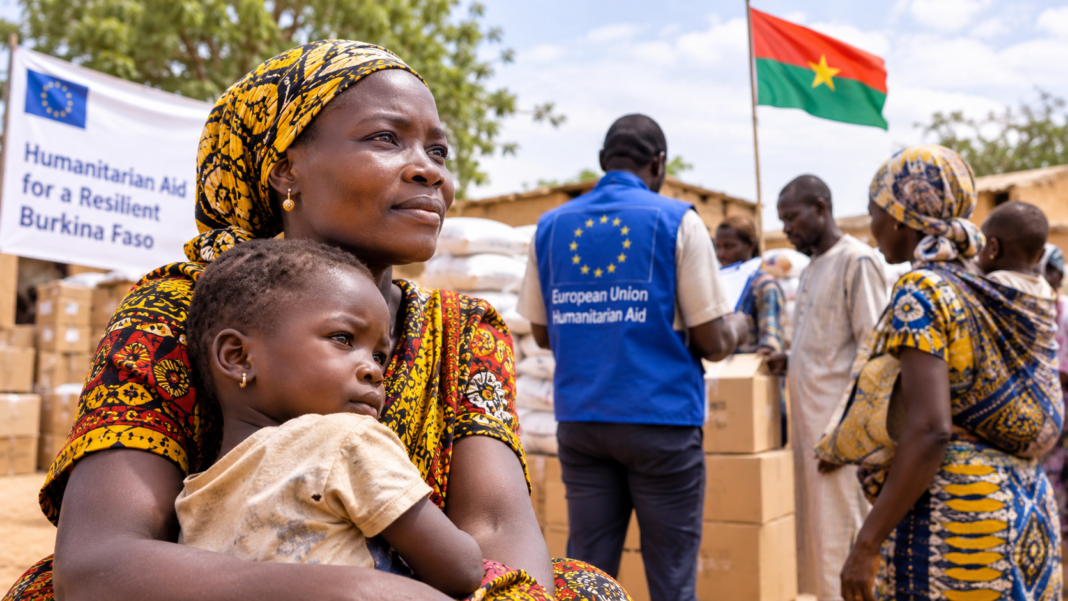

As Burkina Faso pushes for greater national control over humanitarian operations, questions emerge over how international partners can balance emergency assistance, local ownership and access to vulnerable communities.
For families forced from their homes by insecurity, humanitarian assistance can mean the difference between surviving another day and facing an uncertain future.
But beyond the immediate need for food, shelter and other emergency support lies a bigger question: what happens when the assistance stops?
It is a question Burkina Faso’s government wants international humanitarian partners to confront as it pushes for a new approach to aid, one that prioritises local capacity, sustainable recovery and greater respect for national regulations.
During an official visit to Brussels, Foreign Affairs Minister Karamoko Jean Marie Traoré raised the country’s concerns in discussions with European Commissioner for Equality, Preparedness and Crisis Management Hadja Lahbib.
The meeting placed humanitarian cooperation at the centre of discussions, with Burkina Faso seeking to redefine how international assistance is delivered and how humanitarian organisations operate within its borders.
Traoré argued that emergency support should not leave communities permanently dependent on external assistance. Instead, he wants humanitarian interventions to contribute to lasting improvements in the lives of displaced and vulnerable populations.
“We no longer want offers with instruction manuals, but rather support in a sustainable approach, with impacts on the lives of beneficiaries through structuring projects in the areas of return,” he said.
The position reflects a wider debate over the effectiveness of humanitarian assistance in countries experiencing prolonged displacement and insecurity: whether aid should primarily address immediate needs or also create pathways towards recovery and self-reliance.
For Burkina Faso, the government’s preferred approach is one in which people receiving emergency assistance gradually develop the capacity to rebuild their livelihoods and regain independence.
However, translating that ambition into practice will require more than changing the language of humanitarian cooperation.
It will also depend on whether displaced communities can safely return to their homes, access essential services and find the resources needed to rebuild their lives.
Local expertise at the centre
Another major concern raised during the meeting was the role of local actors in humanitarian operations.
Traoré called for greater recognition of local expertise, arguing that organisations and personnel familiar with the country’s social, security and cultural realities are better positioned to understand the communities they serve.
He warned that insufficient knowledge of local conditions could create difficulties for humanitarian interventions.
The government therefore wants local expertise to play a more prominent role in the appointment and implementation of humanitarian actors.
The discussion also addressed the safety of humanitarian personnel and their ability to reach communities requiring assistance.
Both parties acknowledged the importance of ensuring humanitarian actors understand their responsibilities, operational limits and the national principles and regulations governing their work.
For Burkina Faso, humanitarian operations must respect national security requirements while maintaining the ability to reach people affected by crises.
Traoré said the country remained committed to facilitating humanitarian access in secure areas and protecting humanitarian personnel, provided their activities complied with national regulations.
The challenge of balancing access and sovereignty
The discussions highlight a difficult balance facing humanitarian operations in crisis-affected countries.
Governments have a responsibility to protect national security and regulate activities within their territories. At the same time, humanitarian organisations must be able to reach vulnerable populations according to humanitarian principles, including humanity, neutrality, impartiality and independence.
Maintaining that balance is particularly important in areas where insecurity complicates the delivery of emergency assistance.
Restrictions that make humanitarian operations safer and more accountable must also be assessed against their potential consequences for communities that depend on timely support.
During the Brussels meeting, Lahbib expressed the European Union’s willingness to continue its partnership with Burkina Faso and understand the authorities’ vision for future cooperation.
She also welcomed the progress made by the country in resettling displaced people in their localities.
Yet, the sustainability of such returns will ultimately depend on whether families can rebuild their lives and access the services and opportunities they need to remain in their communities.
For displaced populations, returning home is only the beginning of recovery.
Burkina Faso’s renewed push for a different humanitarian model therefore places an important question before its international partners: how can emergency assistance move beyond temporary relief to support communities in rebuilding their futures?
The answer will depend not only on the agreements reached between governments and humanitarian institutions, but also on whether the people at the centre of these interventions experience meaningful and lasting improvements.