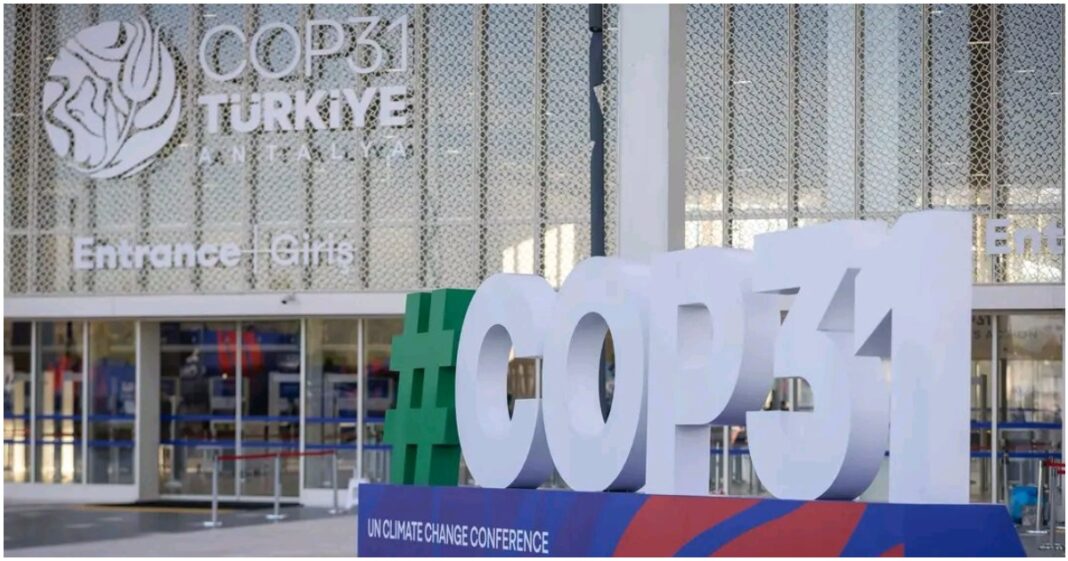

ANTALYA, Türkiye – In an effort to reduce the magnitude and length of the impending 1.5°C overshoot, Greenpeace Africa urges states at the UN climate summit COP31 to take immediate action to phase out fossil fuels and stop forest destruction.
The challenge at COP31 will be whether states can take action in response to the UN Environment Programme’s (UNEP) stark reality check that an excess of the 1.5°C global warming limit will occur.
Instead of achieving the breakthroughs required to address the escalating climate problem, Antalya must end the cycle of discussions that results in incremental compromises.
Dr. Oulie Keita, Executive Director of Greenpeace Africa, says the Global North spent centuries turning the atmosphere into a dumping ground.
“Yet, it is African communities whose historical carbon footprint is practically a rounding error who are absorbing the most brutal shocks of this crisis. As we face a looming 1.5°C overshoot, the African continent demands public, multi-year, grant-based climate finance, not debt-crippling loans that push our economies to the brink,” explains Dr. Keita.
Fossil gas as a transition fuel in Africa
Dr. Keita emphasises that it is time to enforce a progressive tax on the fossil fuel industry and force corporate polluters to pay for the loss and damage unfolding on our frontline communities across the continent.
Fred Njehu, Pan-African political strategist at Greenpeace Africa, remarks that delegates at the two-week conference cannot negotiate their way out of an overshoot while clinging to the fossil fuels of the past or pushing dangerous distractions like fossil gas as a transition fuel in Africa.
“True climate leadership at COP31 means committing to a sovereign, fast, and fair transition that scales renewable energy to at least 75% by 2035. Furthermore, there is no climate credibility without enforceable protection for standing forests like the Congo Basin, ensuring that climate finance goes directly as grants to the Indigenous and local communities who are the true stewards of these vital ecosystems,” Njehu explains.
On his part, Jasper Inventor, Head of the COP31 Greenpeace Delegation, says the world is not short of climate promises, “but we’ve run out of time to prevent a 1.5°C overshoot.”
“Now COP31 must prove how climate diplomacy can deliver real change, not just more commitments that governments spend the next decade discussing how to implement,” he further says.
Greenpeace activists display a giant banner
According to Jasper, COP31 needs to secure a breakthrough that delivers.
“Every fraction of a degree matters, and every year of delay makes the consequences more severe. We need a fast, fair and funded transition away from fossil fuels, an end to forest destruction, urgently required climate finance for developing countries, and to make those most responsible for the climate crisis pay their fair share,” Jasper explains.
“An agreement at COP31 that falls short of what science demands is not a breakthrough, no matter how many countries sign up to it. Implementation cannot mean doing the bare minimum. It’s time for action.”
Meanwhile, ahead of the start of COP31, Greenpeace Türkiye activists displayed a giant banner on the Konyaaltı Beach in Antalya that was visible from space as a symbol of the planetary plight. The banner, which read COP31: KEEP 1.5°C ALIVE, was photographed by satellite.