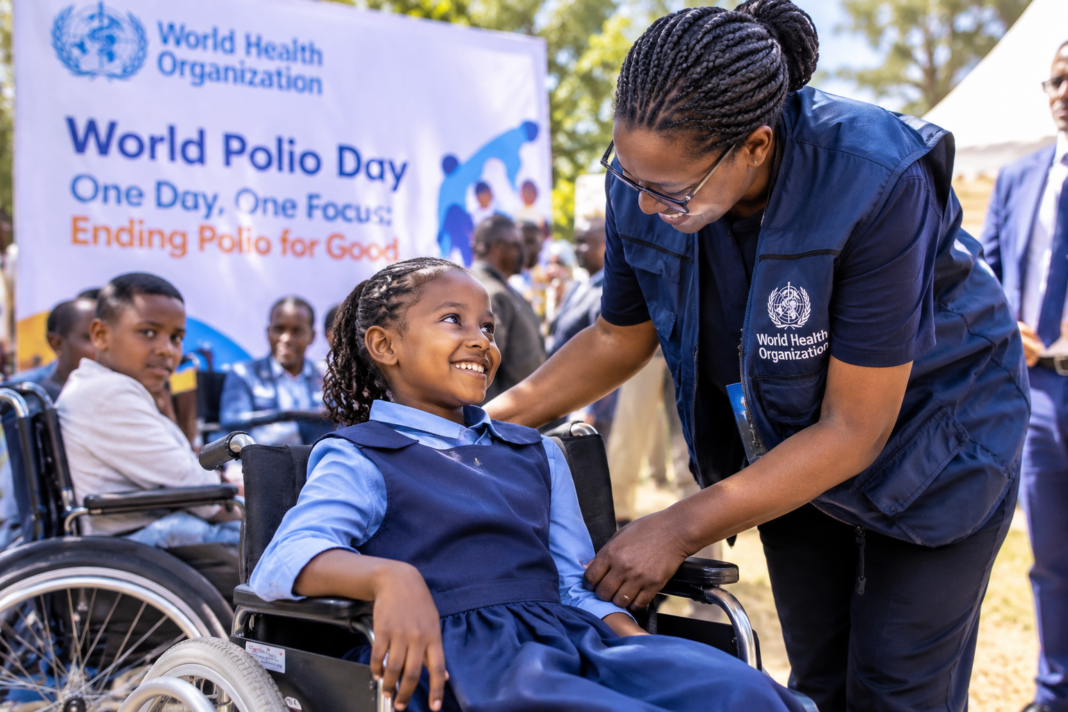

A donation of 24 wheelchairs to a rehabilitation centre in Ethiopia highlights the need to combine polio prevention with long-term support for people living with disabilities.
For people living with disabilities caused by polio, the impact of the disease does not necessarily end when the infection is over.
Years after surviving the disease, access to appropriate rehabilitation, mobility equipment and supportive healthcare services can determine whether someone can attend school, pursue employment, participate in community activities and live independently.
For children growing up with mobility challenges, the availability of a properly fitted wheelchair can make an important difference in accessing education and participating in everyday life.
This is the challenge the World Health Organization (WHO) is seeking to address in Ethiopia, where it has donated 24 wheelchairs to the Menagesha Cheshire Rehabilitation Center to strengthen rehabilitation services and improve mobility for people living with disabilities.
The handover took place during Ethiopia’s national commemoration of World Polio Day on 24 October 2026, bringing together government officials, development partners, rehabilitation specialists, polio survivors and community representatives.
The donation, valued at US$8,300 (ETB 1,356,080), comprised eight pediatric wheelchairs, eight Roughrider wheelchairs and eight rough-terrain wheelchairs.
The different designs are intended to respond to varying mobility requirements and living environments, supporting children and adults who need assistive devices.
However, beyond the equipment, the intervention highlights a wider public-health concern: ensuring that people who survive vaccine-preventable diseases and live with resulting disabilities are not excluded from essential healthcare and rehabilitation services.
The overlooked side of polio elimination
Polio is a highly infectious viral disease that can cause permanent paralysis, particularly among children under five years of age.
Although vaccination remains the most effective way to prevent the disease, people who develop paralysis may require long-term rehabilitation and assistive technologies to support their mobility and independence.
This makes polio elimination a two-sided public-health responsibility: protecting children from infection while ensuring that those already affected can access appropriate care and support.
Speaking on behalf of WHO Representative to Ethiopia, Professor Francis Kasolo, Dr Bejoy Nambiar, Health Policy and Systems Advisor and Team Lead of the Universal Health Coverage Cluster, emphasised the importance of sustaining vaccination, surveillance and stronger health systems.
He also called for continued investment in rehabilitation and assistive technologies for people living with disabilities.
The message reflects the need to ensure that disease prevention does not overshadow the healthcare needs of survivors.
Why access to wheelchairs matters
For people with significant mobility limitations, a wheelchair is more than a mobility device.
When appropriately assessed and fitted, it can support independence, access to education, participation in employment and engagement with family and community life.
WHO’s support to Menagesha Cheshire Rehabilitation Center extends beyond the donation.
Through technical and financial assistance, the organisation has supported basic and intermediate-level wheelchair services and user training, strengthening local expertise in wheelchair assessment, fitting, prescription and maintenance.
The centre has consequently strengthened its capacity to manufacture and customise four types of wheelchairs locally, allowing devices to be adapted to individual users’ functional needs and living environments.
Local manufacturing and customisation are particularly important in rehabilitation because mobility requirements differ from one person to another.
A wheelchair suitable for a child in an urban environment may not adequately serve an adult navigating rough terrain or living in a rural community.
Building local technical capacity can therefore help rehabilitation facilities respond more appropriately to the needs of their users.
A survivor’s experience
For Tigist Bezabih, a polio survivor who shared her experience during the commemoration, access to rehabilitation services and an appropriate wheelchair changed the opportunities available to her.
She described how support from Cheshire Rehabilitation Center, including wheelchair assistance and rehabilitation training, improved her mobility, independence, educational opportunities and confidence.
Her experience illustrated the importance of combining disease prevention with sustained rehabilitation support.
“No child should suffer from polio when it can be prevented through vaccination,” she said, while calling for continued investment in rehabilitation services so that other people living with disabilities can also access opportunities to participate fully in their communities.
Her testimony brought a personal dimension to the World Polio Day discussions, demonstrating that the consequences of polio extend beyond the initial infection and can shape people’s lives long after they survive the disease.
Prevention and inclusion must go together
Held under the theme *One Day, One Focus: Ending Polio for Good*, the 2026 World Polio Day commemoration reinforced the importance of maintaining immunisation efforts to protect children against vaccine-preventable diseases.
But the wheelchair handover also drew attention to the broader responsibilities of health systems towards people living with disabilities.
Access to rehabilitation and assistive products remains an important component of universal health coverage because people should not be excluded from healthcare and opportunities for participation because of mobility limitations.
For Ethiopia, strengthening rehabilitation services will require continued collaboration between the Ministry of Health, WHO, Cheshire Ethiopia and other development partners.
It will also require sustained investment in trained rehabilitation personnel, appropriate equipment, maintenance services and accessible healthcare facilities.
The 24 wheelchairs represent a contribution towards that effort, while the centre’s growing capacity to manufacture and customise mobility devices offers an opportunity to strengthen local rehabilitation services.
Ultimately, ending polio should mean more than preventing new infections. It should also mean ensuring that people who have already experienced its consequences can access the support, dignity and opportunities they need.
A polio-free future will depend on vaccination, but an inclusive health system must also make room for those who survived the disease.