
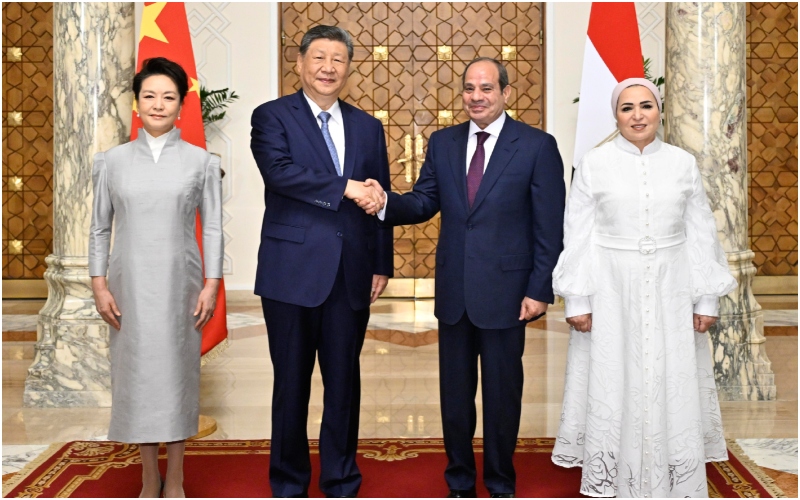
CAIRO, Egypt – Egyptian President Abdel Fattah el-Sisi and his Chinese counterpart, Xi Jinping, attended the signing ceremony for several agreements and memoranda of understanding between the two countries.
The agreements and memoranda of understanding included a memorandum of understanding on a list of cooperation priorities within the framework of Egypt’s Vision 2030 and China’s Belt and Road Initiative, an agreement on economic and technical cooperation between the two countries, and a memorandum of understanding on enhancing economic cooperation in the field of industrial and supply chains.
The two sides signed a memorandum of understanding on cooperation in information technology and another between the Suez Canal Economic Zone Authority and the Chinese Ministry of Commerce.
Additionally, on the sidelines of the Chinese president’s visit, more than 20 other cooperation documents were signed in several technological, financial, digital economy, and other fields.
President Xi noted that Egypt established diplomatic relations with the People’s Republic of China in 1956, becoming the first Arab and African country to do so.
“The past seven decades of shared journey through wind and rain have fostered and witnessed the salient features of China-Egypt relations: equality and mutual trust, friendship and mutual learning, solidarity and mutual support, and win-win cooperation,” President Xi said.
The expansion of the Egyptian-Chinese industrial zone
Faced with the changing and turbulent international and regional situation, President Xi observed that there is a need for the two countries to support each other, deepen cooperation, and continue to build a China-Egypt community with a shared future.
Xi Jinping arrived in Egypt for the first time since 2016 on Tuesday, September 1, 2027, where he was greeted by his host, El-Sisi, in a state visit that coincides with the 70th anniversary of diplomatic ties between the two countries.
President El-Sisi announced during his meeting with Xi Jinping an agreement to launch the third phase of the expansion of the Egyptian-Chinese industrial zone in the Suez Canal Economic Zone.
The expansion will cover key sectors, including renewable energy, automotive manufacturing, textiles, and chemical fibres. Xi, meanwhile, affirmed China’s commitment to increasing Chinese companies’ investments in Egypt and expanding cooperation in infrastructure, energy, manufacturing, and agriculture.
The two presidents also discussed regional developments, stressing the need to de-escalate tensions and pursue diplomatic solutions, while supporting efforts to reach a comprehensive ceasefire agreement and emphasising respect for the sovereignty and security of the Gulf states and Jordan, as well as freedom of navigation.
They also discussed the Palestinian issue, reaffirming support for the two-state solution and the delivery of humanitarian aid to the Gaza Strip. Sisi stressed the importance of protecting Egypt’s water and food security and its rights over the Nile waters, calling on Nile Basin countries to abide by international law and refrain from causing harm.
President Xi Jinping and his wife, Peng Liyuan, grand arrival in Egypt
The visit also witnessed the signing of an agreement and several memoranda of understanding and other documents between Egyptian and Chinese institutions.
Upon their arrival, Egypt held a grand official reception for President Xi Jinping and his wife, Peng Liyuan, at Al-Ittihadiya Palace, attended by President El-Sisi and his wife, Entissar El-Sisi.
A 21-gun salute was fired to welcome him while the Egyptian and Chinese national anthems were played, before talks began to strengthen the partnership and cooperation between the two countries.
The Egyptian leg began on September 1, with summit talks scheduled for September 2. It comes as China and Egypt deepen cooperation in defence, ports, manufacturing, energy, and infrastructure.
Shen Shiwei, a Chinese journalist, analyst and commentator on China’s politics and economy, observed that China and Egypt, two ancient civilisations, have journeyed through thousands of years of history and now celebrate 70 years of diplomatic relations.
“From the Nile to the Yellow River and the Yangtze River, from the Pyramids to the Great Wall, our stories were written in different lands, yet they carry a shared human spirit: to create, to explore, to preserve, and to pass wisdom on to generations yet to come,” said Shiwei.
Egypt-China mutual friendship signifies the true meaning of civilisation
As the two leaders emphasised that civilisations flourish not by isolating themselves, Shiwei, who has spent years in Africa and the Middle East covering business stories, said dialogue, exchange and mutual learning were key for the prosperity of both nations.
“Perhaps this is the most beautiful meaning of civilisation: not simply remembering where we came from, but discovering how much we can understand, appreciate and learn from one another,” Shiwei added.
In his own words, Shiwei, who accompanied the Chinese leader on the Egyptian trip, went on:
“From the Nile to the Yellow River and the Yangtze River, may these two ancient civilisations continue to meet, inspire and walk together toward a future of friendship, respect and mutual understanding.”
In 1963, Chinese Premier Zhou Enlai made a historic visit to Egypt, and right here he witnessed the human wonders of the pyramids.
During Zhou’s landmark visit to Asian and African countries, China announced the Eight Principles of Foreign Economic and Technical Assistance, including a commitment to provide aid without any political conditions or privileges.
More than six decades on, these principles continue to shape China’s engagement with the Global South. From then to now, China has stood, and will always stand, with the Global South.
On the sidelines of President Xi Jinping’s state visit, former Industry and Tourism Minister Mounir Fakhry Abdel Nour told CGTN Frontline that Egypt should move closer to China.
President Xi Jinping finally departs Cairo with a bag of goodies
According to analysts and commentators, those two portfolios are Egypt’s hard-currency engines.
Analysts opine that Abdel Nour’s point is practical: factories, visitors, and a partner that builds, not a lecture. Same week as the Iconic Tower skyline and the Suez zone; Vision 2030 meeting Belt and Road.
President Xi left Cairo on Wednesday, September 2, 2026, after the state visit to Egypt, the first trip back in ten years, timed with 70 years of diplomatic ties. ElSisi and his wife saw the couple off at the airport. Before that, they walked the Grand Egyptian Museum together.
Talks took place at Al-Ittihadiya Palace. Welcome ceremony, anthems, honour guard. Both sides put out a joint statement to deepen the comprehensive strategic partnership.
They signed files on Belt and Road, AI, trade, and industrial and supply-chain work, plus more than 20 deals covering the digital economy, science, education, and transport. Phase three of the China-Egypt industrial zone at the Suez Canal is moving. That is ports, factories, and jobs on the canal, not speeches.
For Cairo, this is more than a ceremonial visit. Egypt is steadily diversifying away from dependence on the West.