
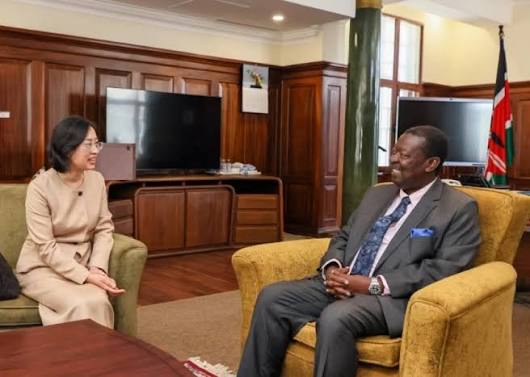

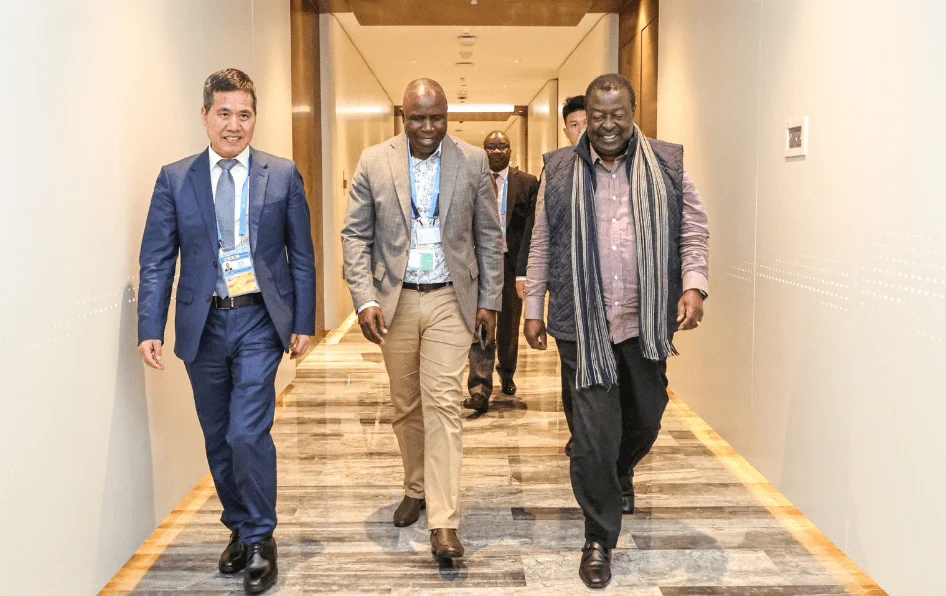
Kenya’s Prime Cabinet Secretary Musalia Mudavadi is expected to travel to Beijing in early September for what could become one of Kenya’s most consequential diplomatic missions of the year, as Nairobi seeks to recalibrate its relationship with China while Washington expands its strategic footprint in the country.
According to an insider familiar with preparations of the trip , the talks are expected to focus on four sensitive areas: critical and rare-earth minerals, expansion of the ports of Mombasa and Lamu, bilateral trade and Kenya’s strategy for managing its Chinese debt.
If confirmed, the visit should not be viewed as routine bilateral diplomacy. It comes as Kenya’s strategic importance to both Washington and Beijing grows because of its geography, mineral potential, transport infrastructure and position as East Africa’s diplomatic and commercial hub.
The anticipated mission also follows an intensive round of Chinese engagements by Foreign Affairs Principal Secretary Dr Abraham Korir Sing’oei.
https://x.com/SingoeiAKorir/status/2083192064536437014
Sing’oei travelled to Beijing in late July, where he met senior Chinese officials, including Vice Foreign Minister Miao Deyu and the vice-chairman of the China International Development Cooperation Agency. Discussions focused on development cooperation, infrastructure connectivity and implementation of agreements reached during the Forum on China-Africa Cooperation summit.
The sequence is significant. Sing’oei’s visit appears to have helped maintain the strategic diplomatic channel with Beijing, while Mudavadi’s possible mission could take the conversation into a more political and economic phase, particularly on issues where Chinese and American interests increasingly overlap.
The rare-earths trigger .At the centre of the emerging geopolitical contest is Kenya’s critical-minerals potential.
Mrima Hill in Kwale County has emerged as one of Kenya’s most strategically important mineral prospects, with deposits of rare-earth elements and niobium. The Government has been pursuing a competitive process to identify an investor for the project.
The mineral equation changed this year after President William Ruto disclosed that Kenya was close to concluding a critical-minerals agreement with Washington.
The proposed framework is expected to cover rare earths and other strategic minerals, with Kenya pushing for domestic processing rather than remaining an exporter of raw materials.
For Washington, Kenyan minerals form part of a broader effort to reduce dependence on China-linked critical-mineral supply chains.
For Beijing, the issue is equally strategic. China dominates much of the global rare-earth processing and downstream supply chain. Any American effort to develop alternative sources in Africa therefore carries implications beyond the commercial value of a single Kenyan mining project.
If minerals reach the negotiating table in Beijing, China is unlikely to view them simply as an investment opportunity. The issue could be considered within the wider context of China’s long-term economic and strategic position in East Africa.
For Nairobi, however, the rivalry presents an opportunity.Kenya could seek better investment, technology transfer, processing capacity and market access from both sides rather than allowing its mineral resources to become bargaining chips in a wider US-China confrontation.
Why the ports matter
The second major issue ,Mombasa and Lamu could prove even more sensitive.Mombasa is East Africa’s principal maritime gateway, serving Kenya and several landlocked neighbours, while Lamu provides an alternative corridor towards northern Kenya, Ethiopia and South Sudan.
China already has a significant infrastructure footprint along the Kenyan coast. Chinese companies were involved in construction of the first berths at Lamu Port, while Chinese financing and construction have helped shape Kenya’s wider transport network.
Across Africa, ports have become an important component of Beijing’s commercial and strategic influence.
But Kenya’s maritime environment is changing. Washington has increased its interest in Kenyan maritime infrastructure and security, while Nairobi is strengthening maritime cooperation with the United States, Britain, France and other Western partners amid security concerns along the Indian Ocean and Red Sea corridors.
Mombasa and Lamu are therefore more than commercial facilities. They sit at the intersection of trade, military logistics, energy security, critical-mineral supply chains and regional influence.
Deep involvement in Kenya’s maritime logistics ecosystem offers any major power an important strategic position in East Africa.
The debt conversation
The third issue is China’s financial exposure in Kenya.
China remains Kenya’s largest bilateral creditor, and the debt relationship has become increasingly complex. Rather than pursuing another wave of large-scale borrowing, Nairobi is seeking ways to restructure existing obligations, reduce repayment pressure and make Chinese financing compatible with its fiscal constraints.
Kenya has already secured changes to some Chinese railway loans, including currency conversion and extended repayment arrangements. The broader objective is to reduce debt-servicing pressure without undermining the economic relationship with Beijing.
That could give Mudavadi an unusually difficult negotiating assignment.
Kenya needs Chinese cooperation on debt while avoiding the perception that Nairobi remains financially dependent on Beijing. China, meanwhile, has an interest in protecting its investments and maintaining Kenya as one of its most important economic partners in East Africa.
The relationship is therefore one neither side can easily abandon.
The Sing’oei factor
The timing of Sing’oei’s Beijing visit is particularly important.
His discussions extended beyond conventional diplomacy, touching on infrastructure, finance, trade and development cooperation. During the visit, Kenya also opened a new Consulate General in Guangzhou, strengthening the economic-diplomacy dimension of its China strategy.
The mission covers Guangdong, Fujian, Hainan and Guangxi regions central to China’s manufacturing, technology, port and commercial sectors.
Taken together, these developments suggest Nairobi is not disengaging from Beijing.
Instead, Kenya appears to be pursuing a more sophisticated strategy: maintaining China’s economic partnership while simultaneously expanding strategic cooperation with Washington.
The closed-door contest
The most consequential part of Kenya’s new diplomacy may therefore be happening away from the cameras.
The US critical-minerals negotiations illustrate this. President Ruto disclosed the proposed agreement at the G7 summit, but many of its commercial and strategic details remain undisclosed.
The real contest is unlikely to be simply about who owns a mine. It is about who controls the value chain.
Who provides the capital and technology? Where will minerals be processed? Who obtains long-term offtake rights? Which companies build supporting infrastructure?
Who controls logistics?
Most importantly, which geopolitical power gains preferential access to Kenya’s strategic economic assets?
These questions make the current phase of Kenya-China-US relations different from the traditional China-Africa investment relationship.
Nairobi’s strategic calculation
Kenya’s strongest position may be neither pro-China nor pro-America, but strategic non-alignment combined with aggressive economic bargaining.
Washington wants Kenya to become part of alternative critical-mineral supply chains. Beijing wants to preserve its economic position and longstanding infrastructure relationships. Both powers have strong reasons to regard Kenya as a gateway to East Africa.
Nairobi therefore has leverage but leverage can quickly become vulnerability if opaque agreements exchange long-term strategic advantages for short-term financing or political support.
Mudavadi’s reported September mission will consequently be watched well beyond Beijing. Washington will be watching. Regional governments, investors, mining companies and other strategic players will also be assessing the outcome.
For Beijing, the central question will be whether Kenya’s growing relationship with the United States represents diversification or the beginning of a strategic realignment.
For Nairobi, the intelligence question is more fundamental: Can Kenya make China and America compete for its partnership without allowing either power to dictate its strategic choices?
Rare earths, ports, debt and trade may appear to be separate negotiating files. They are not.
Together, they form the architecture of Kenya’s emerging geopolitical importance and increasingly place Nairobi at the centre of the contest between the world’s two most powerful economies for influence in Africa.



