
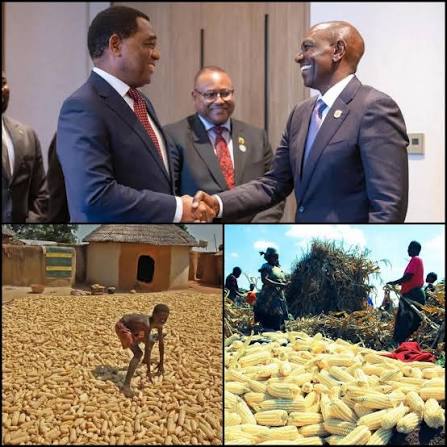

Zambia’s decision to export 540,000 metric tonnes of white Grade A non-genetically modified maize to Kenya could strengthen regional food security while highlighting the growing importance of cross-border agricultural trade as African countries confront the increasingly disruptive effects of climate change.
The Food Reserve Agency (FRA) has signed a contract with Kenya’s Baita Trading Company Limited for the supply of the maize, following a bumper harvest that has left Zambia with substantial grain stocks for both domestic consumption and export.
The agreement comes at a critical moment for food security across Africa, where changing weather patterns, prolonged droughts, floods and rising temperatures are increasingly disrupting agricultural production and exposing the vulnerability of countries that depend heavily on rainfed farming.
For Zambia, the strong maize harvest presents an opportunity to convert agricultural production into export earnings while also positioning the country as an important food supplier to neighbouring and regional markets.
Deputy Secretary to the Cabinet for Finance and Economic Development Siazongo Siakalenge, who witnessed the signing of the agreement in Lusaka, said the country had secured sufficient maize stocks following a major increase in production, creating an opportunity to expand exports.
The 540,000 metric tonne contract will be implemented in six batches. Five shipments of 100,000 metric tonnes will be delivered every three months, while the final consignment will comprise 40,000 metric tonnes.
The scale of the agreement underlines the growing importance of regional agricultural trade in managing food shortages and surpluses. While some African countries experience drought and reduced harvests, others may record better production because of differences in rainfall patterns, soil conditions and agricultural investment.
This makes stronger trade links within regional economic blocs such as the East African Community (EAC) and the Common Market for Eastern and Southern Africa (COMESA) increasingly important.
Kenya, a member of both the EAC and COMESA, has frequently faced pressure on food supplies when poor rains affect maize-growing regions. Zambia, which is a COMESA member, can therefore play an increasingly important role in supplying grain to deficit markets across Eastern and Southern Africa.
The Zambia-Kenya maize trade demonstrates how regional integration can move beyond traditional discussions about tariffs and market access to become a practical tool for protecting households against food shortages and price shocks.
As climate change becomes more unpredictable, countries with agricultural surpluses could increasingly provide a lifeline to neighbouring markets facing production deficits.
Regional trade, however, will depend on efficient transport networks, harmonised standards, predictable trade policies and reduced restrictions at borders. Delays in moving food commodities can worsen shortages and increase prices, particularly when drought or flooding has already disrupted domestic production.
For the EAC and COMESA, the growing threat of climate change provides an opportunity to deepen cooperation on food security, climate-smart agriculture and agricultural trade.
A more integrated regional food market would enable countries to respond faster when one member experiences a production shortfall. Instead of relying heavily on imports from outside Africa, deficit countries could access grain and other agricultural products from surplus-producing nations within the continent.
Zambia’s agricultural sector is already showing signs of increased export potential. Agricultural exports reportedly rose to $1.1 billion last year, compared with $967 million in 2024, reflecting growing production and demand for the country’s agricultural commodities.
Siakalenge said the Government was encouraging businesses and traders to take advantage of the opportunities created by the maize surplus and identify new markets that could support economic growth under the Grow Zambia Agenda.
He said increased maize production had also contributed to sufficient domestic stocks and helped maintain stable mealie meal prices, with excess supplies now available for international markets.
Beyond food security, the export agreement could also support Zambia’s foreign exchange earnings. The Government expects maize exports to contribute to the supply of foreign currency and support stability of the Kwacha.
But the broader significance of the deal lies in the changing relationship between climate, agriculture and regional economic integration.
Climate change is expected to make agricultural planning increasingly difficult across Africa. Farmers are already dealing with irregular rainfall, extreme heat, droughts and floods that can destroy crops and livestock.
Countries will therefore need to invest more heavily in irrigation, drought-resistant seeds, water management, agricultural technology and climate information systems to reduce dependence on unpredictable weather.
Zambia’s recent maize production success also illustrates the potential economic value of building resilient agricultural systems capable of producing enough food for domestic needs while generating exportable surpluses.
The country produced 5.1 million metric tonnes of maize during the last farming season, according to Government figures.
Under the Grow Zambia Agenda, the Hakaide Hichilema’s government is targeting annual maize production of 10 million metric tonnes to serve both domestic consumers and international markets.
Reaching that target could significantly strengthen Zambia’s position as a regional food supplier, particularly as demand for reliable agricultural imports grows across Eastern and Southern Africa.
For Kenya and other EAC markets, closer agricultural links with Zambia and other COMESA producers could provide greater protection against climate-related food shortages.
The maize agreement therefore represents more than a commercial transaction. It offers a reminder that Africa’s response to climate change and food insecurity will increasingly depend on stronger regional cooperation.
As extreme weather reshapes agricultural production, the ability of EAC and COMESA countries to trade food efficiently, invest in climate resilience and share production surpluses could become one of the continent’s most important defences against future hunger and food price crises.



