
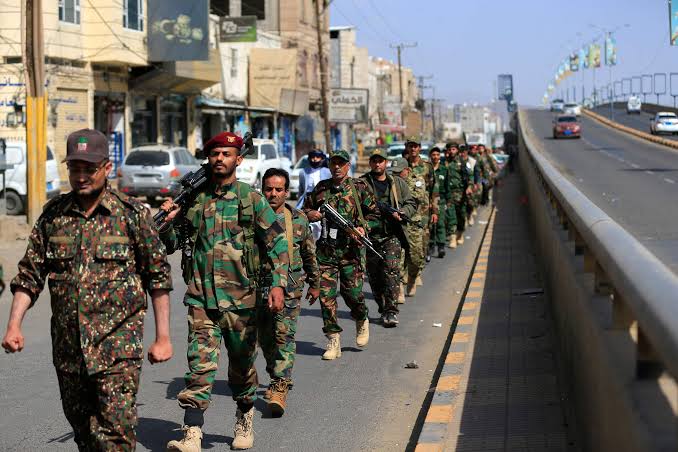

The expanding territorial influence of Yemen’s Houthi rebel movement is reshaping the security balance of one of the world’s most strategically important maritime corridors, raising fresh concerns about Iran’s growing indirect influence over global shipping routes.
As the Iran-backed Houthis consolidate their position along Yemen’s western coast, their ability to threaten the Bab al-Mandab Strait ,the narrow gateway linking the Red Sea to the Gulf of Aden is becoming an increasingly significant geopolitical issue. For Egypt, whose economy and strategic importance are closely tied to the Red Sea and the Suez Canal, the development represents another major challenge in an already volatile regional security environment.
The Houthis’ control of large parts of Yemen’s western coastline gives the movement a strategic position from which it can threaten commercial and energy shipping moving between Asia, Europe and Africa. The Bab al-Mandab is particularly important because disruption there can affect access to the Red Sea and, ultimately, Egypt’s Suez Canal, one of the world’s most important maritime trade routes.
The implications extend far beyond Egypt. A sustained Houthi threat to shipping could further disrupt trade between China and Europe, increase insurance and transport costs, and force shipping companies to continue using longer routes around the African continent.
For Iran, the Houthis’ expanding influence represents an important component of a wider regional strategy in which allied armed groups and strategic geography play an increasingly central role. Iran has long been accused by its rivals of supporting the Houthis politically, militarily and technologically, although Tehran’s relationship with the group has also evolved as the Houthis have become a powerful indigenous force with their own political and military objectives.
Nevertheless, the strategic consequences are difficult to ignore. Iran sits beside the Strait of Hormuz, one of the world’s most important energy chokepoints, while the Houthis operate near the Bab al-Mandab at the southern entrance to the Red Sea. The result is a regional security environment in which two of the world’s most important maritime passages can be threatened by forces aligned, directly or indirectly, with Tehran.
This geographical reality has become even more significant following the escalation of conflict involving Iran and its regional adversaries in 2026. With tensions affecting maritime traffic in the Gulf and Red Sea, governments and energy producers have been searching for alternative routes to protect the movement of oil, gas and commercial goods.
Egypt has sought to position itself as part of that solution. Cairo has ambitions to strengthen its role as a regional energy and logistics hub, using its geographical position between the Red Sea and Mediterranean, as well as infrastructure such as the SUMED pipeline, to facilitate energy exports.
But a more powerful Houthi presence along Yemen’s Red Sea coastline threatens those ambitions.
Egypt has already suffered heavily from instability caused by Houthi attacks on commercial shipping. During the earlier Red Sea crisis, many shipping companies diverted vessels away from the Suez Canal and instead travelled around the Cape of Good Hope. The longer route increased costs for global commerce but also deprived Egypt of vital foreign currency earned through Suez Canal transit fees.
Cairo has estimated the economic damage from disruptions to Red Sea shipping in billions of dollars, adding pressure to an economy already struggling with inflation, foreign currency shortages and debt obligations.
For Egypt, therefore, the Houthi issue is not simply a distant conflict in Yemen. It is increasingly a direct economic and national security concern.
The broader geopolitical picture is also becoming more complicated. The Red Sea has emerged as a zone of intensifying competition involving Middle Eastern powers, African states and international actors. Control of ports, coastlines and maritime routes has become an increasingly important component of national security strategies.
Ethiopia’s ambitions to secure greater access to the Red Sea have added another layer of strategic anxiety for Cairo. Egypt already sees Addis Ababa as its principal rival in the dispute over Nile waters and the Grand Ethiopian Renaissance Dam. Any major geopolitical shift involving Ethiopia’s access to the Red Sea is therefore likely to be closely monitored in Cairo.
At the same time, concerns about military competition and foreign involvement along the Horn of Africa have reinforced Egyptian fears about the security of the southern approaches to the Red Sea.
The Houthis’ growing power also raises concerns about the interaction between different non-state actors operating across the wider region. The Red Sea, Gulf of Aden and western Indian Ocean have long faced threats from piracy, insurgency and organised armed groups.
Security analysts have warned that greater cooperation, coordination or shared interests among armed groups could create additional risks for commercial navigation. Any convergence between maritime insecurity in Yemen and Somalia would significantly complicate efforts to protect one of the world’s busiest shipping corridors.
Despite the growing pressure, Egypt has remained cautious about becoming directly involved in a broader military confrontation with either the Houthis or Iran.
Cairo’s reluctance is shaped partly by history. Egypt’s military intervention in Yemen during the 1960s became a costly and prolonged conflict that exhausted military resources and left lasting political lessons. The experience remains an important reference point for Egyptian policymakers considering any new military involvement in Yemen.
Egypt also faces a difficult geopolitical calculation. Direct military action against the Houthis could quickly be interpreted as participation in a wider confrontation with Iran, particularly because Tehran remains the group’s most important external supporter.
For Cairo, this could undermine its broader strategy of maintaining regional balance and avoiding deeper involvement in conflicts that could drain its economic and military resources.
The central question is whether Egypt can continue pursuing containment if the Houthis become capable of seriously disrupting or closing the Bab al-Mandab Strait.
Such a development would strike directly at Egyptian economic interests and could force Cairo to reconsider its long-standing caution.
As the Houthis strengthen their position near the Bab al-Mandab, Iran’s influence—whether exercised directly or through its regional allies—will remain central to the future security of the Red Sea. For Egypt and the global economy, the stakes are becoming increasingly difficult to ignore.



