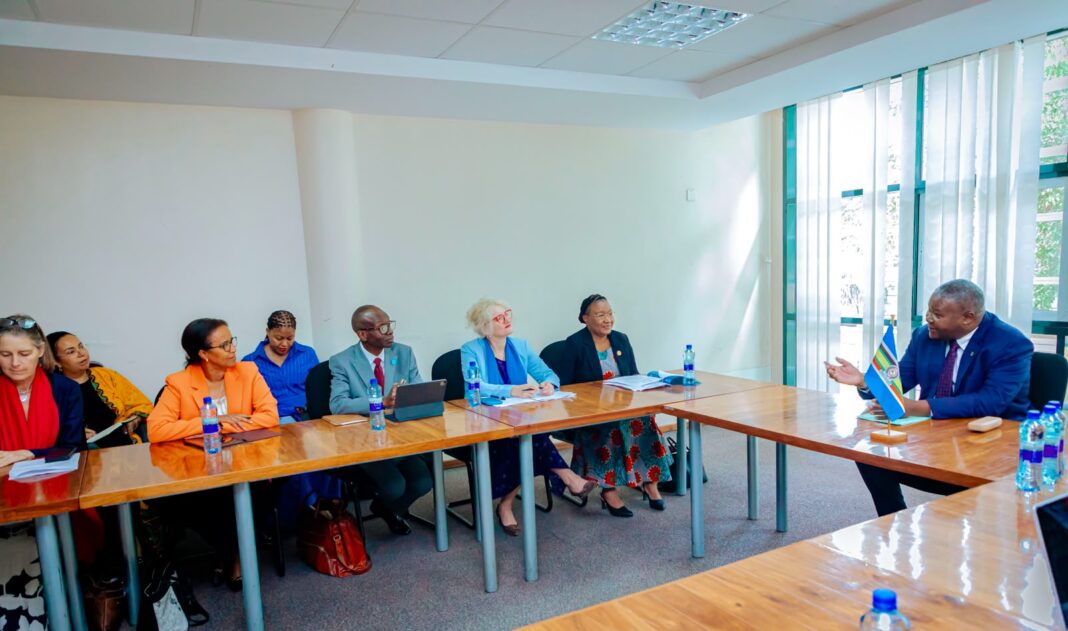
The East African Community and four United Nations agencies have agreed to build a formal partnership framework aimed at sharpening coordination on health and development priorities across the region, following a high-level meeting at EAC Headquarters here on Tuesday.
The agreement emerged from talks between EAC Secretary General Amb. Stephen P. Mbundi and a delegation representing UNAIDS, UNFPA, UNICEF and the World Health Organization. The visiting officials were led by Ms. Lydia Zigomo, UNFPA’s Regional Director for Eastern and Southern Africa, and included WHO Regional Director for Africa Dr Mohamed Yakub Janabi, UNICEF Regional Director Ms. Etleva Kadilli, and UNAIDS Deputy Regional Director Ms. Medhin Tsehaiu.
Once complete, the framework is meant to pull together the various strands of EAC-UN cooperation into a single coordinated mechanism — one designed to turn regional priorities into concrete action that benefits East African citizens directly.
Amb. Mbundi welcomed the proposal, telling the delegation it would help consolidate existing collaboration and support more coherent regional action. But he pushed for speed: the Secretary General called for the partnership to be formalised through a Memorandum of Understanding, and set a three-month deadline for the process to be completed. He also stressed the need to make the EAC’s integration work more visible to the public, arguing that citizens should be able to see its practical impact on their lives.
Health and Human Capital at the Centre
Much of the discussion centred on health and human capital development as a strategic lever for the region. Officials pointed to continued investment in reproductive, maternal, newborn, child and adolescent health (RMNCAH), HIV response, gender equity, and adolescent and youth health, alongside progress toward Universal Health Coverage, as essential to capitalising on East Africa’s young population. Sustainable financing and stronger legal and policy environments were flagged as equally critical to improving outcomes.
The four UN agencies used the meeting to reaffirm their commitment to working alongside the EAC and its Partner States to protect gains already made in these areas.
Building on Existing Work
The proposed framework is not a first step but an evolution of cooperation that already exists. The EAC and the four agencies have previously worked together on regional forums covering RMNCAH, HIV, and health data management, and have jointly developed regional minimum standards for integrated RMNCAH and HIV services.
Going forward, officials say the formal framework will give the EAC, UN agencies and Partner States a clearer, more coordinated platform to align their efforts, build regional capacity, and convert shared priorities into interventions that reach East Africans directly.