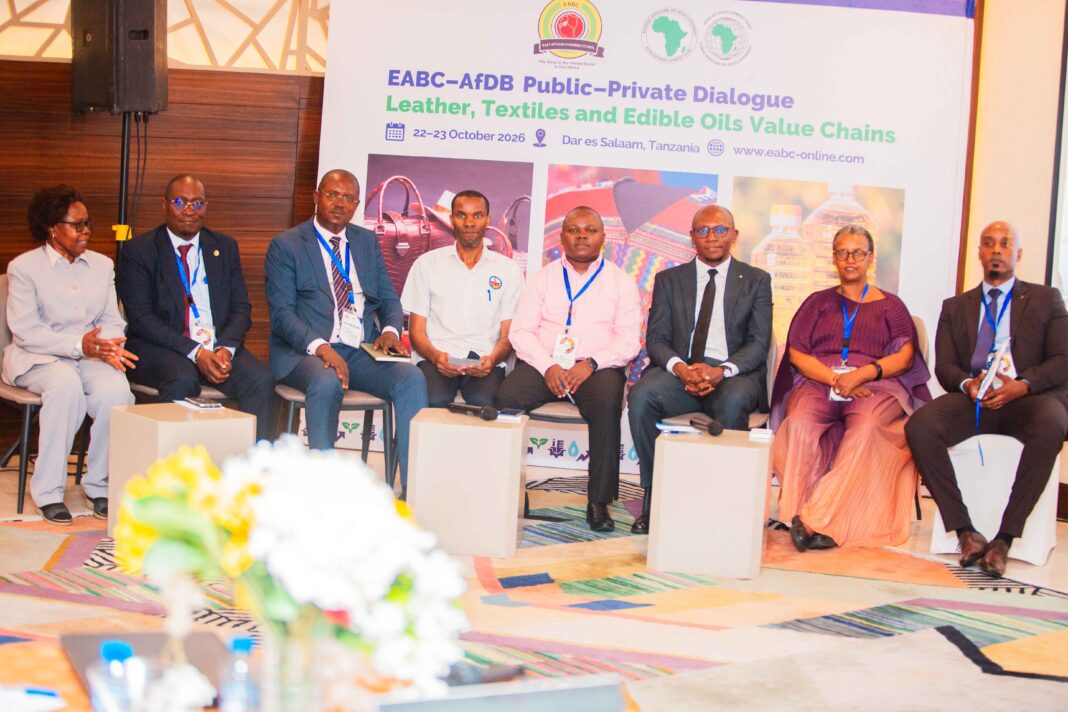

Regional industry leaders and policymakers have called for predictable trade policies, affordable industrial financing, reliable raw materials and targeted reforms to boost manufacturing and value addition across the East African Community (EAC).
The call emerged during a two-day East African Business Council (EABC)–African Development Bank (AfDB) Public–Private Dialogue on the leather, textiles and edible oils value chains in Dar es Salaam, Tanzania. The meeting brought together 65 representatives from governments, manufacturers, business associations, development partners and technical institutions to identify barriers to industrial competitiveness.
Representing EABC Executive Director Ahmed Farah, Trade and Policy Advisor Adrian R. Njau highlighted the gap between the region’s resource base and its manufacturing performance.
East Africa produces approximately 370,000 tonnes of hides and skins annually but imported about US$566 million worth of footwear, footwear parts and leather goods in 2025, compared with exports of approximately US$46 million in hides and semi-processed leather.
In textiles, only 37 per cent of the region’s 119,000 tonnes of cotton lint is spun locally. Imports of textiles, apparel and used clothing reached US$3.24 billion in 2025, against exports of about US$970 million.
The edible oils sector faces similar challenges, with imports valued at US$3.1 billion compared with exports of US$1.2 billion. Regional production meets only about 37 per cent of edible oil consumption.
Presenting a competitiveness study, Dr Onesmos Shuma of Excellon Group said 79 per cent of surveyed firms operated below 75 per cent of production capacity, while 67 per cent had delayed investment. Technology gaps affected 78 per cent of businesses, and 76 per cent believed they could source more inputs within the EAC.
The study found that 86 per cent of leather and footwear firms, 75 per cent of edible-oil businesses and 74 per cent of textile and apparel firms operated below 75 per cent of capacity. Investment had been postponed or cancelled by 79 per cent of leather firms, 59 per cent of edible-oil businesses and 61 per cent of textile and apparel companies.
Six major constraints were identified: access to industrial raw materials, affordable financing, technology and maintenance, market access and buyer linkages, workforce skills, and standards and operating costs.
Confederation of Tanzania Industries Executive Director Frank Dafa called for stronger links between agriculture, livestock production and manufacturing. He advocated improved regional application of the Common External Tariff (CET), rules of origin and duty remission, alongside strategic public procurement and investment in skills, technology and infrastructure.
Sylvester Kazi, a member of the EABC–AfDB Project Steering Committee, urged governments to coordinate trade instruments and improve access to industrial inputs. He also called for evidence-based reviews of trade measures and stronger regional approaches to local content and public procurement.
A separate analysis by Dr Margaret Chemengich of Charmy Investments found that 25 of 39 stays of application affecting the three value chains had been renewed in every budget since the 2022/23 financial year. Applied duties on refined sunflower oil also differed across Partner States, ranging from approximately 26 per cent in Tanzania to 60 per cent in Uganda.
The findings underscored the need for consistent trade policies that encourage regional sourcing and manufacturing without raising input costs or creating market distortions.
Amedeus Arbogast Mzee of Tanzania’s Ministry of Foreign Affairs and East African Cooperation called for commercially viable solutions backed by clear timelines, resources and measurable outcomes.
Participants recommended strengthening regional raw-material supply chains, expanding affordable value-chain financing, upgrading technology and workforce skills, improving supplier–buyer partnerships, and harmonising standards and conformity assessments.
They also urged governments and industry to monitor progress through indicators including capacity utilisation, investment, regional sourcing, commercial contracts, compliance costs and trade performance.
The dialogue called for coordinated action by EAC Partner States, manufacturers, farmers and financial institutions to translate the region’s agricultural and livestock resources into competitive industries, jobs and greater regional trade.