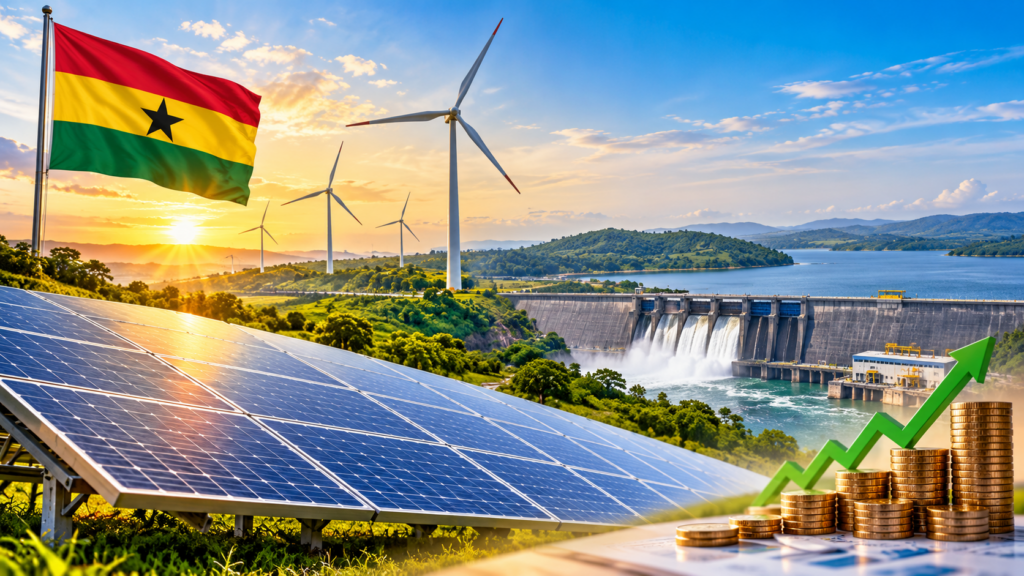

Ghana plans to mobilise approximately $10.8 billion for renewable energy development between 2026 and 2030, with investments in utility-scale solar and wind power, rural electrification and clean cooking technologies expected to create new opportunities for energy developers and investors.
The updated Renewable Energy Master Plan targets 852 megawatt-peak (MWp) of utility-scale solar capacity and 709 MWp of utility-scale wind power, reflecting the West African country’s ambition to expand clean-energy generation and diversify its electricity supply.
Kowatek Solar Ltd, a renewable energy company operating in Nigeria, says Ghana’s investment programme highlights the growing commercial opportunities in West Africa’s clean-energy market as governments seek to attract private capital and expand access to reliable electricity.
The proposed investment envelope is nearly double the $5.6 billion associated with Ghana’s 2019 renewable energy plan, signalling a more ambitious approach to renewable power development over the five-year period.
Solar projects are estimated to require approximately $631 million, while wind power development could attract about $999 million. The broader programme also incorporates hydropower, decentralised electricity systems and clean cooking initiatives.
According to summaries of the updated plan, Ghana is targeting an additional 127 megawatts of hydropower capacity, alongside the development of 440 mini-grids to serve rural and island communities.
The programme also includes the distribution of 1.1 million solar lanterns and measures to expand biofuel use and access to improved cookstoves.
These interventions are designed to address different energy needs, from large-scale electricity generation for the national grid to smaller, decentralised systems serving communities beyond the reach of conventional power infrastructure.
The plan is projected to support more than 353,000 jobs if its manufacturing, installation and operations components are fully realised. The employment potential will depend on project implementation, investment flows and the extent to which local businesses participate in the renewable energy supply chain.
Implementation remains the key test
Despite the ambitious targets, Ghana faces the challenge of translating its investment commitments into operational projects.
Implementation of the previous planning cycle was reportedly constrained by weaknesses in coordination, monitoring and evaluation, affecting data collection, reporting and progress assessment.
The new programme’s success will therefore depend on effective institutional oversight, transparent procurement, access to financing and timely connections of new generation capacity to the electricity grid.
For investors, these factors will be important in assessing project viability, particularly in markets where renewable energy developments can face delays related to regulation, infrastructure and financing.
Utility-scale solar and wind projects also require different financing structures from rural mini-grids. Large power plants typically depend on substantial capital investment, grid infrastructure and long-term arrangements for selling electricity, while mini-grid projects must balance construction costs with the purchasing power and electricity demand of smaller communities.
Ghana’s programme seeks to address both segments while incorporating clean cooking and off-grid solutions into its wider energy transition.
Regional investment opportunities
The expansion comes as other West African markets explore financing mechanisms to accelerate renewable energy deployment, including Nigeria’s Distributed Renewable Energy Fund, which targets decentralised energy solutions.
For renewable energy developers and equipment suppliers, the parallel initiatives could create opportunities in project design, solar installations, hybrid power systems and decentralised electricity infrastructure.
Businesses capable of integrating solar generation with battery storage and other power sources may find opportunities among commercial and industrial customers seeking to improve energy reliability and manage electricity costs.
Kowatek Solar, which operates in Nigeria and has outlined expansion plans involving Canada, identifies the region’s growing clean-energy requirements as an opportunity for companies providing renewable energy systems.
However, the scale of the opportunity will ultimately depend on whether announced targets translate into bankable projects, competitive tenders and completed installations.
For Ghana, the 2026–2030 master plan sets an ambitious investment agenda. Its impact will be measured by the amount of new capacity connected to the grid, the number of communities gaining reliable electricity and the extent to which the programme attracts sustainable private investment.