

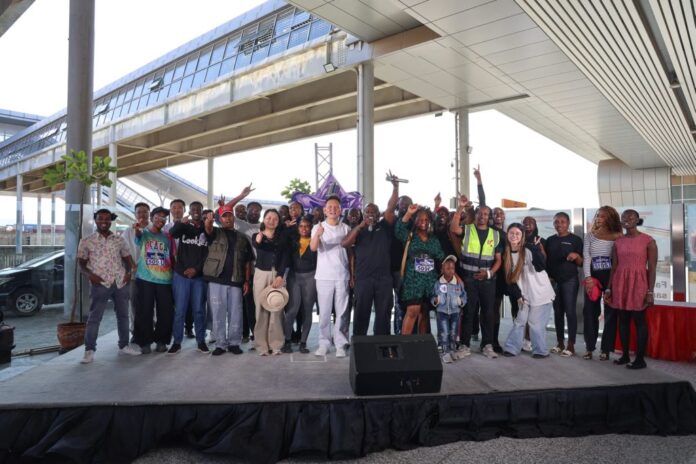
The Nairobi SGR Terminus became an unlikely stage for China-Africa cultural diplomacy last Saturday, as more than 100 aspiring female musicians auditioned for the second season of ‘Sing for Africa,’ a competition that combines entertainment with talent development, professional exposure, and access to China’s creative industry.
For contestants, the attraction is straightforward: a Sh1 million prize, a fully sponsored recording deal, professional opportunities, and a chance to travel to China. But the competition also forms part of a much broader China-Africa program in which music, culture, education, and youth exchanges are being used to strengthen people-to-people connections.
The timing is significant; 2026 has been designated the China-Africa Year of People-to-People Exchanges, as China and African countries mark 70 years since the establishment of diplomatic relations between China and African states. Beijing’s official program for the year specifically lists Sing for Africa among its key youth and people-to-people initiatives, alongside the China-Africa Youth Festival, cultural forums, innovation competitions, and other exchange programs.
Music, in this context, becomes more than entertainment. It provides an informal platform through which young Africans can interact with Chinese institutions, media and entertainment professionals while giving African performers opportunities to reach audiences in China.
The competition involves Hunan TV International, bringing Chinese television and entertainment expertise into an African talent-search format.
Zhu Simeng, an organizer and official from Hunan TV International, said the objective was to identify promising musicians from Kenya and other African countries while helping them develop sustainable careers and access China’s entertainment market.
“Season two is for girls only. Last year we did season one, which was a boys only season,” she said. “We want to find more young musical talent from Kenya and all over Africa, and we want to help them build their careers and also help them access the Chinese market.”
The first season has already produced examples of the cross-border opportunities the organisers envisage.
According to Zhu, two male contestants travelled to China to participate in television programmes and music festivals. Their appearances exposed them to Chinese audiences while also giving them platforms to showcase Kenyan culture.
“They are doing some TV programme shows in China, also attending some music festivals,” she said, adding that the contestants had gained followers in China and promoted Kenyan culture through elements including Maasai clothing and accessories.
That experience points to a model that goes beyond a one-off cultural performance. Talent competitions can create continuing professional relationships, audience networks and opportunities for African artists to participate in China’s expanding entertainment market.
Zhu said the organizers wanted the programme to move contestants from competition into the wider creative economy.
“We are not only a cultural exchange event. After the event finishes, we will help the talents to build their careers and help them enter the industry,” she said. “We will help them transform their talent into economic opportunities.”
Music and China’s wider Africa strategy
The competition sits within a wider framework of Chinese engagement with Africa that combines culture with education, vocational training, media, technology and youth development.
Under the FOCAC Beijing Action Plan 2025-2027, China committed to provide 60,000 training opportunities to Africans, with priority given to women and young people. The plan also includes the training of 1,000 African culture and tourism professionals in China and cooperation in radio, television and audiovisual innovation.
The same framework includes youth innovation programmes, Chinese-language and vocational-skills initiatives, media training and exchanges in science and technology.
These initiatives are officially presented by Beijing as mechanisms for mutual learning and stronger people-to-people ties. They also provide China with additional channels of engagement beyond traditional government-to-government diplomacy.
In Kenya, Sing for Africa illustrates how such engagement can intersect with popular culture and everyday public spaces.
Auditions have also been held in Kibera, Embu, the University of Nairobi and the Kenyatta University Confucius Institute, according to Kerita Irungu, a journalist and international business specialist with Hunan TV International.
The organisers say the approach is intended to reach contestants from different social and economic backgrounds.
The competition will progress through several stages, with contestants competing for places in the Top 100 before professional judging and public participation determine subsequent advancement.
AFRISTAR, which operates the railway service, is participating as part of its corporate social responsibility and talent-development activities.
CSR Coordinator Winrose Wachira said the company believes talent development should extend beyond academic and professional achievement.
Several Kenya Railways and SGR employees also auditioned. Among them was Senior Train Operations Assistant Damaris Mutinda, who has a background in church singing and teaching Chinese through music.
If she wins, Mutinda said she would use part of the prize to support students learning Chinese by helping finance classes and learning materials.
Her ambition reflects the two-way nature of cultural exchange. African participants are not simply receiving Chinese cultural content; they can also carry African music, languages, fashion, and traditions into Chinese audiences and institutions.
For Nigerian student Itohan Thomson, the competition represents an opportunity for confidence and exposure.
“I love singing, and whether I win or not is not the most important thing,” she said. “The fact that I get an opportunity to sing and share my talent is what matters to me.”
As China places youth and cultural exchanges at the center of its 2026 engagement with Africa, Sing for Africa offers a visible example of how entertainment can become part of international relationship-building.
For African contestants, the immediate benefits are access to a platform, professional exposure, talent development and potentially a new international market.
For China, the programme creates direct connections between its media and entertainment institutions and a younger African generation—adding music and talent mobility to the broader architecture of China-Africa people-to-people relations.

