
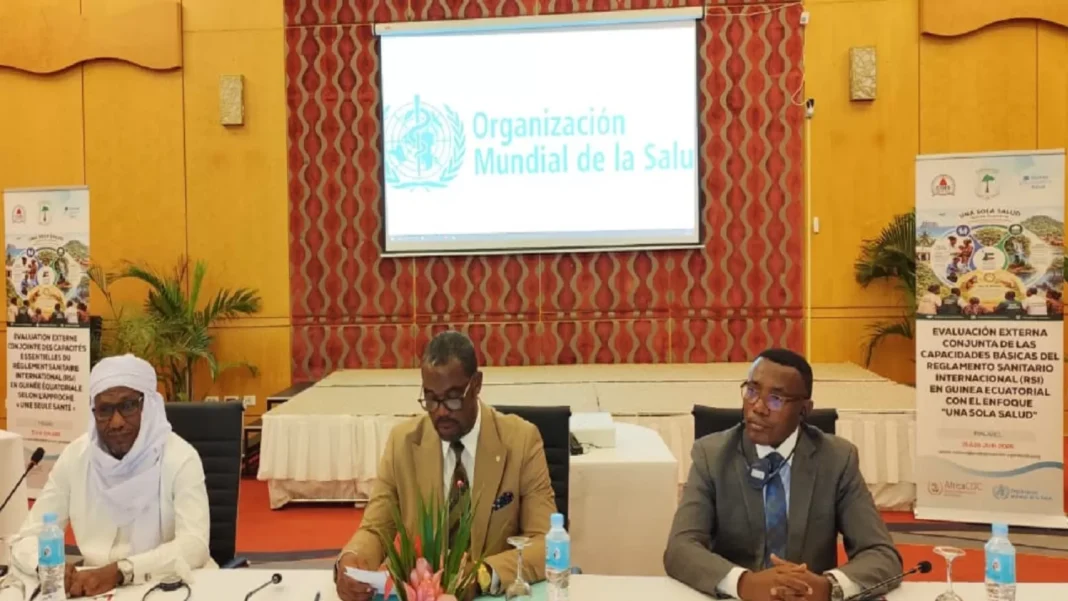

Equatorial Guinea has identified significant gaps in its capacity to prevent, detect and respond to public health emergencies, despite progress in vaccination, disease surveillance and laboratory diagnostics.
The findings follow a Joint External Evaluation (JEE) conducted from June 15 to 19 under the International Health Regulations (IHR 2005), with technical support from the World Health Organization (WHO) and the Africa Centres for Disease Control and Prevention (Africa CDC).
The assessment examined 19 technical areas against 56 indicators to establish the country’s preparedness for health threats and identify priority interventions to strengthen national health security.
According to WHO, most of the country’s capacities remain at levels one and two, indicating that several systems are still at the early stages of development.
The evaluation highlighted gaps in legal frameworks and financing for implementing international health regulations, coordination across sectors, surveillance of antimicrobial resistance, management of diseases transmitted between animals and humans, and preparedness for chemical and radiological emergencies.
It also identified weaknesses in infection prevention and control, food safety, biological safety, emergency logistics and health security at airports, seaports and other points of entry.
Florentino Abaga Ondo Ndoho, Director-General of Public Health, said the assessment would help the country identify its strengths and areas requiring improvement.
He said the priority was to translate the recommendations into practical measures to strengthen preparedness, coordination and the resilience of the health system.
The evaluation brought together nine external experts from Brazil, Spain and the Netherlands, alongside specialists from WHO and Africa CDC. It followed a national self-assessment involving 82 experts from various ministries and institutions, with participation from technical and financial partners.
Using the One Health approach, which recognises the links between human, animal and environmental health, the exercise examined how institutions could work together to prevent and respond to emerging health threats.
Despite the identified shortcomings, the assessment recognised progress in immunisation, epidemiological surveillance, risk assessment and emergency preparedness.
The country has an Integrated Disease Surveillance and Response strategy, supported by focal points at district level. Pilot activities have also been conducted in Malabo, Bata, Evinayong, Mongomo and Ebebiyín.
Equatorial Guinea has also begun training and establishing rapid response teams to improve the verification, investigation and management of public health events.
However, WHO noted that several activities and mechanisms already in operation were inadequately documented, limiting the extent to which their implementation could be recognised during the assessment.
The findings also pointed to the need to improve coordination between disease surveillance systems and laboratories, strengthen the national laboratory network, and invest in specialised training, research and sustainable financing.
Visits to the Baney and Castroverde laboratories revealed existing diagnostic capabilities, qualified personnel and equipment. The Castroverde laboratory was noted for its modern equipment and substantial diagnostic capacity, while Baney demonstrated structured documentation on biosafety and quality management.
The evaluation recommended further investment in laboratory accreditation, specialised skills and human resources to sustain and expand these capabilities.
Immunisation was another area where existing structures offered a foundation for improvement. Equatorial Guinea has an Expanded Programme on Immunization, trained personnel, management tools and monitoring mechanisms.
Nevertheless, the assessment called for stronger financing, improved vaccination microplanning, better cold-chain management and increased capacity at local level.
Communication and community engagement also emerged as priorities for strengthening emergency preparedness.
Although a national risk communication plan is being finalised, WHO recommended integrating it fully into the national Public Health Emergency Operations Centre, clarifying institutional responsibilities and establishing mechanisms to monitor rumours and misinformation.
The findings underscore the importance of ensuring that communities receive timely, accurate information during outbreaks and other health emergencies, when public trust and coordinated action can influence the effectiveness of response measures.
Eulalia Nvo Esono Abeng, Director-General of Civil Protection, said the exercise had improved understanding of the country’s capabilities and challenges while strengthening coordination among institutions responsible for managing public health risks.
WHO country preparedness team leader Angela Katherine Lao Seoane said the evaluation provided an opportunity to define national priorities and strengthen implementation of the International Health Regulations.
She reaffirmed WHO’s commitment to supporting the country in implementing the agreed priority actions.
Among the recommended measures are formalising national coordination mechanisms for the IHR, making the emergency operations centre fully operational, digitising surveillance systems, improving links between epidemiological surveillance and laboratory services, and developing the health emergency workforce.
The assessment also called for progress on a National Action Plan for Health Security covering 2026–2031, supported by clear monitoring mechanisms to track implementation.
The final day of the mission was dedicated to jointly validating the findings and priority actions before presenting the agreed conclusions to national authorities.
The evaluation provides Equatorial Guinea with a roadmap for addressing weaknesses in its health emergency systems. Its impact will ultimately depend on whether the recommendations are backed by sustained financing, clear institutional responsibilities and measurable implementation.
As countries face the continuing threat of infectious disease outbreaks and other public health emergencies, strengthening surveillance, laboratory networks, cross-sector coordination and public communication remains central to building resilient health systems.
For Equatorial Guinea, the next challenge is to turn the assessment’s findings into lasting improvements in its ability to detect threats early and respond effectively before they escalate into wider health crises.



