
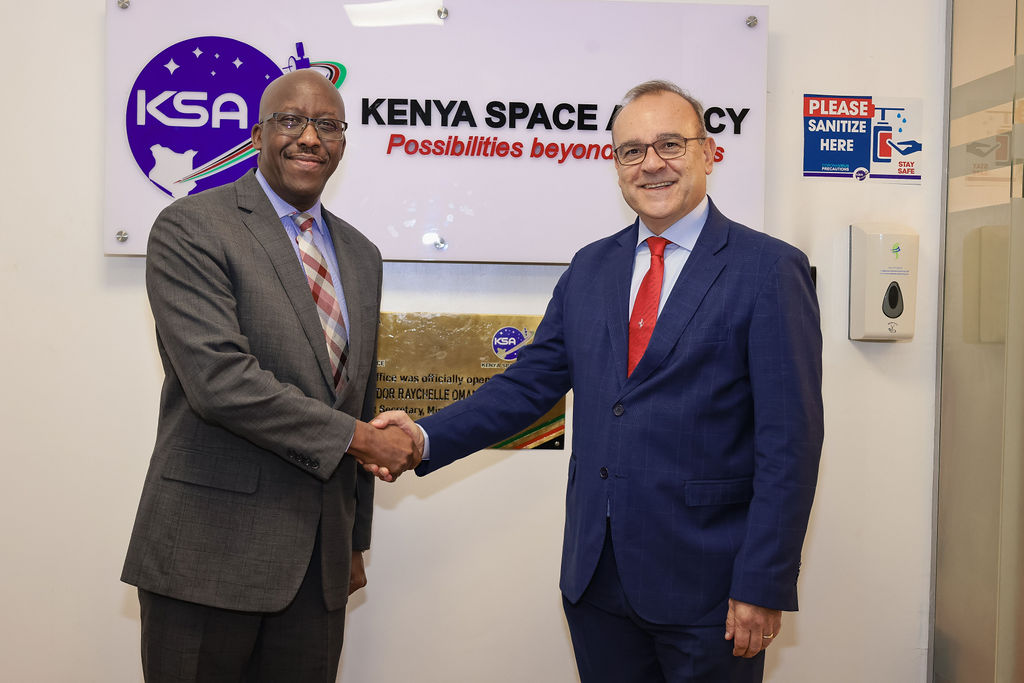

Kenya is looking to deepen the use of space technology as a driver of economic development, with growing cooperation with Italy creating opportunities in satellite data, Earth observation, research, skills development and space-based applications.
The potential was highlighted during a meeting between Italian Ambassador to Kenya Vincenzo Del Monaco and Kenya Space Agency (KSA) Director General Major General Hillary Kipkosgey, during which the ambassador also visited the KSA’s Regional Centre for Earth Observation (CREO) in Nairobi.
The discussions focused on strengthening Italy–Kenya cooperation in Earth observation, satellite data and the development of new skills and applications. The engagement comes as Kenya seeks to build a stronger domestic space ecosystem capable of generating commercial opportunities while supporting national development.
For Kenya, the economic value of space extends well beyond launching or owning satellites. Satellite imagery and Earth observation data can support agriculture, climate monitoring, disaster management, urban planning, natural-resource management and infrastructure development.
The Kenya Space Agency says space-derived data can improve decision-making and productivity across sectors including agriculture, natural resources and urban planning. Its mandate also includes developing national space capabilities, infrastructure and a regulatory environment while supporting the growth of a domestic space economy.
This creates an opportunity for Kenya to move from being primarily a consumer of space-based services to developing locally owned technologies, businesses and expertise that can serve both the domestic and African markets.
One area with significant potential is the commercialisation of Earth observation data. Kenya already has initiatives aimed at turning satellite and Earth observation capabilities into businesses and practical solutions. The Africa Business Innovation Lab (ABIL), supported through the Africa–EU Space Partnership Programme, is designed to accelerate space and Earth observation innovations in areas such as agriculture, climate resilience, disaster management, urban planning and natural-resource management.
For Kenyan entrepreneurs, this could create opportunities in geospatial services, agricultural intelligence, climate-risk assessment, mapping, logistics, insurance, environmental monitoring and data analytics.
The next stage of growth, however, will require stronger links between government, universities, research institutions and the private sector. Investment in engineering, software development, geospatial technology, satellite communications and data science will be critical if Kenya is to develop companies capable of competing in the rapidly expanding global space economy.
Italy provides an important partner in this effort. The two countries have a long history of cooperation in space, including the Luigi Broglio Space Centre in Malindi, which has operated since 1964 and remains an important facility for satellite tracking, telemetry and remote-sensing activities.
The partnership could therefore evolve beyond institutional cooperation into a broader economic relationship involving research, technology transfer, skills development, startups and commercial applications.
Kenya can also use its position as a regional technology and innovation hub to develop space solutions for other African markets. Rather than concentrating only on large-scale space infrastructure, the country could build a competitive downstream industry around the use of satellite data and space-enabled technologies.
Developing this ecosystem would create opportunities for young engineers, scientists, software developers, data specialists and entrepreneurs. It could also encourage universities and technical institutions to establish programmes aligned with the needs of an emerging space industry.
Recent initiatives by the Kenya Space Agency show that this ecosystem is already taking shape. The agency has been working with international partners and local institutions to promote innovation, investment and the development of market-ready space applications.
The Italy–Kenya relationship could help accelerate that process by connecting Kenyan researchers and companies to European expertise, research networks, technology and investment.
For Kenya, the broader objective is to turn space technology into an economic asset — generating businesses, jobs, knowledge and services while improving productivity across the wider economy.
As global demand for satellite-based information grows, Kenya’s opportunity may lie not only above the Earth but also in the businesses, skills and innovations built around space technology on the ground.



