
In Wajir, a parasite Kenya’s health system was not built to manage routinely is testing how far a county can stretch.
For years, Plasmodium vivax was the other malaria, a disease associated with other places and populations. Then it emerged in a county whose daily struggles most Kenyans rarely see.
Wajir is remote, vast and semi-arid. Here, the daily fight is for food and water, for people and their animals, long before it is about disease.
Mumina Golo knows this better than most. In Adadijole village, she has battled malaria three times this year, in April, May and June. Each time, she received treatment, first artemether-lumefantrine, followed by a four-day course of hydroxychloroquine, according to the account of her treatment. She never received primaquine, the medicine used to eliminate the dormant liver-stage parasites responsible for recurring P. vivax infections.
“When I had malaria, I was bedridden,” Mumina says. She could not cook for her children, fetch firewood or carry water.
Her experience reveals a problem beyond the immediate illness: treatment can ease the symptoms of malaria without necessarily eliminating the parasite responsible for another episode.
Where the parasite found her
Mumina believes she contracted the infection in the Ogorji Hills, where she regularly travels in search of greener pasture for her goats. Her movements, dictated by the seasons and the availability of grazing land, are part of the reality of pastoralist life in Wajir.
While in the hills, she and her younger children shelter in a makeshift house that offers little protection from mosquitoes. They have no mosquito nets.
For Siyad Kulow Mohamed, a community malaria professional with the Wajir County malaria programme, such mobility complicates efforts to prevent and control infections.
“Our biggest challenge is the population dynamics,” he says. People move from one place to another in search of pasture and water, sometimes spending nights in areas where protection against mosquito bites is limited.
The county has strengthened its community health strategy, with community health promoters helping suspected patients reach health facilities and following up on treatment. In Mumina’s case, a community health promoter helped with transport to the dispensary and back home.
But reaching a health facility is only one part of the challenge. Patients must also receive the medicines needed to complete their treatment.
A parasite that hides
Unlike Plasmodium falciparum, the parasite responsible for most malaria infections in Kenya, P. vivax can remain dormant in the liver after the infection in the bloodstream has been treated.
These dormant forms, known as hypnozoites, can reactivate weeks or months later, causing another episode of malaria.
Dr Joy Gakenia, head of malaria elimination at Division of National Malaria Programme, says the distinction has important implications for diagnosis and treatment. Standard blood-stage treatment alone does not eliminate dormant P. vivax parasites.

Primaquine is used to clear these liver-stage parasites and reduce the risk of relapse. The recommended course described by Gakenia lasts 14 days, followed by clinical follow-up and retesting as appropriate.
However, primaquine must be administered with attention to patient safety. Testing for glucose-6-phosphate dehydrogenase (G6PD) deficiency is necessary because the drug can cause serious damage to red blood cells in people with the deficiency.
Kenya’s malaria response has historically focused on P. falciparum, which Gakenia says accounts for approximately 76 per cent of reported malaria cases nationally. The emergence of P. vivax has required the country to expand diagnostic capacity and adapt its treatment approach.
Yet the medicine needed to prevent relapses is scarce.
Wajir County has been without primaquine for approximately six months, Kulow says. The Kenya Medical Supplies Authority (KEMSA), which procures and distributes medicines for the public health system, does not routinely stock it.
The explanation is that relatively few patients in Kenya have historically required the drug, limiting its routine demand.
“We have ordered for it,” Kulow says, adding that the county hoped supplies would arrive within one or two months.
The shortage is not the county’s first experience with the medicine. Kulow recalls a malaria upsurge in 2025 that caused deaths and heightened public concern. Wajir responded by sourcing primaquine within Kenya, but that supply has since run out.
The situation exposes a gap between recognising an emerging health threat and ensuring that the medicines needed to manage it are consistently available.
For patients such as Mumina, the immediate symptoms may subside after treatment. Without appropriate anti-relapse treatment, however, the risk associated with dormant parasites remains unresolved.
The shortage also raises questions about how national procurement systems respond to diseases that affect relatively small populations but require specialised treatment.
A warning from across the border
Wajir recorded 1,163 confirmed malaria cases in 2025, including 83 attributed to P. vivax, according to county figures shared by Kulow. Between January and June 2026, it recorded 500 confirmed malaria cases, 36 of them P. vivax.
The emergence of the parasite in Wajir was not entirely unexpected.
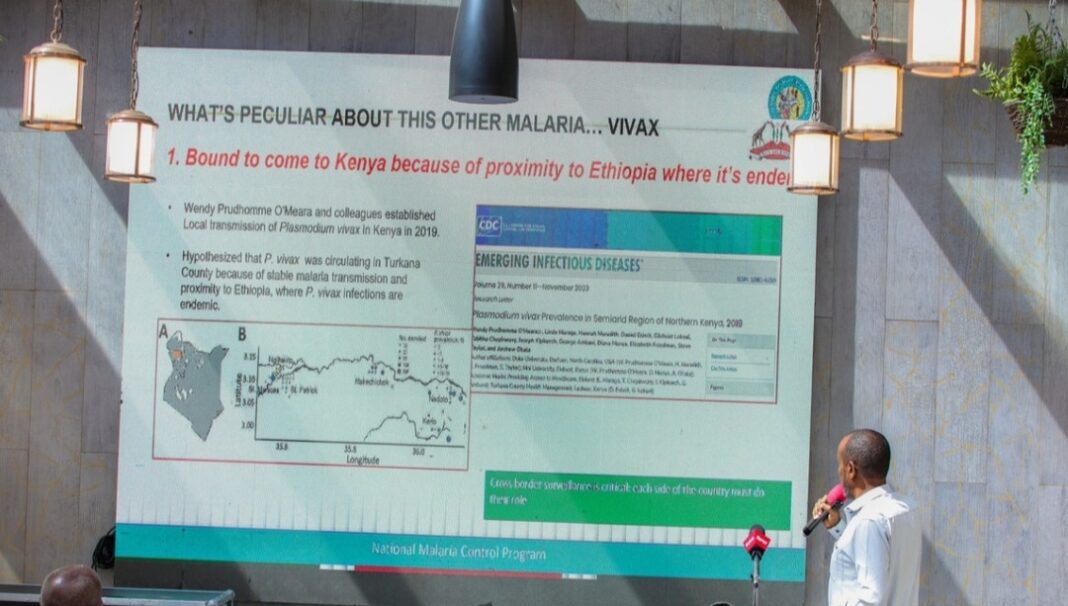
During his presentation, Kulow highlighted research by Wendy Prudhomme O’Meara and colleagues published in the journal Emerging Infectious Diseases. The study documented local transmission of P. vivax in Turkana County in 2019, demonstrating that the parasite had already established a foothold in northern Kenya.
The researchers suggested that its presence in Turkana was associated with existing malaria transmission and the county’s proximity to Ethiopia, where P. vivax is endemic.
The findings underline that Wajir’s experience is part of a wider regional pattern, rather than an isolated development.
Ethiopia has a substantial P. vivax burden, and movement between the two countries complicates surveillance. Pastoralist communities cross geographical boundaries in search of livelihoods, while workers travel between regions for employment, including gold mining.
“The border between Kenya and Ethiopia is not a line that mosquitoes respect, nor do the communities,” says Mohamed Hassan, Wajir County’s Director of Public Health and Sanitation.
According to Hassan Abass Ahmed Ag County Director for Medical Services, people infected across the border can introduce the parasite into Kenyan communities, where mosquitoes may transmit it to others.
Kulow says Wajir’s first identified case was imported from Ethiopia in 2024. The county now reports local transmission, with approximately 90 per cent of cases believed to be locally acquired, according to his assessment.
Gold-mining activity presents another potential transmission pathway. Kulow says workers from different parts of Kenya and Ethiopia have tested positive for P. vivax at facilities serving the area.
The evidence reinforces the need for surveillance that follows the movement of infections and people, rather than relying solely on geographical boundaries.
What Wajir is doing
The county has taken steps to strengthen its response. It has prioritised Wajir North and Eldas as malaria hotspots and expanded access to pan-species rapid diagnostic tests, which can detect multiple Plasmodium species.
Of Wajir’s 162 public health facilities, 37 facilities in the two hotspot sub-counties have these tests, alongside buffer stocks intended to reduce interruptions in supply. Microscopy is used to confirm results and identify the parasite species where laboratory services are available.
Community health promoters help connect suspected cases to facilities, support transport and follow up with patients who may struggle to complete treatment.
The county has also strengthened case surveillance, recording confirmed infections to help distinguish imported cases from those acquired locally.
But significant gaps remain. Kulow says laboratory coverage is below 30 per cent, with most facilities relying on rapid diagnostic tests rather than microscopy.
This limits the county’s ability to investigate infections fully and may leave some cases undetected.
Hassan wants national malaria programmes to recognise Wajir’s changing epidemiological situation and provide support comparable to that offered in established malaria-endemic regions.
For Prof Isabella Oyier of the Kenya Medical Research Institute, the challenge is turning scientific evidence into practical interventions.
Researchers, she says, should work with county governments and national programmes to strengthen diagnosis, develop locally appropriate responses and listen to the experiences of affected communities.
Her message is simple: “Test, treat, track.”
That means identifying infections accurately, providing the appropriate medicines and following patients to establish whether treatment has worked.
It also means responding early to warning signs. The research documenting P. vivax transmission in Turkana in 2019 illustrates why surveillance findings must inform timely action, particularly in border regions where infections can spread between communities.
The question Mumina cannot answer
Back in Adadijole village, Mumina says she is feeling better.“After I was given medication, I no longer have malaria,” she says.
Her improvement is encouraging, but the available account does not establish whether her dormant liver-stage parasites have been eliminated. She received treatment for the infection in her blood but did not receive primaquine.
Whether the parasite has been cleared or could cause another episode remains uncertain without appropriate clinical assessment and follow-up.
Her experience captures the challenge confronting Wajir. The county has invested in diagnostics, surveillance and community health services, yet the shortage of a specialised medicine limits its ability to deliver complete treatment for P. vivax.
Addressing the problem will require reliable access to primaquine, appropriate G6PD testing, expanded diagnostic capacity and stronger coordination between county and national authorities. Cross-border surveillance must also reflect the reality that people, parasites and mosquitoes do not stop at administrative boundaries.
For Mumina, recovery means returning to her children and the daily work of sustaining her household. For Wajir, the task is to ensure that recovery does not become a temporary reprieve from an infection that can return.
The county has done what it can with the resources available. Whether that will be enough depends partly on whether the national health system responds to the warning before the parasite spreads further.
For a disease that can hide long after its symptoms disappear, the real test is not simply whether patients feel better when they leave a clinic. It is whether the health system can provide the treatment, surveillance and follow-up needed to make that recovery last.
Mumina Golo’s story was originally reported by DeFrontera Media. Additional reporting, expert interviews and analysis by Mercy Kachenge.