

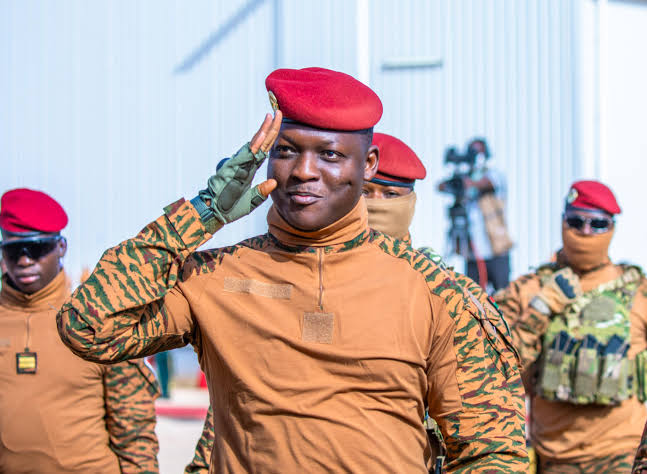
Burkina Faso’s push to reclaim greater state control over its economy has entered a new and potentially costly phase after a Libyan state-owned bank took the government of Captain Ibrahim Traoré to an international investment tribunal linked to the World Bank.
The development has intensified debate over Traoré’s economic policies, particularly his efforts to increase state ownership of strategic assets, mining resources and major companies.
But contrary to some claims circulating around the dispute, the case filed by Libya is not directly about Burkina Faso’s gold mines. It concerns the nationalisation of a commercial bank jointly owned by Libya and Burkina Faso.
The Libyan Foreign Bank filed the arbitration case on August 17, 2026, at the International Centre for Settlement of Investment Disputes (ICSID), an institution of the World Bank Group. The case, Libyan Foreign Bank v. Burkina Faso, is registered as ICSID Case No. ARB(AF)/26/3 and remains pending.
The dispute centres on Banque Commerciale du Burkina (BCB), a financial institution created through a partnership between the Burkinabe and Libyan states. The two sides originally held equal shares.
In May 2024, however, Traoré’s government nationalised the bank, effectively ending Libya’s ownership stake.
Ouagadougou justified the decision by pointing to longstanding operational and financial difficulties at the institution. According to Burkina Faso’s government, attempts to resolve the problems through discussions with its Libyan partner had failed. The government subsequently moved to take full control of the bank in the interest of improving its governance.
The Libyan side disputes that justification and has now chosen international arbitration to challenge the takeover.
Since taking power in 2022, Traoré has positioned Burkina Faso’s economic policy around greater national control of resources and reduced dependence on foreign interests. His government has increasingly argued that a country endowed with gold and other natural resources should capture a larger share of the wealth generated from those assets.
Burkina Faso adopted a new mining code in 2024 that increased the state’s participation in mining projects, while the government has moved to acquire or restructure several mining assets. In 2025, the government transferred the former assets of several mining companies, including Wahgnion Gold and Boungou, to the state-owned Société de Participation Minière du Burkina (SOPAMIB). The government described the move as part of a policy of sovereign appropriation of mineral resources for the benefit of the population.
The country’s gold strategy has also involved strengthening state participation in the industry and developing greater domestic capacity to process the precious metal.
In July 2026, the Burkinabe government announced the creation of Bouboulou, an industrial gold mine wholly owned by the state, reinforcing the direction of travel under Traoré.
This is why the Libyan arbitration has attracted attention far beyond the banking sector.For investors, the case raises a fundamental question: how far can a government go in reclaiming strategic assets without exposing itself to international investment claims?
For African governments pursuing resource nationalism, the answer could have major implications. International investment agreements and arbitration mechanisms can provide foreign investors with avenues to challenge state measures that they believe violate investment protections. Burkina Faso is already facing another ICSID proceeding brought by Canadian mining company Sarama Resources over a gold-mining dispute. That case was registered in December 2024 and remains separate from the Libyan banking case.
The emerging legal pressure therefore creates a difficult balancing act for Ouagadougou.On one side is the argument for economic sovereignty: African states should have the authority to regulate their natural resources, restructure failing institutions and ensure that national wealth benefits their citizens.
On the other is the international investment system, under which governments may face legal consequences when changes in ownership or regulation affect protected investments.
The Traoré administration appears willing to accept some of that confrontation.Burkina Faso has continued expanding state ownership beyond mining. In April 2026, the government nationalised the Société Burkinabè des Fibres Textiles (SOFITEX), arguing that state ownership was necessary to address the company’s financial difficulties and strengthen its performance.
Burkina Faso, Mali and Niger have established the Alliance of Sahel States (AES), presenting the bloc as an alternative framework for security and political cooperation after distancing themselves from several traditional Western partnerships.
Economic sovereignty is increasingly becoming part of that political project. For supporters of Traoré, the confrontation with foreign investors and international institutions represents a broader struggle to rewrite the terms under which Africa’s resources and capital are managed.
Critics, however, could argue that aggressive nationalisation carries risks if governments cannot provide transparent valuations, compensation mechanisms, effective management and predictable rules for investors.
The Libyan case will not determine whether Burkina Faso has the right to control its own resources. Instead, the tribunal will examine the specific legal issues surrounding the investment and the nationalisation of BCB.
The case is still at an early stage, and no international tribunal has ruled that Burkina Faso breached its obligations.
What began as a dispute over a bank now sits at the intersection of African resource nationalism, foreign investment, state ownership and the continent’s long-running search for economic independence.
For Traoré, the challenge will be to prove that Burkina Faso can turn its sovereignty-first economic agenda into a sustainable model—without allowing the legal and financial costs of that transformation to undermine the very independence it seeks to achieve.