
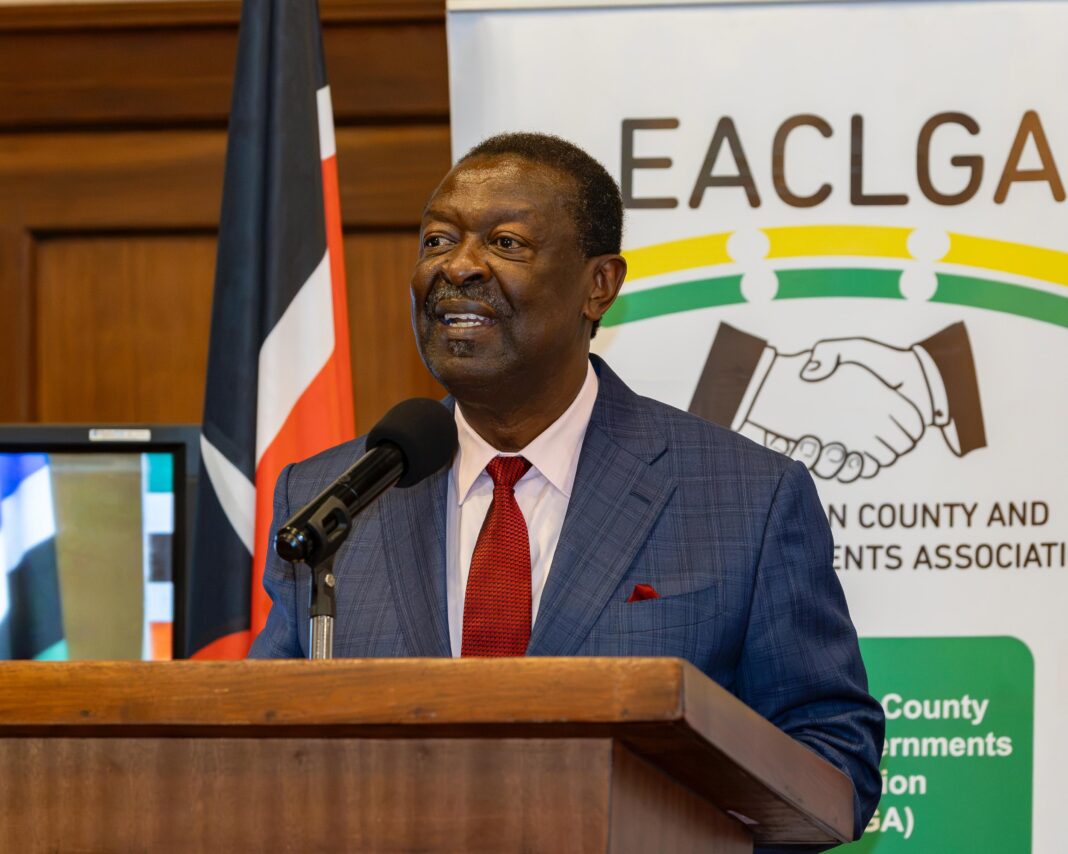

Kenya has pledged to champion deeper economic integration, stronger regional trade and greater cooperation among East African Community (EAC) member states as it assumes the chairmanship of the East Africa Local Governments Forum.
Prime Cabinet Secretary and Cabinet Secretary for Foreign and Diaspora Affairs Musalia Mudavadi said a stronger East African bloc must be built on empowered local governments, effective institutions and economic opportunities that directly benefit citizens across the region.
Speaking during the official opening of the 9th East Africa Local Governments Forum in Nairobi, Mudavadi said Kenya’s assumption of the chairmanship from Uganda presented an opportunity to accelerate regional integration by strengthening governance and cooperation at the grassroots level.
He emphasised that regional integration should go beyond political agreements and institutional frameworks to deliver tangible economic and social benefits to communities.
“A stronger East Africa begins with stronger communities, empowered local governments and opportunities that reach every citizen,” Mudavadi said.
He said Kenya would use its leadership to promote greater local autonomy, equitable resource allocation, stronger institutions and meaningful citizen participation across the EAC.
The Prime Cabinet Secretary said empowering local authorities was essential to ensuring that the benefits of regional cooperation reached ordinary citizens through improved healthcare, infrastructure, public services and expanded economic opportunities, particularly for young people and entrepreneurs.
The push for stronger local governance comes as the EAC seeks to accelerate the implementation of its regional integration agenda, including the Customs Union, Common Market, Monetary Union and the long-term ambition of establishing a political federation.
For businesses, deeper integration would create a larger and more predictable regional market, allowing manufacturers, traders and investors to operate across national borders with fewer regulatory restrictions.
However, persistent trade barriers continue to limit the bloc’s economic potential.
According to the East African Business Council’s 2026 East Africa Trade and Investment Climate Report, total EAC trade reached $156.6 billion in 2025, while intra-community trade stood at $19.54 billion, representing approximately 12.5 per cent of total trade.
Although intra-regional trade increased by 28.2 per cent, its relatively small share of overall trade highlights the significant opportunity to expand commerce among member states.
The EAC Secretariat has also identified non-tariff barriers, inconsistent customs procedures, duplicative inspections, transport costs and differences in regulatory standards as major obstacles to the smooth movement of goods and services.
In February 2026, the regional bloc convened a high-level dialogue in Kigali, Rwanda, to address these challenges and accelerate implementation of the Customs Union and Common Market.
The discussions highlighted the need to move beyond regional policy commitments towards practical enforcement, improved coordination and the removal of administrative restrictions affecting cross-border businesses.
East African Community+1
Mudavadi’s emphasis on stronger local governments therefore places decentralisation within the broader economic integration agenda, recognising that regional markets can only thrive when communities, businesses and local institutions are connected to opportunities across borders.
For East African enterprises, a more integrated bloc could reduce the cost of moving goods, expand access to consumers, encourage regional manufacturing and attract investment into infrastructure, agriculture, technology and industrial production.
It would also strengthen the region’s collective bargaining position in international trade negotiations and improve its competitiveness in attracting foreign direct investment.
The eight-member EAC comprises Kenya, Uganda, Tanzania, Rwanda, Burundi, South Sudan, the Democratic Republic of Congo and Somalia. Its combined market offers significant opportunities for businesses seeking to expand beyond national boundaries.
The Common Market framework provides for the free movement of goods, services, people, labour and capital, alongside the rights of establishment and residence. However, implementation across member states remains uneven.
East African Community + 1
Kenya’s chairmanship of the local governments forum comes at a critical moment when regional leaders are under pressure to translate integration commitments into measurable economic outcomes.
The challenge will be ensuring that decentralisation does not operate in isolation from national and regional economic policies but instead supports coordinated planning, infrastructure development, trade facilitation and investment promotion.
Mudavadi said the ultimate measure of successful integration should be its impact on people’s everyday lives, including better public services, thriving local economies and communities having a meaningful voice in shaping their future.
As Kenya takes over the leadership, its priorities are expected to include strengthening cooperation among local authorities, improving institutional capacity and ensuring that regional integration delivers opportunities across all member states.
The broader ambition is to build an East African Community that operates increasingly as one economic space, with stronger institutions, fewer trade restrictions and greater opportunities for businesses and citizens.
For the bloc, achieving full integration will require political commitment, consistent implementation of regional agreements and a willingness by member states to place collective economic interests above protectionist national policies.



