
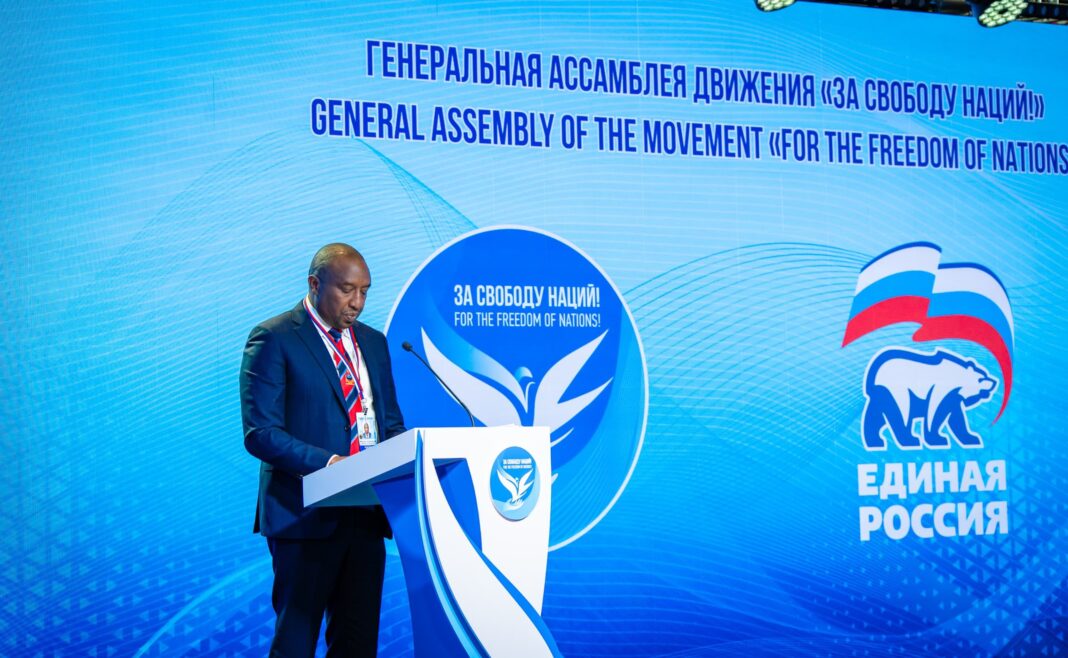

Kenya’s ruling United Democratic Alliance (UDA) Party has stepped up its international political engagement after participating in the General Assembly of the Movement for the Freedom of Nations in Moscow, in a move that signals growing efforts to strengthen political cooperation between Kenya and Russia.
UDA, a member of the Kenya Kwanza Alliance Coalition, attended the international gathering at the invitation of Dmitry Medvedev, Chairman of Russia’s United Russia Party, bringing the Kenyan political organisation into a multilateral platform focused on international political relations, national sovereignty and opposition to neocolonial practices.
The assembly, held in Moscow from November 14 to 17, 2026, brought together approximately 200 delegates from 72 countries, providing a platform for political parties and international organisations to exchange perspectives on global governance, sovereignty and the changing international order.
The participation represents an expansion of UDA’s international outreach and opens another channel for engagement between political organisations in Kenya and Russia.
UDA Executive Director Nicodemus Bore, who addressed the gathering, called for a shift away from what he described as external democratic supervision towards international cooperation anchored in mutual respect, sovereign equality and democratic partnerships.
He argued that international democratic institutions and standards should provide equal opportunities for African countries and other Global South nations, rather than placing them under external oversight.
Bore’s remarks reflect a broader debate among developing countries about political independence, the influence of powerful nations in international institutions and the need for greater representation in global decision-making.
Russia’s growing political engagement with Africa
The engagement comes as Russia continues to expand its political and diplomatic outreach across Africa, using bilateral relations, multilateral platforms and party-to-party engagements to strengthen its presence on the continent.
The United Russia Party, which dominates Russia’s political system and holds a parliamentary majority, has increasingly used international political networks to establish relationships with parties and political movements beyond its borders.
Medvedev, a former Russian president and current Deputy Chairman of Russia’s Security Council, has been central to the party’s international political engagement.
The Movement for the Freedom of Nations, convened under the United Russia Party’s initiative, provides a platform for discussions on what its organisers describe as contemporary forms of neocolonialism and the importance of national sovereignty.
For Kenya, UDA’s participation provides an additional avenue for political engagement with Moscow beyond traditional government-to-government diplomacy.
It also places the governing party within a wider international political conversation involving countries seeking to diversify their diplomatic partnerships and strengthen their influence in multilateral institutions.
Implications for Kenya-Russia relations
Kenya and Russia have maintained diplomatic relations for decades, with cooperation extending across trade, education, agriculture, security and other areas.
Political party diplomacy could complement these existing relations by creating opportunities for exchanges on governance, political organisation, leadership development and international cooperation.
For UDA, engagement with United Russia offers an opportunity to establish international political networks, exchange experiences with foreign political organisations and strengthen its international profile as the leading party within the Kenya Kwanza Alliance Coalition.
However, the Moscow engagement should be understood as party-to-party cooperation rather than a new bilateral agreement between the Kenyan and Russian governments. Any wider economic or diplomatic outcomes would require separate government-level engagement.
The development also comes against the backdrop of increasing competition among global powers for diplomatic, economic and strategic partnerships across Africa, as African governments seek to diversify their international relationships.
For Kenya, maintaining engagement with different international partners remains important to its foreign policy interests, particularly in expanding export markets, attracting investment, strengthening technology partnerships and securing a stronger voice in global affairs.
UDA’s participation in the Moscow assembly therefore marks another development in the growing intersection between political party diplomacy and international relations, highlighting how political organisations are increasingly becoming channels for building international partnerships.



