

Terrorist groups across West Africa and the Sahel are increasingly exploiting artificial intelligence (AI), drones, cryptocurrencies and digital communication platforms to finance operations, recruit members and coordinate attacks, prompting African security agencies to strengthen their technological capabilities to counter emerging threats.
From major extremist organisations to smaller cells and affiliated factions, terrorist networks are expanding their use of information and communication technologies (ICTs) to evade surveillance, move funds across borders, spread extremist propaganda and recruit supporters online.
The growing threat has raised concerns among regional security agencies about the ability of governments to keep pace with rapidly evolving technologies and the increasing sophistication of terrorist networks.
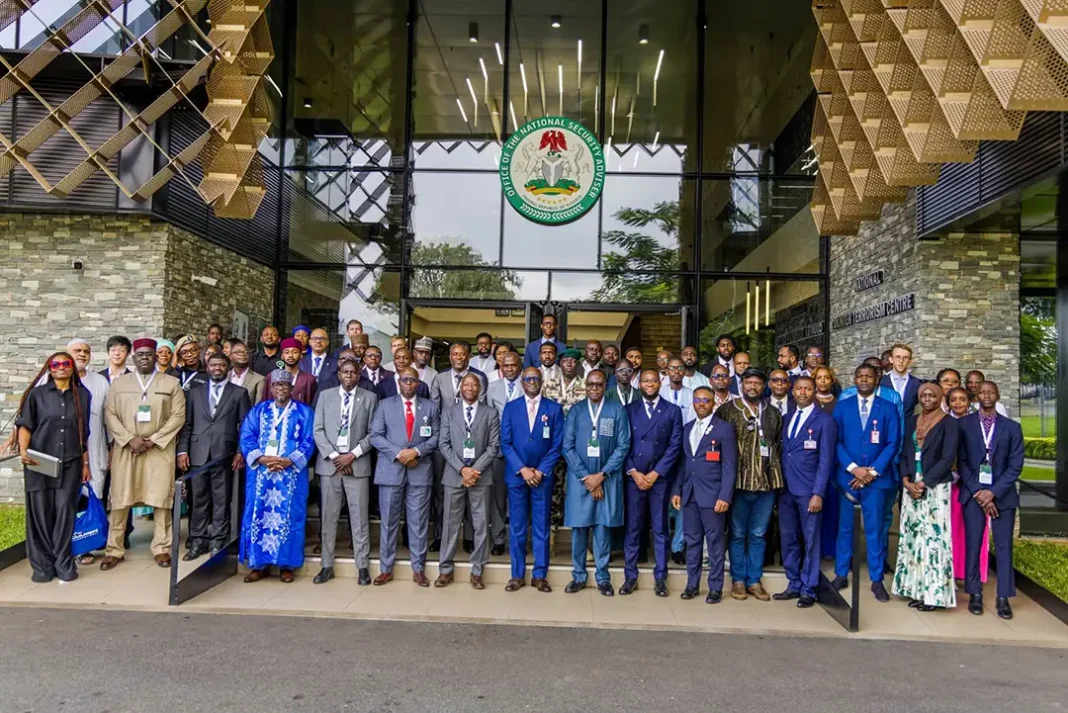
Against this backdrop, the African Union Counter-Terrorism Centre (AUCTC) organised a three-day training programme in Abuja, Nigeria, from October 13 to 15, focusing on detecting and disrupting terrorist exploitation of ICTs and other emerging technologies.
“Across West Africa and the Sahel today, ISWAP, Boko Haram and JNIM are extending their reach through technology,” said Idriss Lallali, acting director of the AUCTC, during the opening session.
He cited the use of social media for recruitment, mobile money, gift cards and cryptocurrencies for financing, darknet marketplaces for acquiring weapons, and satellite communications to evade conventional security networks.
Terrorist groups are also increasingly deploying drones across borders and using artificial intelligence to customise propaganda, target online audiences and circumvent detection systems.
According to Lallali, digital technologies have significantly lowered the cost of operating sophisticated communication and recruitment networks, enabling even small extremist cells to reach audiences far beyond their geographical locations.
“What makes this difficult is speed and cost. A cell with a modest budget can now reach audiences far beyond its physical presence and move faster than our procedures can respond,” he said.
He warned that the capacity to detect and counter technology-enabled terrorism remains unevenly distributed across African Union member states, highlighting the need for stronger regional cooperation, technical expertise and intelligence-sharing mechanisms.
More than 60 experts from 17 AU member states across West Africa and the Sahel attended the Abuja training. The participants included representatives from security forces, intelligence services, law enforcement agencies, financial intelligence units and cybersecurity institutions, alongside regional and international organisations.
In his keynote address, Nigeria’s Coordinator of the National Counter Terrorism Centre, Major General Adamu Laka, said artificial intelligence, unmanned aerial vehicles and virtual assets were introducing new dimensions to the security challenges facing Nigeria and neighbouring countries.
“Emerging technologies add further complexity: Artificial intelligence can rapidly produce personalised content; drones and autonomous systems can expand operational capabilities; and virtual assets can create new financing channels,” Laka said.
He called for stronger capabilities to anticipate, detect, analyse and disrupt emerging threats before they translate into terrorist attacks.
The financial dimension of technology-enabled terrorism is also attracting increased attention from authorities.
In its 2025 annual report released in August, Nigeria’s Financial Intelligence Unit (NFIU) detailed several terrorist financing schemes, including a crowdfunding network allegedly used to raise and transfer money for terrorist activities.
The report highlighted how fundraising campaigns disguised as humanitarian assistance or educational support can be used to collect small contributions from sympathisers through social media, encrypted messaging applications and online payment platforms.
According to the NFIU, foreign-based facilitators used platforms such as Telegram and Signal to circulate links to PayPal pages and conventional bank accounts, attracting contributions ranging from $50 to $500.
The report also identified the use of bank accounts belonging to deceased individuals among the methods uncovered by financial investigators, illustrating the challenges authorities face in tracing illicit financial flows.
To strengthen responses, the AUCTC programme equipped participants with skills in open-source intelligence, cyberthreat intelligence, digital forensics and blockchain analysis.
The training focused on improving the ability of security agencies to identify online recruitment networks, preserve electronic evidence, investigate suspicious digital transactions and trace cryptocurrency movements linked to extremist financing.
The initiative was organised in collaboration with Nigeria’s National Counter Terrorism Centre and the Fusion and Liaison Unit of the Sahel.
Beyond the three-day programme, the AU Centre aims to develop a network of specialised trainers who can transfer the knowledge and technical skills to operational and field-level security officers in their respective countries.
This approach is intended to strengthen national capacities while improving cooperation among intelligence, cybersecurity, law enforcement and financial investigation agencies across the region.
Lallali also called for closer collaboration with social media companies, telecommunications operators and financial service providers, noting that terrorist networks increasingly exploit privately owned digital infrastructure to facilitate their activities.
“You leave as this continent’s first cohort of trainers in this domain,” he told participants. “You will leave here not just carrying home a certificate, but a responsibility. The Centre will stand behind you. But the multiplier is you.”
As digital technologies become increasingly embedded in terrorist financing, recruitment and operational planning, the Abuja initiative highlights the growing importance of cybersecurity, digital intelligence and cross-border cooperation in Africa’s counterterrorism strategies.



