
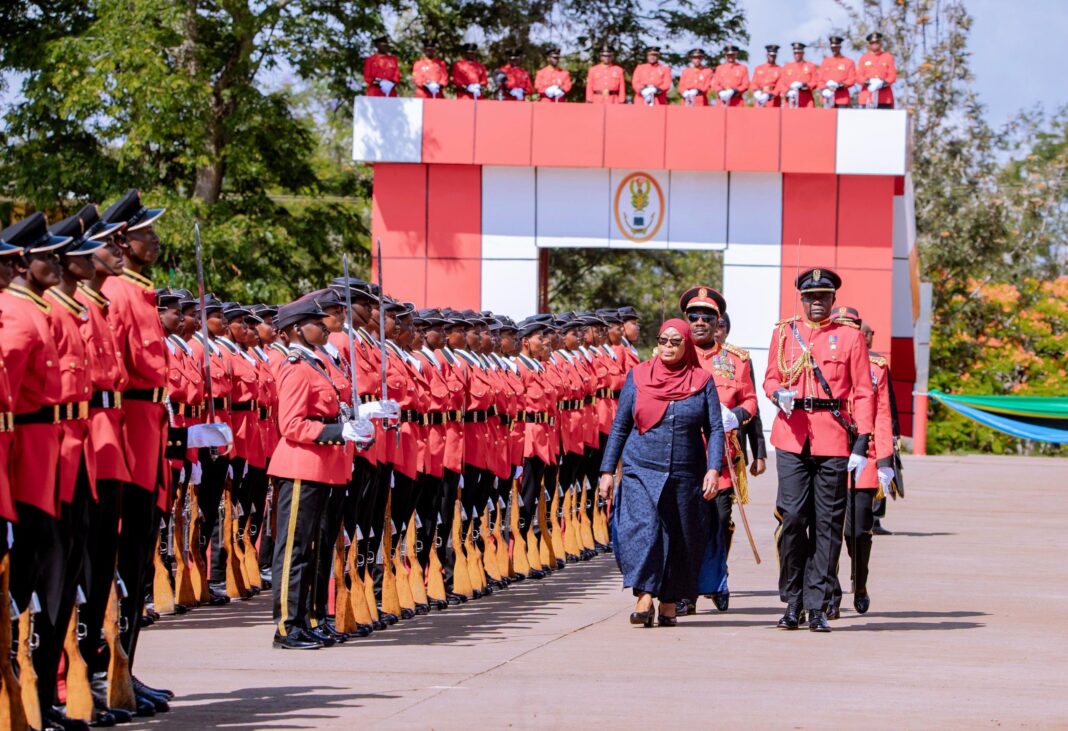

Tanzania could have a new or substantially amended Constitution by 2028 or 2029, President Samia Suluhu Hassan has announced, raising expectations of long-awaited political reforms that opposition parties say are essential to strengthening democracy, limiting executive powers and restoring public confidence in state institutions.
The announcement marks a renewed attempt to revive a constitutional review process that has remained stalled for more than a decade, amid growing pressure from opposition parties, civil society organisations and governance advocates for a new constitutional framework that reflects the country’s changing political and democratic aspirations.
Speaking on November 20, 2026, at the Tanzania Police Force’s Senior Officers Conference in Moshi, Kilimanjaro Region, President Hassan said her administration was preparing to establish a Reconciliation Commission bringing together political parties, religious leaders, civil society organisations and other stakeholders.
The commission will provide a platform for addressing political divisions following the disputed October 2025 general election, identifying national concerns and determining areas of the Constitution requiring reform.
Hassan said consultations were already under way to secure nominations from religious organisations, political parties and civil society groups, with the commission expected to be announced soon.
She reaffirmed her government’s commitment to delivering either a new or amended Constitution by 2028 or 2029, in line with the ruling Chama Cha Mapinduzi (CCM) party’s 2025–2030 election manifesto.
The initiative follows recommendations by a presidential inquiry commission led by retired Chief Justice Mohamed Chande Othman, which investigated violence surrounding the October 2025 elections and called for constitutional reforms ahead of the next general election.
Opposition demands deeper reforms
However, opposition parties have consistently argued that reconciliation alone will not resolve Tanzania’s political challenges without fundamental changes to the country’s governance structure.
The main opposition party, Chadema, has called for a new Constitution guaranteeing judicial independence, greater autonomy for state institutions and stronger democratic governance.
Its Secretary-General, John Mnyika, has maintained that genuine reconciliation must address the underlying political grievances, including demands for accountability over the October 2025 violence.
Chadema has also demanded an independent investigation into the election-related killings and the release of its detained national chairman, Tundu Lissu, whom the party considers central to the reconciliation process.
Meanwhile, ACT-Wazalendo has advocated constitutional reforms that limit presidential powers, strengthen the separation of powers and establish a genuinely independent electoral commission.
The party has also supported restructuring the Union between mainland Tanzania and Zanzibar to provide greater autonomy and address longstanding disagreements over the distribution of political and administrative powers.
ACT-Wazalendo’s proposals include a three-government structure comprising the Union Government, a mainland Tanzania government and the Zanzibar Government.
What could a new Constitution contain?
The debate is likely to revisit several contentious issues that have shaped Tanzania’s constitutional reform agenda since the 2010s.
One of the most significant is the balance of power between the presidency, Parliament and the judiciary. Opposition parties and governance advocates want constitutional safeguards that prevent excessive concentration of authority in the executive, strengthen parliamentary oversight and protect judicial independence.
Another major issue is electoral reform. Proposals include strengthening the independence of electoral institutions, improving transparency in elections and ensuring that political parties compete under fair conditions.
The Constitution could also introduce stronger protection of fundamental rights, including freedom of expression, assembly, political participation and access to justice.
The relationship between mainland Tanzania and Zanzibar will remain central to negotiations. The 2013 Warioba constitutional draft proposed a three-government Union structure, although the arrangement was subsequently removed during deliberations by the Constituent Assembly in 2014.
Other possible reforms include clearer accountability mechanisms for public officials, greater transparency in government decision-making and stronger protection of citizens’ participation in managing national resources.
These are proposals advanced by different stakeholders, not provisions that the government has formally adopted.
A decade-old constitutional question
Tanzania’s constitutional reform process dates back to 2012, when former President Jakaya Kikwete established a Constitutional Review Commission chaired by retired Prime Minister and Chief Justice Joseph Warioba.
The commission collected public views and produced a draft Constitution in 2013, which proposed significant changes to the country’s governance structure and distribution of powers.
However, disagreements within the Constituent Assembly, particularly over the proposed three-government Union arrangement, stalled the process. A planned national referendum was subsequently postponed indefinitely.
The latest initiative therefore presents President Hassan with an opportunity to resolve a constitutional question that has remained unsettled for years.
Its success, however, will depend on whether the proposed reconciliation process accommodates competing political interests and allows Tanzanians to participate meaningfully in shaping the country’s supreme law.
With the 2029 target approaching, the challenge will be moving beyond political commitments towards an inclusive drafting process, parliamentary consideration and a credible national referendum.



