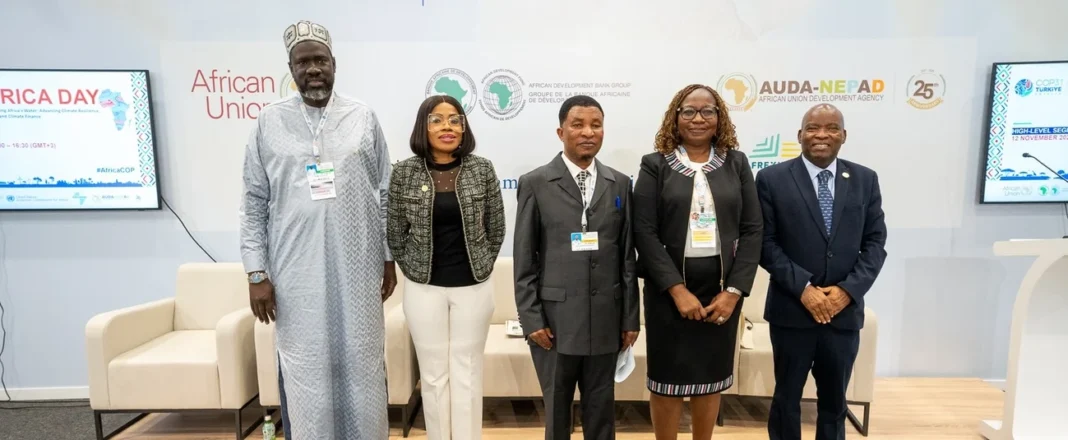

Africa has called for increased investment in water security, climate-resilient infrastructure and early warning systems, warning that climate change is placing growing pressure on the continent’s water resources, food production and economic development.
The call was made during Africa Day at the 31st Conference of the Parties (COP31) to the United Nations Framework Convention on Climate Change (UNFCCC), held on November 12 under the theme “Securing Africa’s Water: Advancing Climate Resilience, Early Action and Climate Finance.”
The high-level meeting brought together African Union leaders, governments, development finance institutions, private sector representatives and civil society organisations to discuss how the continent can strengthen its capacity to withstand climate-related shocks while advancing the African Union’s Agenda 2063 development priorities.
Discussions focused on three key areas: financing climate-resilient water and sanitation infrastructure, strengthening multi-hazard early warning systems and anticipatory action, and restoring ecosystems, forests and landscapes that sustain water resources.
Water security has become an increasingly important development priority for Africa as prolonged droughts, unpredictable rainfall, floods and other extreme weather events threaten agriculture, energy production, public health and livelihoods.
In a statement delivered on his behalf by Commissioner Moses Vilakati for Agriculture, Rural Development, Blue Economy and Sustainable Environment, African Union Commission Chairperson Mahmoud Ali Youssouf urged governments to place water security and sanitation at the centre of national climate strategies and public investment programmes.
He also called on international partners, multilateral development banks and climate finance institutions to make adaptation funding more accessible, predictable and responsive to the needs of African countries.
“Investing in preparedness today is less costly than responding to disasters tomorrow. Early warnings must lead to early action, backed by strong climate services, preparedness plans and financing that enables communities and governments to act before hazards become disasters,” he said.
The meeting also highlighted the need to mobilise public and private capital for watershed management, irrigation, climate-smart agriculture and resilient rural livelihoods.
Strengthening weather forecasting, hydrometeorological infrastructure and climate information services was identified as another priority, particularly through accelerated implementation of the Early Warnings for All initiative across Africa.
Participants also called for greater preparedness for the anticipated 2026-2027 El Niño, which could expose vulnerable communities and agricultural systems to further climate-related risks.
Professor Anthony Nyong, Director of Climate Change and Green Growth at the African Development Bank, said protecting water resources requires an integrated approach to managing forests, land and water ecosystems.
“Water security begins in restored landscapes. Africa will secure its water only if it treats forests, land and water as one system, and finances them as one agenda,” Nyong said.
He called for a stronger pipeline of water-resilience investments ahead of COP32, which Ethiopia will host in 2027, adding that the African Development Bank was ready to support investments linking healthy ecosystems, resilient infrastructure and effective institutions.
The transition from COP31 in Antalya to COP32 in Addis Ababa was also identified as an opportunity for Africa to push for stronger commitments on adaptation financing and climate action.
AUDA-NEPAD Chief Executive Officer Nardos Bekele-Thomas said the two climate summits should be treated as part of a continuous process, with commitments secured in Antalya translated into concrete outcomes in Addis Ababa.
She said the African Union Assembly had mandated AUDA-NEPAD in February to provide technical and financial support to Ethiopia throughout the COP32 preparation cycle and mobilise additional resources from African institutions, development partners and member states.
Bekele-Thomas reaffirmed the agency’s commitment to supporting Ethiopia and ensuring that young African climate negotiators remain actively involved in the negotiations.
United Nations Under-Secretary-General and Executive Secretary of the Economic Commission for Africa Claver Gatete said the continent must move beyond climate commitments towards investments that generate measurable economic and development outcomes.
“As we move from COP31 in Antalya towards COP32 in Addis Ababa, our priority must be to turn climate commitments into investments that deliver results for African countries,” Gatete said.
He identified affordable climate finance, stronger project preparation and mobilisation of domestic resources and private capital as essential to scaling up climate investments.
Afreximbank also emphasised the importance of linking climate resilience with industrialisation, infrastructure development and regional economic integration.
Helen Brume, the bank’s Director of Project and Asset-Based Finance, said investments in resilient infrastructure, renewable energy, agricultural value chains and regional trade could help African economies withstand climate shocks.
She argued that investing in preventive infrastructure and productive economic systems would reduce the risk of climate disasters escalating into wider economic crises.
The discussions underscored the need to bridge the gap between climate commitments and implementation through stronger partnerships, investment-ready projects and financing mechanisms that address Africa’s adaptation needs.
As preparations gather pace for COP32 in Ethiopia in 2027, African institutions are seeking to build a common negotiating position that places water security, climate adaptation and accessible financing at the centre of the continent’s climate agenda.
Africa Day at COP31 was organised by the African Union Commission and ClimDev-Africa partners, including the African Development Bank, Afreximbank, the United Nations Economic Commission for Africa and AUDA-NEPAD, in collaboration with the African Centre of Meteorological Applications for Development (ACMAD).