

The African Development Bank Group (AfDB) and Japan International Cooperation Agency (JICA) are seeking to expand their investment partnership in Africa, targeting increased financing for infrastructure, agriculture, energy, digital technology and private sector development.
The two institutions are exploring new financing mechanisms to attract Japanese businesses and private investors into African markets, as development partners seek to bridge the continent’s infrastructure and investment financing gaps.
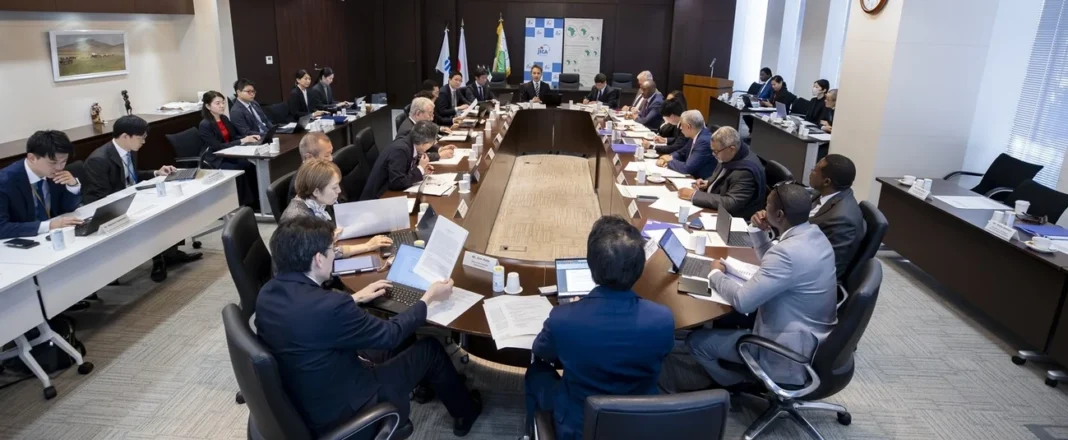
The renewed push follows high-level discussions between AfDB President Dr Sidi Ould Tah and JICA President Dr Akihiko Tanaka at the agency’s headquarters in Japan on November 13, where they reviewed ongoing projects and identified new areas for cooperation.
Critical minerals, healthcare, skills development, artificial intelligence, digital technology and climate resilience featured among the priority areas, alongside efforts to mobilise private capital for development projects.
A key focus of the discussions was how to strengthen private sector participation in Africa’s development by improving access to financing, technology and investment opportunities for Japanese companies.
Ould Tah said the partnership could play a greater role in attracting Japanese investors and mobilising private capital, aligning with his strategic vision and the proposed New African Financial Architecture for Development (NAFAD).
The framework seeks to improve how development finance is mobilised, allocated and deployed, while strengthening risk-sharing mechanisms to make African investment opportunities more attractive to international investors.
The partnership builds on the Enhanced Private Sector Assistance for Africa (EPSA), a joint financing initiative launched by the AfDB and Japan in 2005.
Its sixth phase, EPSA 6, covering 2026–2028, has a joint financing target of $5.5 billion, providing a framework for expanding investment in infrastructure and private sector-led growth across the continent.
AfDB officials disclosed that the institution’s ongoing project portfolio with JICA stood at approximately $7 billion, highlighting the scale of existing cooperation and opportunities for additional co-financing.
Max Magor Ndiaye, AfDB Director of Syndication, Co-financing, Client Solutions and the African Investment Forum, discussed prospects for expanding joint financing, while Ousmane Fall, Director of Non-Sovereign Operations and Private Sector Support, outlined mechanisms for increasing private sector investment.
Energy and agriculture are among the sectors expected to benefit from the expanded partnership.
In energy, JICA is supporting Mission 300, an initiative led by the AfDB and the World Bank Group to connect 300 million people in sub-Saharan Africa to electricity by 2030.
The initiative is expected to require substantial public and private investment in electricity generation, transmission and distribution, creating opportunities for development finance institutions and private investors.
In agriculture, the two institutions are working to expand financing for food security, agribusiness and agricultural value chains.
Under the Africa Food System Investment Platform, the AfDB and JICA plan to jointly identify and finance value-chain opportunities in three countries and one regional corridor, building on their previous co-financing experience under EPSA 5.
The approach is intended to attract private investment into agricultural production, processing and distribution while strengthening food security and regional trade.
Separately, the two leaders signed an agreement covering a $583.4 million concessional loan from Japan to support the 17th replenishment of the African Development Fund (ADF-17), the AfDB’s concessional financing window for low-income countries.
Japan’s ADF-17 financing package also includes grants and contributions linked to compensation under the Multilateral Debt Relief Initiative, bringing the additional support to approximately $600 million.
The financing is expected to strengthen the Fund’s capacity to provide affordable resources to eligible African countries, particularly those facing high borrowing costs and limited access to international capital markets.
Tanaka said the longstanding relationship between the two institutions provided a foundation for mobilising additional resources and expertise, calling for the proposals discussed to be translated into concrete joint projects.
The expanded partnership comes as African governments seek to diversify development financing sources, attract foreign direct investment and reduce dependence on traditional public borrowing to fund infrastructure and economic transformation.



