
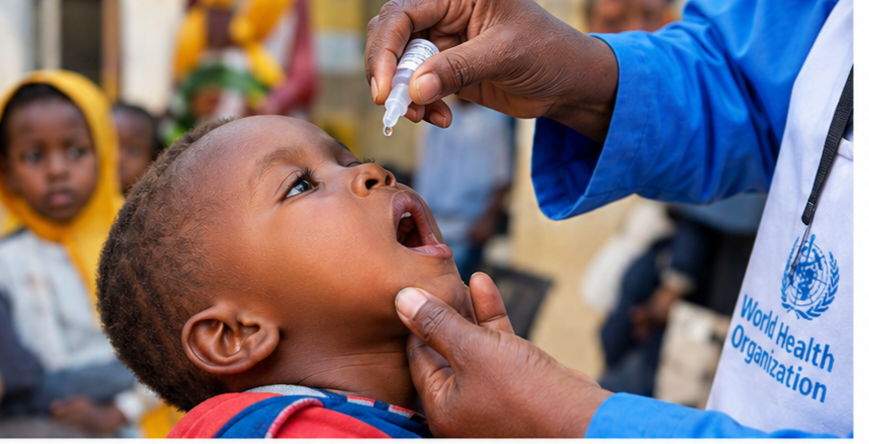

Ethiopia’s progress towards eliminating polio is facing a renewed test, with 11 cases of circulating variant poliovirus type 1 reported in 2026, prompting preparations for a vaccination campaign targeting more than 11.3 million children.
The development highlights a persistent challenge in the global fight against polio: ending transmission of wild poliovirus does not automatically eliminate every form of the disease.
As the world marked World Polio Day on October 24, the Global Polio Eradication Initiative (GPEI) and its partners renewed their commitment to protecting every child, warning that continued vaccination and surveillance remain essential to preventing new outbreaks.
Ethiopia has made significant progress in controlling wild poliovirus. The country interrupted indigenous wild poliovirus transmission in 2001, reported its last imported case in 2014 and was wild polio-free in 2017.
The African Region was officially certified free of indigenous wild poliovirus on August 25, 2020.
However, Ethiopia continues to face outbreaks of circulating variant poliovirus type 1, which can emerge in communities where vaccination coverage remains persistently low.
According to a joint statement issued by GPEI partners, five of the 11 cases reported in Ethiopia in 2026 were from Gambella Region, while four were recorded in West Shoa zone of Oromia Region. The remaining two cases were reported in Gofa and Gardule zones of the South Ethiopia Region.
The cases have triggered plans for a new vaccination response targeting affected communities and neighbouring areas considered at high risk.
Millions of children targeted
The Ethiopian government, working with international health partners, is preparing to vaccinate 11,348,548 children under five across 629 woredas in 68 zones spanning five regions.
In West Shewa, Oromia Region, the campaign will extend eligibility to children under ten years of age.
The first round is scheduled for November 20–23, 2026, followed by a second round from December 18–21.
The campaign will cover Addis Ababa, Central Ethiopia, Oromia, South Ethiopia and Southwest Ethiopia.
Beyond responding to reported infections, the exercise is also expected to identify children who have never received a routine vaccine dose, as well as those whose immunisation schedules are incomplete.
These children, commonly described as zero-dose and under-vaccinated, are a priority because gaps in immunisation can leave communities vulnerable to outbreaks.
The approach builds on earlier vaccination campaigns conducted in Gambella and neighbouring areas, including Benishangul Gumuz and two zones of Oromia.
Those campaigns reached more than one million children under five, with nearly 100 per cent administrative coverage, according to the WHO statement. They also incorporated catch-up vaccinations and were synchronised with campaigns in neighbouring South Sudan.
Why vaccination remains critical
Variant poliovirus is different from wild poliovirus, but it can still threaten children, particularly where immunity is low.
According to WHO, circulating variant poliovirus can develop when the weakened virus used in oral polio vaccines circulates for a prolonged period in under-immunised communities and undergoes genetic changes.
This makes sustained vaccination coverage essential, including in areas that have made significant progress against wild poliovirus.
Ethiopia has also stopped type 2 poliovirus transmission, with the last case reported on October 7, 2025, according to the joint statement.
Maintaining that achievement will require continued monitoring to detect any new transmission and ensure that vaccination gaps are addressed quickly.
Surveillance beyond national borders
Health authorities are also emphasising surveillance in border and cross-border communities because poliovirus transmission can extend beyond national boundaries.
The GPEI partners say stronger acute flaccid paralysis surveillance, environmental monitoring, coordinated cross-border action and rapid information-sharing will be important in identifying transmission and responding to emerging threats.
Ethiopia’s response is being supported by the Ministry of Health, regional health bureaus, WHO, UNICEF, the United States Centers for Disease Control and Prevention, Gavi, Rotary, the Gates Foundation and other partners.
Community leaders and frontline health workers will also be essential to ensuring vaccination teams reach eligible children and that parents understand the importance of completing recommended vaccine schedules.
The renewed campaign comes as polio eradication efforts enter a crucial phase, with health authorities seeking to protect earlier gains while responding to outbreaks that continue to threaten vulnerable populations.
For Ethiopia, the challenge is no longer only to preserve its progress against wild poliovirus, but also to prevent variant strains from gaining a foothold in communities with gaps in immunity.
As GPEI partners marked World Polio Day under the theme “One day, one focus, ending polio for good,” they called for stronger community engagement, sustained vaccination coverage and continued investment in surveillance.
The central message is clear: a polio-free future depends not only on national milestones, but on ensuring that every child receives the protection they need, regardless of where they live.



