
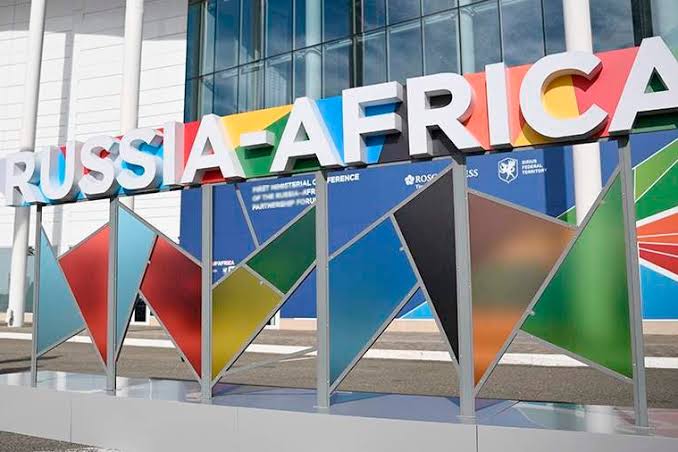

African leaders are heading into the Third Russia–Africa Summit this week with a broader agenda than diplomacy alone, seeking tangible gains in trade, food security, energy, technology transfer and education as the continent continues to diversify its global partnerships.
Kenya’s Prime Cabinet Secretary and Cabinet Secretary for Foreign and Diaspora Affairs, Dr. Musalia Mudavadi, arrived in Moscow ahead of the summit and the accompanying Russia–Africa Economic and Humanitarian Forum, scheduled for October 28–30. His participation places Kenya among dozens of African states looking to convert political goodwill into investment and market access at a time of intensifying geopolitical competition across the continent.
Hosted by Russia, the summit brings together heads of state, ministers and business leaders to discuss political cooperation, international peace and security, economic development and humanitarian collaboration.
For Africa, the gathering comes as governments increasingly pursue a multi-alignment foreign policy, engaging Russia alongside China, the European Union, the United States, Gulf states, India and Türkiye rather than relying on a single strategic partner.
Africa’s priorities are ;
- Trade & market access
- Food security
- Energy cooperation
- Industrial investment
- Science & technology
- Education & skills
The summit also offers African governments an opportunity to strengthen cooperation on peace and security, particularly as conflicts in the Sahel, Sudan, the Horn of Africa and eastern Democratic Republic of Congo continue to affect regional stability and economic growth.
Kenya’s economic agenda
According to Kenya’s Ministry of Foreign and Diaspora Affairs, Dr. Mudavadi will use the summit to advance practical economic priorities aimed at boosting exports, attracting investment and creating jobs.
A key focus will be expanding access for Kenyan tea, coffee and horticultural products to the Russian market while encouraging Russian investment in agriculture, energy, manufacturing, science and technology.
The visit also includes a scheduled bilateral meeting with Russian Foreign Minister Sergey Lavrov, where discussions are expected to cover bilateral relations, regional developments and opportunities for deeper economic and political cooperation.
On the sidelines of the summit, Mudavadi will meet counterparts from participating countries to explore new partnerships aligned with Kenya’s development priorities.
The ministry says Kenya will also seek cooperation in education, skills development, tourism and technology transfer as part of efforts to strengthen value addition and sustainable economic growth.
Russia’s push for influence
For Moscow, the summit represents another effort to expand its footprint across Africa through diplomacy, trade, education, security cooperation and humanitarian engagement.
Russia has increasingly positioned itself as a partner advocating for what it describes as a more balanced international order, while promoting cooperation in sectors including energy, mining, agriculture, nuclear technology and higher education.
African countries, however, have generally approached these partnerships pragmatically, seeking concrete investments and development outcomes rather than becoming drawn into broader geopolitical rivalries.
A changing geopolitical landscape
The Moscow summit comes as Africa’s strategic importance continues to grow globally.With a population expected to exceed 2.5 billion by 2050, vast mineral resources critical to the global energy transition and the implementation of the African Continental Free Trade Area (AfCFTA), the continent has become a major arena for international economic competition.
Rather than choosing between competing global powers, many African governments are pursuing relationships that expand financing options, open export markets and accelerate industrialization.
Kenya’s participation reflects that broader diplomatic approach
As Dr. Mudavadi begins engagements in Moscow, Nairobi is expected to balance traditional diplomatic ties with new economic opportunities, reinforcing Kenya’s strategy of diversifying international partnerships while advancing trade, investment and technology cooperation for long-term national development.



