
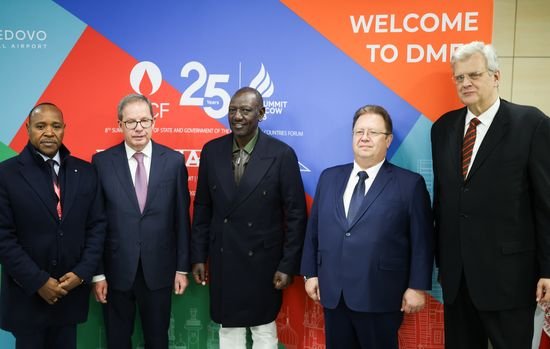

Kenyan President William Ruto has arrived in Moscow for the Third Russia–Africa Summit and Economic and Humanitarian Forum, seeking new markets for Kenyan exports, investment and partnerships to support industrialisation and job creation.
President William Ruto is expected to use the October 28–30 summit to strengthen Kenya’s economic ties with Russia and other participating countries as Nairobi seeks to diversify its international trade partnerships and attract capital and technology.
According to State House, the visit will focus on expanding access to the Russian market for Kenyan tea, coffee, cut flowers, fresh produce and value-added products, while promoting investment in manufacturing, agriculture, energy and infrastructure.
Kenya is also seeking partnerships in artificial intelligence, digital innovation and technology transfer, areas the government views as important to improving productivity, creating employment and strengthening the country’s competitiveness.
The summit brings together African and Russian leaders, government officials, business executives and other stakeholders to discuss economic cooperation, political relations, international security and humanitarian partnerships.
Prime Cabinet Secretary and Foreign Affairs Cabinet Secretary Musalia Mudavadi arrived in Moscow ahead of the presidential engagements, reflecting Kenya’s efforts to prepare for high-level discussions on trade, investment and diplomatic cooperation.
State House Spokesperson Hussein Mohamed said Ruto would use the engagements to advance Kenya’s commercial interests and support broader African efforts to secure better access to international markets.
“As the AU champion on the African Continental Free Trade Area, the President will seek greater market access for African tea, coffee, cut flowers, fresh produce and value-added products,” Mohamed said in a statement issued on Tuesday.
The focus on market access comes as Kenya seeks to increase export earnings by moving beyond the sale of raw agricultural commodities towards processing and value addition. Greater access to Russia could create opportunities for Kenyan producers and exporters, although the scale of any gains will depend on commercial agreements, logistics, payment arrangements and the ability of businesses to meet market requirements.
At the Africa–Russia Business Roundtable, Ruto is expected to present Kenya as an investment destination and a gateway to the wider African market. The government hopes to attract joint ventures that could establish or expand local production, strengthen domestic supply chains and create jobs.
Investment in agro-processing is expected to be a key area of interest, particularly as Kenya seeks to increase the value of agricultural exports. Partnerships in manufacturing could also support technology transfer and help local companies improve production capacity.
The government is further pursuing cooperation in energy and infrastructure, alongside efforts to secure affordable agricultural inputs and strengthen food security. Access to competitively priced inputs could help farmers improve productivity, although the benefits would depend on affordability, availability and reliable supply.
Beyond bilateral relations, the summit provides a platform for African countries to coordinate their economic priorities and engage Russia on trade, investment, development financing and technology. Discussions are also expected to cover international peace and security, Africa’s representation in global decision-making and reforms to international governance institutions.
On the sidelines, Ruto is expected to meet other heads of state and government, representatives of international organisations, financial institutions and major corporations to mobilise investment and advance Kenya’s economic priorities.
For Kenya, the Moscow visit comes amid a wider push to diversify export destinations and attract investment that supports industrialisation. Russia offers a potential market for agricultural products and a possible partner in selected industrial and technological sectors.
However, the summit’s economic value will ultimately depend on whether discussions translate into concrete business agreements, sustained market access and investments that benefit Kenyan producers and workers.
The government’s immediate objective is to turn diplomatic engagement into commercial opportunities, with expanded exports, local manufacturing and employment creation among the expected gains.
The three-day summit therefore presents Kenya with an opportunity to strengthen its engagement with Russia while positioning its businesses to explore new markets and partnerships across a changing global economy.



