
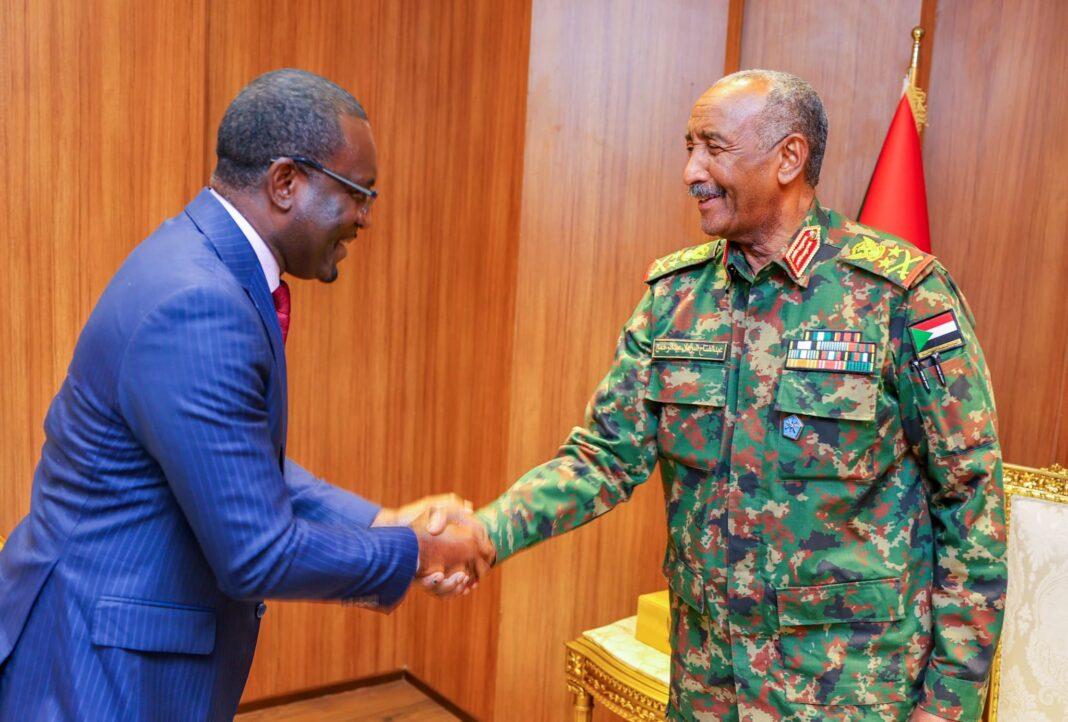

Sudan is seeking to strengthen its regional security partnerships through expanded military intelligence cooperation with Gabon, as the country’s military leadership continues to confront the Rapid Support Forces (RSF) in a war that has drawn growing regional and international attention.
Sudan Sovereignty Council Chairman General Abdel Fattah al-Burhan held talks with Gabon’s intelligence director, Gérard Ondjambi Ongaye, on Sunday, focusing on bilateral relations, security cooperation and coordination against regional security threats.
The meeting, attended by Sudan’s intelligence chief, General Ahmed Ibrahim Mufaddal, highlighted Khartoum’s interest in strengthening intelligence-sharing arrangements and building closer security partnerships with African governments amid the prolonged conflict.
Ongaye also conveyed greetings from Gabon’s President, underscoring the diplomatic dimension of the engagement and the importance of maintaining relations between the two countries.
The discussions come at a critical moment for Sudan, where the conflict between the Sudanese Armed Forces (SAF), led by al-Burhan, and the RSF, commanded by Mohamed Hamdan Dagalo, popularly known as Hemedti, has evolved into one of Africa’s most devastating humanitarian and security crises.
Since fighting erupted in April 2023, the conflict has disrupted state institutions, damaged critical infrastructure, displaced millions of people and created conditions for widespread food insecurity. It has also raised concerns about the possibility of the war destabilising neighbouring countries and expanding regional rivalries.
Foreign involvement raises regional stakes
The Gabonese intelligence engagement also comes against a backdrop of increasing foreign involvement in Sudan’s conflict, with the United Arab Emirates, Türkiye, Qatar, Egypt, Saudi Arabia and other regional powers pursuing different diplomatic, economic and security interests.
The UAE has faced repeated allegations of providing military and logistical support to the RSF, including weapons and other military equipment. Abu Dhabi has consistently denied backing the paramilitary group. However, a September 2026 United Nations fact-finding report identified networks involving individuals and entities in the UAE, Chad, Libya and Somalia that allegedly facilitated the transfer of weapons, equipment, training and personnel to the RSF.
The report illustrates how external supply networks have helped sustain the conflict, complicating international efforts to secure a ceasefire. Reuters reported that the UN investigators also documented the growing use of advanced drones by both sides, with more than 1,000 people reportedly killed in drone strikes during the first five months of 2026.
Türkiye, meanwhile, has increasingly aligned itself with Sudan’s regular army, reportedly providing military equipment, drones and technical assistance. Ankara has also sought to position itself as a potential diplomatic interlocutor capable of engaging Sudanese authorities and other regional actors.
Qatar’s involvement has largely been associated with diplomatic engagement, humanitarian assistance and its longstanding relations with Sudan. Doha has maintained contacts with Sudanese authorities and supported efforts aimed at addressing the humanitarian consequences of the conflict. Its diplomatic role is distinct from the military support attributed to some other external actors.
The involvement of these countries reflects the wider geopolitical significance of Sudan, whose location along the Red Sea, proximity to the Horn of Africa and access to important agricultural, mineral and maritime resources have made the conflict a concern beyond its borders.
Qatar has also maintained close diplomatic relations with al-Burhan’s administration. In January 2026, Qatar’s Emir, Sheikh Tamim bin Hamad Al Thani, held talks with the Sudanese leader in Doha, discussing bilateral cooperation and efforts to preserve Sudan’s unity and sovereignty. Doha has also committed approximately $5 million in humanitarian assistance for Sudan in 2026, targeting displaced populations and communities requiring food, healthcare, shelter and water.
These different relationships illustrate the competing interests shaping the Sudanese conflict. While the UAE has been identified in international investigations as a major alleged external supporter of the RSF, Türkiye has increasingly supported the Sudanese Armed Forces. Qatar, on the other hand, has emphasised humanitarian assistance, Sudan’s territorial integrity and diplomatic negotiations.
Gabon’s engagement and Sudan’s search for security partners
For Sudan, strengthening relations with Gabon could provide an opportunity to broaden its diplomatic and security engagement across Central and West Africa.
Gabon occupies a strategic position in Central Africa, where regional security challenges include cross-border criminal networks, illicit trafficking, political instability and the movement of armed groups.
Although details of the discussions between Ongaye and al-Burhan have not been publicly disclosed, intelligence cooperation could potentially cover information-sharing, counterterrorism, organised crime and regional security coordination.
The engagement also comes as Sudan faces the risk of further territorial fragmentation. The Sudanese army and RSF continue to control competing areas, with fighting increasingly concentrated in Darfur and the Kordofan region.
The humanitarian consequences remain severe, with millions displaced and communities facing hunger, collapsing healthcare services and limited access to essential supplies.
Ultimately, closer intelligence cooperation with Gabon could strengthen Sudan’s regional diplomatic outreach. However, the country’s long-term stability will depend on more than military partnerships.
A sustainable solution will require international pressure on external actors to stop supplying weapons to the warring parties, alongside a credible ceasefire, unhindered humanitarian access and an inclusive political process that restores civilian governance.
For Gabon, the engagement offers an opportunity to strengthen bilateral relations with Sudan at a time when security developments in the Horn of Africa, Central Africa and the Red Sea region are increasingly interconnected.



