
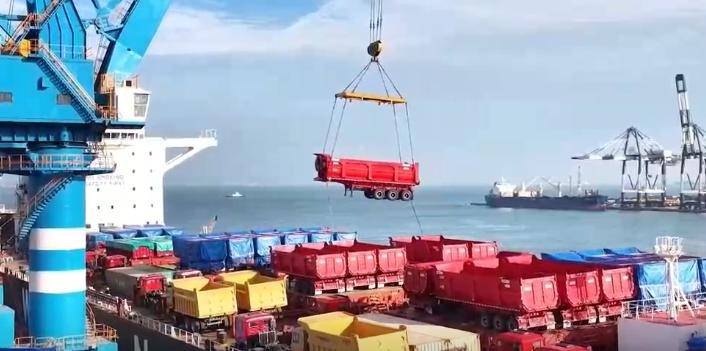

Africa’s growing trade uncertainty with Washington, following the proposed removal of South Africa and Rwanda from the African Growth and Opportunity Act (AGOA), is exposing the geopolitical weaknesses of America’s preferential trade arrangements. As China expands duty-free access to its markets for African countries, competition between the world’s two economic powers is creating new opportunities for the continent while raising important questions about economic sovereignty, industrialisation and long-term trade dependence.
Africa’s longstanding trade relationship with the United States is entering another period of uncertainty following President Donald Trump’s decision to initiate the removal of South Africa and Rwanda from AGOA, effective January 1, 2027.
Announced by the Office of the United States Trade Representative on November 2, 2026, the move has reignited debate about whether America’s flagship African trade programme has delivered meaningful economic transformation or left African economies dependent on a system largely shaped by Washington’s political and economic interests.
Established in 2000, AGOA provides eligible sub-Saharan African countries with preferential access to the American market, allowing thousands of qualifying products to enter duty-free. The programme was designed to encourage industrial development, attract foreign investment, create employment and strengthen commercial relations between Washington and African governments.
Its benefits have been particularly visible in sectors such as textiles, apparel, agriculture, automotive components and manufacturing. However, more than two decades after its introduction, questions remain about its contribution to transforming African economies.
Limited manufacturing capacity, inadequate infrastructure, high production costs and dependence on raw commodity exports have constrained the programme’s wider industrial impact.
One of AGOA’s fundamental weaknesses is its conditional nature. Beneficiary countries must satisfy eligibility requirements established by Washington, including commitments relating to human rights, political pluralism, labour protections, the rule of law and market-oriented economic policies.
While these conditions are presented as mechanisms for promoting good governance, they also mean that countries risk losing preferential market access following disagreements over domestic policies, trade practices or foreign policy positions.
Washington’s trade policy and the question of sovereignty
The proposed removal of South Africa and Rwanda illustrates how trade arrangements can become entangled in geopolitical considerations.
Washington has cited concerns involving trade barriers, corruption, human rights, governance and national security. Rwanda has also faced American criticism relating to political pluralism, labour rights and its regional foreign policy interests.
South Africa’s position is particularly significant because it is among the largest beneficiaries of AGOA. Its exports to the United States include automobiles, automotive components, citrus products and wine. According to Reuters, South Africa exported approximately $1.7 billion worth of goods under the programme in 2025.
Pretoria’s increasingly independent foreign policy, including its positions on international conflicts, has contributed to tensions with Washington.
For African policymakers, the development raises an important question: should access to international markets become vulnerable to political disagreements between trading partners?
The uncertainty also affects businesses planning long-term investments. Manufacturers require predictable market access before committing resources to factories, machinery, employment and export infrastructure. The possibility of losing preferential access can discourage investment and weaken industrial planning.
Although Congress reauthorised AGOA in February 2026, the programme’s extension currently runs only until December 31, 2026, leaving its longer-term future dependent on further negotiations.
China’s zero-tariff policy changes the equation
While Washington reviews its trade relationship with African countries, Beijing is pursuing a different approach to market access.
On May 1, 2026, China expanded its zero-tariff arrangement to cover all 53 African countries with which it maintains diplomatic relations. The initiative builds on an earlier arrangement that provided duty-free treatment to 33 African least-developed countries.
The expansion brings another 20 countries, including Kenya, Nigeria, South Africa, Egypt and Mauritius, into the arrangement. For these countries, preferential tariff treatment is initially scheduled to run for two years, until April 30, 2028. Eswatini remains excluded because it maintains diplomatic relations with Taiwan rather than Beijing.
The initiative could significantly improve opportunities for African agricultural producers, manufacturers and exporters seeking access to China’s enormous consumer market.
For Kenya, potential beneficiaries include coffee, tea, avocados, horticultural products and other agricultural exports. South African citrus and wine producers, Nigerian agricultural exporters and Ghanaian cocoa producers could also benefit.
Unlike AGOA, which links preferential access to American eligibility conditions, China’s initiative extends tariff preferences broadly to African countries maintaining diplomatic relations with Beijing.
This positions China as an alternative economic partner at a time when African governments are increasingly seeking to diversify their international trade relationships.
However, Beijing’s approach is not entirely detached from its strategic and commercial interests. China is also negotiating Economic Partnership Agreements for Shared Development with African countries to establish longer-term institutional arrangements for trade and investment.
The geopolitical competition for Africa
The contrasting trade approaches reflect the wider competition between Washington and Beijing for economic and strategic influence across Africa.
For the United States, AGOA has historically served both commercial and foreign policy objectives, strengthening diplomatic partnerships, encouraging economic reforms and supporting American influence across the continent.
China, meanwhile, has developed a substantial economic presence through infrastructure investment, construction, mining, manufacturing, telecommunications and trade.
Its zero-tariff initiative strengthens this position by presenting Beijing as a partner willing to expand market access while Western economies increasingly embrace protectionist trade policies.
However, China’s growing commercial influence also reflects its own economic interests. Chinese companies require access to African minerals, agricultural products, energy resources and expanding consumer markets.
The relationship is not without challenges. Despite expanding trade volumes, the imbalance between African exports and Chinese manufactured imports remains a major concern.
According to figures reported by the Associated Press, China-Africa trade reached approximately $348 billion in 2025. Chinese exports accounted for $225 billion, compared with imports from Africa of $123 billion.
The disparity highlights a fundamental weakness in Africa’s international trade relationships: the continent continues to export significant volumes of commodities while importing higher-value manufactured products.
Zero tariffs alone cannot resolve this structural imbalance.Can Africa turn competition into economic advantage?
The central question is not whether Africa should abandon the United States in favour of China. Rather, African governments must use the growing competition between the two economic powers to negotiate better commercial terms and secure long-term development benefits.
African countries need to move beyond exporting raw agricultural products and minerals towards processing, manufacturing and value addition.
Instead of exporting unprocessed coffee, cocoa, tea and minerals, governments should encourage domestic industries capable of producing finished goods for international markets.
The African Continental Free Trade Area (AfCFTA) also offers an opportunity to strengthen regional manufacturing, expand intra-African trade and create larger markets for locally produced goods.
Kenya and other African economies must invest in transport infrastructure, reliable electricity, agricultural technology, industrial skills and efficient customs systems to benefit meaningfully from China’s expanded market access.
Without these investments, zero tariffs could simply increase commodity exports while leaving African economies dependent on imported manufactured products.
There is also a need for transparent trade agreements that protect domestic industries, promote technology transfer, encourage local employment and ensure that foreign investment contributes to economic development.
A new chapter in Africa’s global economic diplomacy
The emerging contrast between AGOA and China’s zero-tariff policy signals a changing international economic order in which Africa is becoming an increasingly important arena of geopolitical and commercial competition.
Washington’s decision involving South Africa and Rwanda demonstrates the vulnerability of trade arrangements closely linked to political and diplomatic conditions. Beijing’s initiative, meanwhile, offers an alternative market opportunity, although its long-term benefits will depend on whether African countries can overcome structural weaknesses in production and trade.
Ultimately, Africa must avoid replacing one form of economic dependence with another.
The continent’s greatest opportunity lies in pursuing a diversified trade strategy that maintains productive relationships with the United States, China, Europe and other emerging markets.
For African governments, the lesson is clear: preferential market access is valuable, but it cannot substitute for industrial capacity, economic independence and strategic bargaining power.
The real measure of a successful trade partnership should not simply be how many African products enter foreign markets duty-free, but how much employment, technology, manufacturing capacity and domestic wealth those exports generate.
Africa must therefore move beyond competing for access to foreign markets and become a strategic economic partner capable of shaping the rules of global trade.



