In the Democratic Republic of Congo, Alain Alithum is using local relationships, patient conversations and survivor testimonies to persuade families that Ebola treatment centres can save lives.
When Francine Mave began experiencing symptoms of Ebola, seeking medical attention was not her first thought. The 39-year-old had already watched her husband die after choosing treatment from a traditional healer instead of going to an Ebola treatment centre.
For Mave, the treatment facility had become associated with death rather than recovery. Convinced that patients admitted there never returned home, she decided to hide from health workers.
But her decision was putting more than her own life at risk. Her children and other relatives could also be exposed to the virus.
Her situation reflects one of the difficult challenges facing health workers responding to the Bundibugyo virus disease outbreak in the Democratic Republic of the Congo (DRC): overcoming fear and mistrust that prevent patients from seeking timely treatment.
In Mongbwalu, Ituri Province, a community mobiliser is working to change that perception, one household at a time.
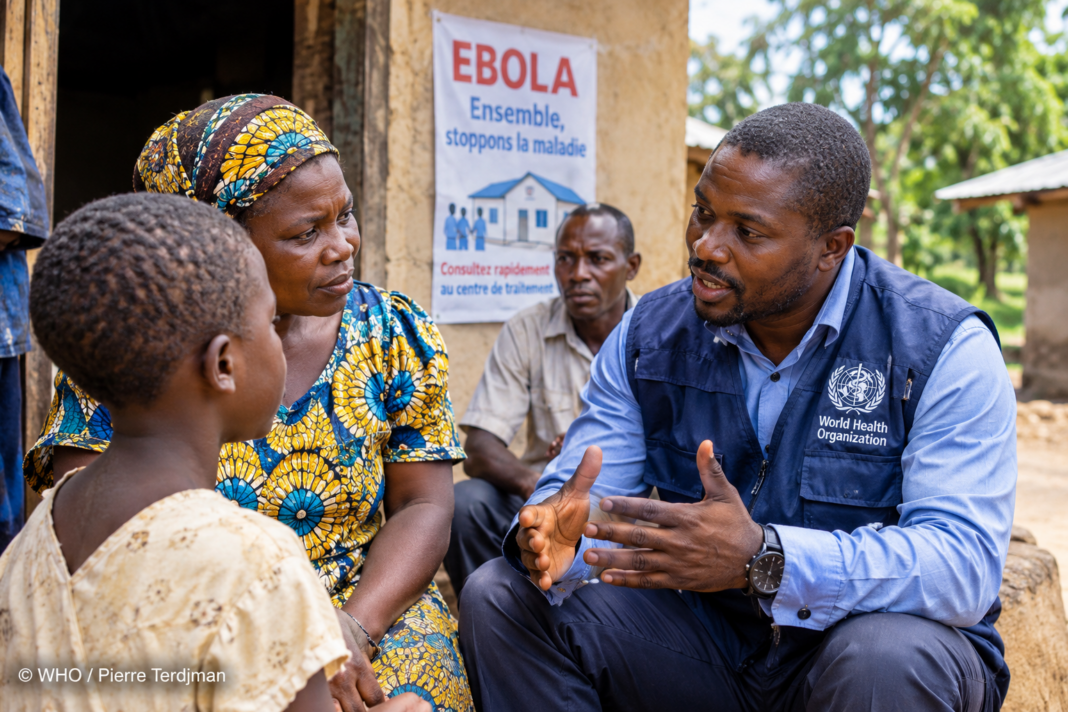
Alain Alithum, a socio-anthropologist deployed by the World Health Organization (WHO), has made it his responsibility to reach families who refuse treatment, understand their concerns and help them make informed decisions about seeking care.
His work rarely involves addressing large crowds. Instead, he visits homes, listens to families and engages community members whose influence can help resolve resistance to the outbreak response.
Between 26 August and 29 October 2026, Alithum persuaded approximately 30 people to seek care at the Ebola treatment centre. His household engagements reached nearly 600 people.
“I intervene in the most difficult and strategic situations where no solution has yet been found. I do not carry out mass sensitization. But I am in the community every day,” he explains.
For Mave, one of those visits changed the course of her illness.
Alithum eventually reached her home and spent time explaining the risks of remaining untreated, including the danger of exposing her children and other close relatives.
She eventually agreed to seek care, but only on the condition that her neighbours would not see her boarding an ambulance.
She walked to the treatment centre, where she tested positive for Ebola. After eight days of treatment, she was declared cured.
Her experience transformed her understanding of the facility she had previously feared.
Today, Mave describes herself as an ambassador for the treatment centre, sharing her experience with neighbours who may still be reluctant to seek care.
“I owe my survival to Papa Alain. My return was celebrated by all the neighbours who now believe that the centre is a place of treatment and not a place of death,” she says.
Her story illustrates how one patient’s recovery can become a powerful tool in changing community perceptions, particularly where rumours and fear have undermined confidence in the health response.
The challenge is considerable. The current Bundibugyo virus disease outbreak in the DRC has a case fatality rate of approximately 48 per cent, according to WHO.
In communities where survivors are few and misinformation spreads easily, families may associate hospital transfers with losing their loved ones.
Alithum’s approach draws heavily on his understanding of the community he serves.
Born and raised in Mongbwalu, he understands the social relationships, cultural dynamics and local leadership structures that influence how residents respond to public health interventions.
Before joining the Ebola response, he worked as a researcher on mining governance in a region where gold production shapes economic and social relationships.
That experience helped him establish connections with customary authorities, mining cooperatives and community leaders, networks that have become valuable in reaching families who distrust the response teams.
“As a son of the area, people do not accuse me of joining the Ebola response just to find work. On the contrary, they know me and trust me,” he says.
This local credibility allows him to approach difficult situations differently.
When families resist safe and dignified burials, refuse decontamination or reject treatment referrals, he identifies trusted community members who can help reopen conversations.
These include street leaders, traditional healers and Ebola survivors whose personal experiences can challenge misconceptions about treatment.
His work demonstrates that controlling an outbreak requires more than medical teams, laboratories and treatment facilities. It also requires understanding why people make certain decisions and addressing the social realities behind them.
Jules Villa, a medical anthropologist at the Institut Pasteur in Paris who was deployed to the DRC response through the Global Outbreak Alert and Response Network (GOARN), describes Alithum’s contribution as remarkable.
He says Alithum uses his knowledge of the town to make people comfortable, sometimes beginning conversations about everyday issues before addressing the outbreak.
His ability to establish relationships, Villa observes, has helped him find solutions in some of the most difficult circumstances.
But not every intervention ends in recovery.
Gashamba Mugisha Muzungu, 36, lost his wife and was left caring for his sick son. Convinced that treatment centres were places from which patients did not return, he fled with the child and rejected repeated attempts by response teams to arrange medical care.
Alithum continued visiting the family and enlisted survivors to share their experiences in an effort to change the father’s perception.
Muzungu eventually agreed to have his son taken for treatment, but the intervention came too late to save the child’s life.
Days later, Muzungu himself developed symptoms of Ebola.
Despite his earlier reluctance, he eventually accepted medical care following another intervention by Alithum and survived.
The experience left him grieving his wife and child but with a changed understanding of the treatment centre and the people who had tried to help his family.
“I lost my wife and my son, but I gained a brother,” he says of Alithum. “Ebola will pass, but our friendship will remain.”
His experience exposes the devastating consequences that delayed treatment can have on families, while illustrating the importance of building trust before fear determines a patient’s decision.
For survivors such as Muzungu and Mave, recovery has also created an opportunity to support the wider response. Their testimonies offer something that public health messages alone may struggle to achieve: firsthand evidence that people can receive treatment and return to their communities.
Alithum believes survivors have an essential role in overcoming resistance and encouraging others to seek care.
“The fight against Ebola is a collective mission. Survivors play an essential role in overcoming reluctance,” he says.
The experience in Mongbwalu highlights the contribution of social sciences to epidemic preparedness and response. Understanding household relationships, community influence, cultural beliefs and patient experiences can help health teams develop interventions that respond to people’s actual concerns.
It also demonstrates why community engagement should not be treated as an additional activity in emergency response but as an essential part of delivering healthcare.
For families confronting an unfamiliar and frightening disease, trust can influence whether they seek medical attention, cooperate with surveillance teams or allow health workers to carry out essential response activities.
In Mongbwalu, the work continues through conversations that often begin behind closed doors, where families are given an opportunity to express their fears before deciding whether to accept help.
For Mave, returning home after treatment changed the story her neighbours told about Ebola treatment centres. For Muzungu, survival came with the painful loss of his wife and son, but also a renewed willingness to trust the people working to protect his community.
And for Alithum, the measure of progress is not simply the number of households reached, but whether fear can be replaced with confidence before another family loses the opportunity to seek care.
Source: World Health Organization (WHO), Regional Office for Africa.