
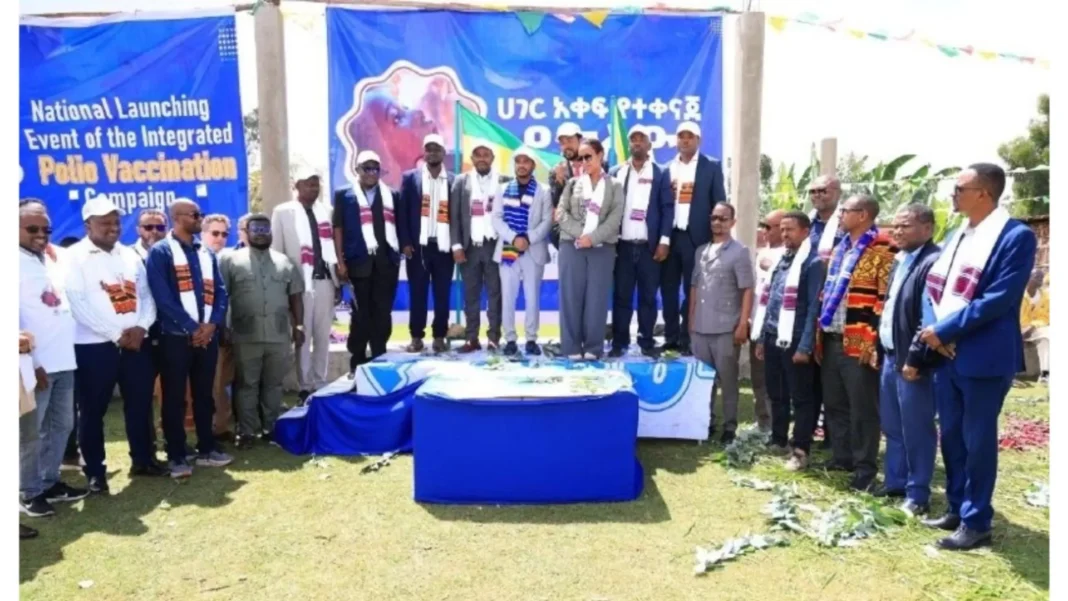

- In the race to protect children from polio, Ethiopia is taking its vaccination efforts beyond health facilities and into households, targeting more than 11.3 million children in a campaign designed to close immunity gaps and prevent further transmission.
The campaign, launched on 21 November 2026, comes as the country faces renewed threats from circulating variant poliovirus, with infections reported this year in Gambella, Oromia and South Ethiopia.
Although Ethiopia remains free of wild poliovirus, the continued detection of variant strains highlights a challenge facing polio eradication efforts: the virus can still spread where children have insufficient immunity.
The four-day first round of vaccination, running from 21 to 24 November, will cover Addis Ababa, Oromia, Central Ethiopia, South Ethiopia and Southwest Ethiopia.
A second round is scheduled for 18 to 21 December.
The Government of Ethiopia is implementing the campaign alongside the World Health Organization (WHO), UNICEF, Global Polio Eradication Initiative partners and other organisations.
But the campaign’s significance extends beyond the number of children receiving vaccines. Health teams will also identify children who have never received routine immunisation and those who have missed some of their scheduled doses, linking them to health services.
This approach seeks to address the gaps that allow poliovirus to circulate even in countries that have made substantial progress towards eliminating the disease.
“Every child vaccinated during this vaccination campaign brings Ethiopia to contributing one step closer to a polio-free future,” said Dr Loveday Nkwogu, who delivered a joint partners’ statement on behalf of WHO Representative to Ethiopia, Prof. Francis Kasolo, at the campaign launch in Arba Minch, South Ethiopia Region.
Nkwogu called on parents, community leaders, health workers and partners to work together to ensure that every eligible child is reached.
The campaign will rely on house-to-house visits, with teams of health workers and community volunteers administering polio vaccines to eligible children.
The strategy is intended to reach children who might otherwise be missed by facility-based immunisation services, particularly in communities where access to healthcare is limited or routine vaccination coverage is incomplete.
Alongside vaccination, teams will identify zero-dose children, who have not received any routine vaccine, and under-vaccinated children who have missed scheduled doses.
These children will be linked to routine immunisation services, creating an opportunity to address broader vaccination gaps beyond the immediate polio campaign.
The effort is particularly important in areas affected by population movement, where children may move between communities and remain outside the reach of regular health services.
WHO says the campaign builds on previous outbreak-response efforts in Gambella, Benishangul-Gumuz and parts of Oromia, which reached more than one million children.
Those campaigns demonstrated the value of coordinated action between government authorities, communities, health workers and partners in responding to poliovirus threats.
However, the detection of variant poliovirus in three regions this year shows that continued vigilance remains necessary.
## The surveillance challenge
Vaccination is only one part of the response.
WHO is also calling for stronger surveillance to detect poliovirus transmission quickly and support timely responses to new infections.
Acute Flaccid Paralysis (AFP) surveillance, which monitors cases of sudden weakness or paralysis in children, remains an important tool in identifying possible poliovirus infections.
Environmental surveillance, which tests environmental samples for evidence of the virus, provides another means of detecting circulation, including where cases have not yet been identified.
Together, these systems help health authorities understand where the virus may be spreading and where vaccination efforts need to be strengthened.
The campaign is supported by 28 WHO central and field staff, who are assisting with coordination, advocacy, planning, training, supervision, data management and community engagement.
WHO has also supported the training of health workers and supervisors in the use of Open Data Kit, a digital data-collection platform, as well as independent monitors and surveyors responsible for assessing campaign quality.
The monitoring process includes lot quality assurance sampling, a method used to assess whether vaccination activities have reached the required standards.
These measures are intended to ensure that the campaign does not simply count doses administered, but also assesses whether children are being reached effectively.
A campaign with a wider purpose
The latest vaccination drive reflects the continuing challenge of protecting children in a country where substantial progress against wild poliovirus has not eliminated the threat posed by variant strains.
For Ethiopia, the immediate priority is to interrupt transmission in affected areas and prevent the virus from spreading to communities where children may have inadequate immunity.
The identification of zero-dose and under-vaccinated children also presents an opportunity to strengthen routine immunisation, which remains essential to sustaining protection beyond the campaign period.
The two vaccination rounds will therefore serve both an immediate and a longer-term purpose: responding to the current outbreak threat while addressing gaps that could allow future transmission.
WHO continues to provide technical and operational support to Ethiopia’s government, including assistance with planning, coordination, monitoring, supervision and surveillance.
The organisation says the effort forms part of the wider global campaign to eradicate polio.
For the children targeted by the vaccination teams, the outcome will depend on whether the campaign reaches every eligible household and whether children who have missed previous vaccinations are connected to routine health services.
Ethiopia’s latest campaign is built around a clear objective: no child should be missed and no community should be left behind.
But with variant poliovirus continuing to circulate, the challenge will be to ensure that the protection provided during the campaign is sustained long after the vaccination teams have completed their household visits.



