
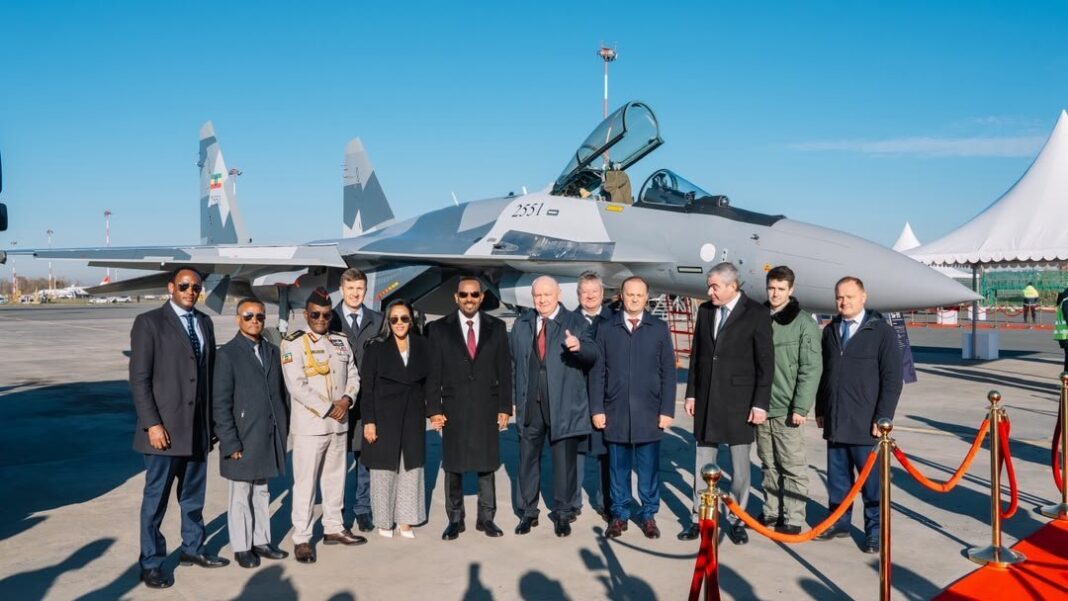

Addis Ababa’s reported plan to acquire 12 Su-35 fighter jets and four S-400 air defence batteries highlights its push to modernise its military and strengthen cooperation with Moscow.
Ethiopia is seeking to deepen military cooperation with Russia as Prime Minister Abiy Ahmed prioritises national defence capabilities amid evolving security challenges in the Horn of Africa.
A reported arms agreement announced on the sidelines of the third Russia–Africa Summit in Moscow involves bringing forward the delivery of 12 Russian-made Su-35 fighter jets by one year and securing four batteries of the S-400 air defence system.
If confirmed and implemented as reported, the deal would mark a significant step in Ethiopia’s efforts to strengthen its air force and improve its ability to defend national airspace.
The agreement also underscores the strategic importance of Russia to Ethiopia’s military modernisation programme, with the two countries seeking to expand cooperation beyond traditional diplomatic and economic engagement.
Speaking at the 12th Tana High-Level Forum on Security in Africa on October 24, Abiy stressed the importance of protecting civilians, upholding the constitutional order and pursuing dialogue as essential elements of lasting peace.
“For Ethiopia, lasting peace is personal. It requires protecting civilians, upholding the constitutional order, and keeping the door open to dialogue,” he said, according to the Ethiopian News Agency.
The prime minister’s remarks reflect the government’s stated position that national security requires both effective defence institutions and political efforts to sustain peace.
Advanced weapons to strengthen air defence
The Su-35 is a Russian multirole combat aircraft designed for air superiority and ground-attack missions. Its advanced radar, manoeuvrability and capacity to carry different weapons could enhance Ethiopia’s ability to conduct air operations and monitor potential threats.
The S-400 is a long-range surface-to-air missile system designed to intercept aircraft and certain missile threats. Its deployment would potentially strengthen Ethiopia’s ground-based air defence capabilities and protection of strategically important infrastructure.
However, the reported agreement’s financial value, contractual details and delivery schedule have not been independently verified. The extent to which the systems would improve Ethiopia’s operational readiness would also depend on training, maintenance, spare parts and integration with existing military infrastructure.
The procurement comes as Ethiopia continues to develop its defence capabilities amid wider security concerns involving cross-border instability, armed groups and tensions among countries in the Horn of Africa.
Moscow and Addis Ababa expand military partnership
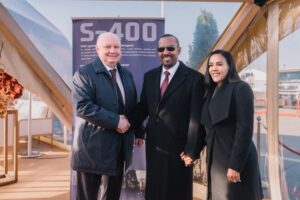
Defence cooperation has remained an important component of Ethiopia–Russia relations, which date back more than a century.
In March 2026, Russian Deputy Defence Minister Vasily Osmakov met Ethiopian Air Force Chief Lieutenant General Yilma Merdassa in Moscow to discuss bilateral defence cooperation, according to Addis Standard.
The discussions followed earlier engagements between military officials from the two countries aimed at strengthening professional exchanges and implementing existing defence agreements.
In 2021, Ethiopia and Russia signed a military cooperation agreement providing a framework for further collaboration, including technical assistance to the Ethiopian armed forces.
The partnership has gained additional diplomatic momentum through high-level meetings. On September 12, 2026, Abiy and Russian President Vladimir Putin met on the sidelines of the BRICS summit in New Delhi, discussing defence and security alongside trade, investment, education and technology.
The Ethiopian prime minister described the relationship as productive and expressed appreciation for cooperation across several sectors.
For Moscow, closer ties with Ethiopia offer an opportunity to sustain its defence relationships in Africa and expand its broader engagement with countries seeking military equipment and technical cooperation.
Regional security and economic considerations
Ethiopia’s strategic position makes its defence policy consequential for the wider Horn of Africa. The country borders Eritrea, Djibouti, Somalia, Kenya, South Sudan and Sudan, placing it at the centre of regional security and trade dynamics.
As a landlocked country, Ethiopia also relies heavily on neighbouring states for maritime access, making the stability of regional transport corridors important to its economic and strategic interests.
Nevertheless, expanding military capabilities presents financial and operational challenges. Advanced aircraft and air defence systems require sustained investment in maintenance, training, ammunition and specialist personnel.
The government must therefore balance defence modernisation with development priorities, including infrastructure, education, healthcare and employment.
As the Russia–Africa Summit brings African leaders and Russian officials together in Moscow on October 28–29, Ethiopia’s reported arms agreement highlights the growing role of military cooperation in its international partnerships.
Whether the deal delivers lasting security benefits will depend on implementation, operational readiness and continued diplomatic engagement with neighbouring countries. For Addis Ababa and Moscow, the challenge will be to translate closer defence ties into tangible security outcomes while supporting stability across the Horn of Africa.



