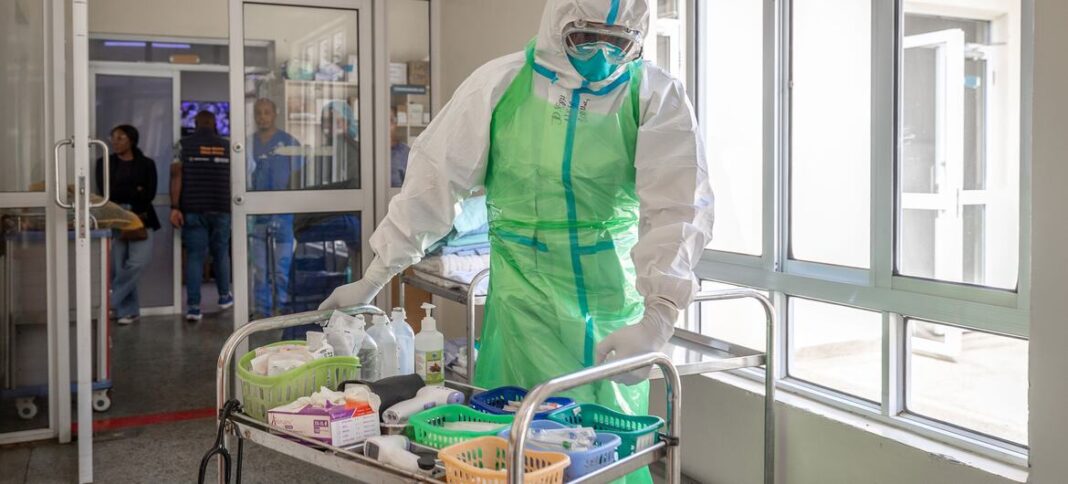

When rumours spread that health workers were contaminating toilets and shower facilities with substances linked to Ebola, some residents of Niania in the Democratic Republic of the Congo (DRC) began questioning the intentions of the teams sent to protect them.
Others feared that patients taken to Ebola treatment centres would never return home alive.
The misinformation threatened to undermine efforts to contain the outbreak caused by the Bundibugyo virus, discouraging people from seeking medical attention and making it harder for health workers to implement public health measures.
But in Niania, health authorities are turning to a different tool to counter the rumours: community dialogue.
The approach is bringing religious leaders, traditional authorities, women, young people and other community representatives into conversations with response teams, allowing residents to raise concerns, question health workers and participate in decisions affecting their communities.
For Reverend Bienvenu Ndombe, a representative of revival churches in the Bandaka chiefdom, the experience has changed his understanding of the outbreak response.
Initially, he struggled to distinguish rumours from facts as allegations about the treatment of patients circulated among residents.
His perspective shifted after participating in a dialogue with response teams and visiting the Niania Ebola treatment centre alongside other religious leaders.
There, they spoke with patients, observed their care and saw that some were recovering and returning home.
“We spoke with patients. We saw that they were receiving proper care, recovering and returning home,” Ndombe said.
He has since encouraged members of his congregation to seek medical attention promptly if they develop symptoms.
His changing position illustrates a central challenge in controlling infectious disease outbreaks: providing medical services is not enough if the people who need them do not trust the systems delivering them.
When fear delays care
Misinformation during an outbreak can influence whether people seek treatment, accept referrals or cooperate with interventions intended to prevent transmission.
In communities where residents fear health facilities or suspect the motives of response teams, symptoms may go unreported and suspected cases may not receive timely assessment.
For Sébastien Mugiamaro, a school administrator in the Babonde area, the consequences of the outbreak are deeply personal.
He lost both his mother and father to Ebola. When he later developed severe headaches, he immediately sought medical attention because he feared he might also have contracted the disease.
Tests ruled out Ebola, allowing him to receive appropriate treatment.
“I knew that early treatment could give me a chance of recovery,” Mugiamaro said.
He now shares that message with other residents, encouraging them to seek care rather than rely on rumours.
His experience highlights the importance of early assessment during an outbreak, when symptoms associated with Ebola may also be caused by other illnesses requiring medical attention.
Dr Joseph Pemanakue Babundiak, chief medical officer of Niania Health Zone, said listening to community concerns was essential to rebuilding confidence in the response.
“When rumours emerge, our priority is to listen to community concerns and provide concrete responses,” he said.
He added that dialogue could gradually rebuild trust, encourage early care-seeking and strengthen community participation.
Beyond public health announcements
The response, led by the Ministry of Public Health, Hygiene and Social Welfare with support from the World Health Organization (WHO) and partners, has expanded risk communication and community engagement activities.
Rather than relying exclusively on public announcements, teams are engaging groups whose influence and experiences shape how information circulates within communities.
Discussions have involved traditional and religious leaders, young people, women’s associations, motorcycle taxi drivers and traditional healers.
These forums give residents an opportunity to explain their fears and seek clarification directly from health workers.
The discussions are also accompanied by practical demonstrations on safe and dignified burials and the preparation of chlorinated solutions for infection prevention and control.
Such activities address concerns while demonstrating how protective measures are carried out.
Paulin Koingo, a community mobilizer, said feedback from residents had helped shape the response strategies.
The approach recognises that rumours do not always emerge from deliberate attempts to mislead. They may also reflect fear, uncertainty, previous experiences with healthcare services or a lack of clear information.
For communities affected by an outbreak, addressing these underlying concerns can be as important as communicating the official health guidance.
Turning conversations into participation
Evidence of growing community involvement has emerged from several local initiatives.
On August 11, 2026, a dialogue in Likpangola brought together approximately 55 participants, 52 of whom expressed a willingness to contribute to the response.
On September 10, an awareness campaign reached nearly 2,500 people in the Juhudi and Bafwabango health areas.
Two days later, 110 community volunteers, including 45 women, participated in an orientation session.
Radio spots in French, Swahili and Lingala, alongside radio programmes broadcast on five community stations, have extended the reach of the awareness efforts.
According to WHO, these initiatives have helped facilitate activities that had previously faced resistance, including safe burials, decontamination and the referral of suspected cases to health facilities.
The figures suggest that community engagement can move beyond raising awareness to encourage residents to take an active role in outbreak control.
However, participation does not mean all concerns have disappeared. WHO reports that some doubts persist, underscoring the need for continued dialogue.
Why rumours require more than facts
For Dr Bavon Tangunza Ngunga, who oversees infodemic management and risk communication and community engagement at the WHO office in the DRC, countering misinformation requires understanding why it spreads.
“A rumour cannot be resolved by a message alone,” he said.
He explained that rumours may reflect fear, negative experiences with healthcare or practical concerns, such as difficulties accessing a treatment centre quickly.
This means that correcting inaccurate information without addressing the conditions that sustain it may not be enough to change behaviour.
WHO is supporting health authorities to analyse community concerns, conduct targeted listening sessions with leaders from different groups and adapt interventions in response to the feedback.
The strategy places communication within a broader public health effort: communities must not only receive information but also have opportunities to question, understand and influence how the response operates.
Where access to care is difficult, reassurance alone cannot resolve the problem. Where people fear mistreatment, health workers may need to demonstrate how patients are cared for. Where burial practices are contested, explanations and respectful engagement can help communities understand the reasons behind safety measures.
Trust as part of outbreak preparedness
For Ndombe, the shift has been significant. Having witnessed the care provided at the treatment centre, he now encourages residents to trust the response teams and participate in efforts to contain the disease.
“Today, we have confidence. We tell the population to trust the response teams because the disease is real,” he said.
His role as a religious leader also gives him an opportunity to reach people who may be hesitant to listen to official health messages.
The experience in Niania demonstrates how trusted community figures can help bridge the gap between public health authorities and residents, particularly when fear and uncertainty threaten cooperation.
It also highlights a wider lesson for outbreak management: trust cannot simply be demanded from communities. It must be built through listening, transparency, practical support and visible evidence that health interventions serve people’s needs.
As the Ebola response continues in the DRC, community dialogue is helping turn suspicion into participation. Its lasting value will depend on whether authorities sustain these conversations, respond to concerns and ensure that residents remain partners in protecting their own health.
In Niania, the shift begins when people who once questioned the response become willing to engage with it and encourage others to do the same.