
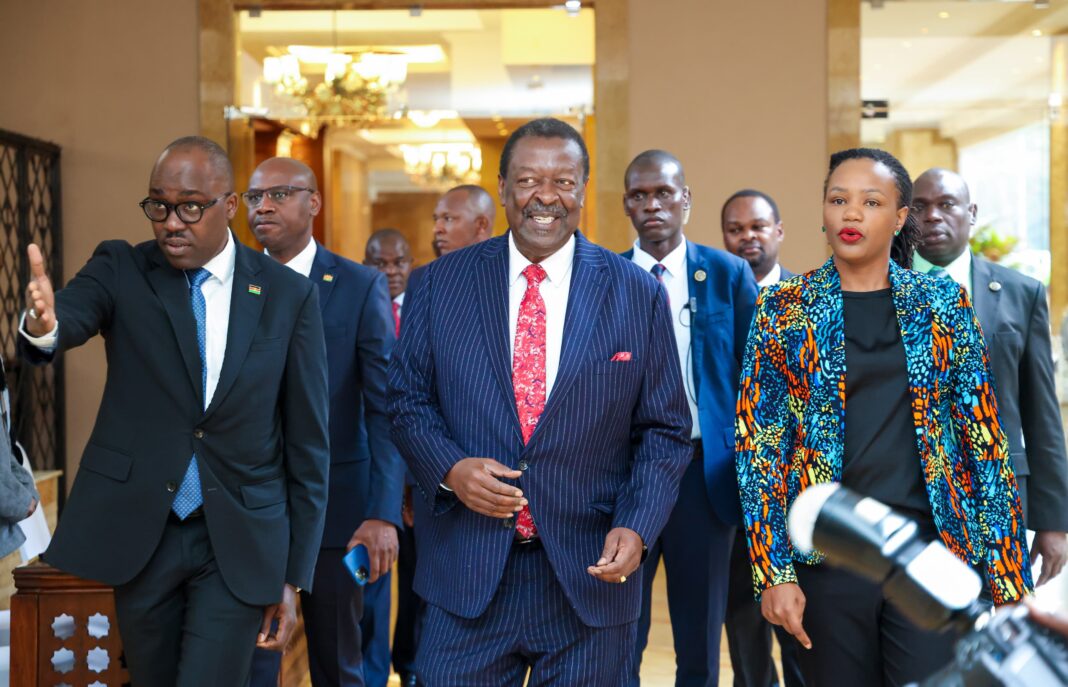

Kenya is pursuing a more assertive diplomatic agenda aimed at turning foreign relations into a strategic tool for economic growth, regional integration, peacebuilding and greater influence in global affairs.
Speaking during a diplomatic briefing to ambassadors, high commissioners and representatives of international organisations in Nairobi, Prime Cabinet Secretary and Foreign and Diaspora Affairs Cabinet Secretary Musalia Mudavadi outlined a foreign policy increasingly linked to Kenya’s domestic development ambitions and Africa’s changing geopolitical position.
While the briefing covered six thematic areas, four major priorities emerged: economic diplomacy and investment, regional integration, peace and security, and stronger multilateral engagement.
The message to Kenya’s diplomatic partners was clear; Nairobi intends to remain open to global partnerships while championing a stronger African voice in international affairs.
Economic diplomacy takes centre stage
At the heart of Kenya’s diplomatic strategy is the effort to attract investment, expand trade and position the country as a gateway to African markets.
Mudavadi said Kenya’s economy continued to demonstrate resilience, recording 5.3 per cent real GDP growth during the first quarter of 2026, compared with 4.9 per cent during the same period last year.
He also cited the stability of the Kenyan shilling, foreign exchange reserves of $14.9 billion and the Nairobi Securities Exchange surpassing Sh4 trillion in market capitalisation as indicators of the country’s economic strength.
“Kenya’s diplomacy must deliver tangible economic value for our people by attracting investment, expanding trade, supporting innovation and creating opportunities that strengthen our productive capacity and competitiveness,” Mudavadi said.
The government is seeking to convert these economic indicators into deeper commercial partnerships, with the Kenya Development Corporation and Nairobi International Financial Centre positioned as key institutions for connecting international investors with opportunities in the country.
Kenya’s economic diplomacy is also shifting beyond attracting capital towards partnerships that support technology transfer, local manufacturing, value addition and digital transformation.
The establishment of the National Infrastructure Fund and the Sovereign Wealth Fund further signals Nairobi’s intention to attract long-term investment and public-private partnerships.
Regional integration and Africa’s expanding market
https://x.com/i/broadcasts/1oJMvNqLQnWxQ
The second pillar is Kenya’s commitment to regional and continental integration.
Kenya reaffirmed its support for the African Union, East African Community, IGAD, ICGLR and the African Continental Free Trade Area, arguing that integration remains central to the country’s diplomatic strategy.
The country recently played host to host the fourth COMESA-EAC-SADC Tripartite Summit in Nairobi, bringing together regional blocs representing 29 countries, more than 700 million people and a combined GDP exceeding $1.4 trillion.
“Africa’s future prosperity depends on our ability to remove barriers, connect our markets and build an integrated continent where African goods, services and ideas can move freely and create shared prosperity,” Mudavadi said.
For Kenya, the summit presents an opportunity to strengthen Nairobi’s position as a regional diplomatic and commercial centre.
The government is also attempting to balance regional integration with protection of national economic interests. Nairobi has clarified that foreign participation in small-scale businesses is not subject to a blanket ban but must comply with immigration, work permit, registration and licensing requirements.
Peace and security as an economic priority
The third pillar is peace and security, with Kenya continuing to position itself as one of Africa’s leading centres for mediation and peacebuilding.
Mudavadi said Kenya supports African-led solutions to African challenges while calling for stronger international financing for peace operations on the continent.
Kenya has called for progressive capitalisation of the African Union Peace Fund and proposed that 2030 be declared the Year of Peace, Security and Stability in Africa.
The country’s diplomatic focus remains particularly strong on Somalia, Sudan, counterterrorism and maritime security.
“Peace is not separate from development. Without security and stability, trade cannot flourish, investment cannot grow and communities cannot realise their full potential. Peacebuilding is therefore both a moral and economic responsibility,” Mudavadi said.
Kenya is advocating for adequate financing for the African Union Support and Stabilisation Mission in Somalia and greater implementation of UN mechanisms supporting.
African-led peace operations
On Sudan, Nairobi maintains that the conflict cannot be resolved militarily and requires coordinated mediation and a humanitarian truce.
Strengthening Kenya’s global voice
The fourth pillar is Kenya’s ambition to expand its influence within the global multilateral system.
Kenya is preparing to participate in the 81st session of the UN General Assembly while hosting the inaugural Global Trust Summit in Nairobi in October.
The summit is expected to reinforce Nairobi’s position as a centre for international diplomacy, particularly as the only UN headquarters in the Global South.
Kenya is also seeking support for its candidates to the International Court of Justice and the International Criminal Court.
“Kenya will continue to champion a stronger, fairer and more representative multilateral system in which Africa’s voice is heard and our continent has a meaningful role in shaping decisions that affect the future of humanity,” Mudavadi said.
As Kenya moves towards the 2027 General Election, the government’s diplomatic outreach is also intended to reassure international partners of institutional stability and preparations for a peaceful electoral process.
Ultimately, Mudavadi’s agenda presents diplomacy as more than the management of international relations. Kenya is positioning foreign policy as an instrument for economic transformation, African integration, regional peace and global influence.
In an era of geopolitical rivalry and economic fragmentation, Nairobi’s message is that Kenya intends to remain a bridge between Africa and the wider world while ensuring its diplomacy delivers measurable benefits at home.



