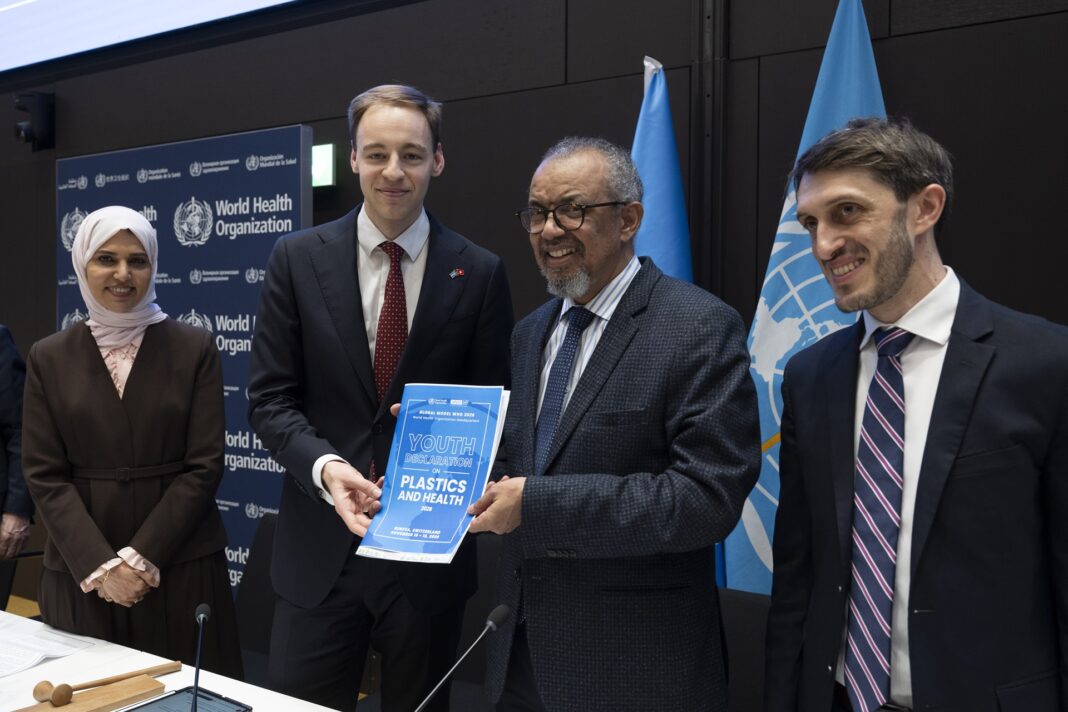

More than 400 young people from over 50 countries are urging governments to make human health a central part of the proposed global plastics treaty, warning that plastic pollution poses risks extending far beyond environmental degradation.
The call follows the adoption of the Global Model WHO Youth Declaration on Plastics and Health during the fourth Global Model World Health Organization (WHO), held at the organisation’s headquarters in Geneva from 10 to 13 November 2026.
The four-day gathering brought together young delegates representing all six WHO regions to negotiate solutions to pressing global health challenges, including artificial intelligence, urban health, oral health, health information and trust, international recruitment of health personnel, and the commercial determinants of health.
The declaration places particular emphasis on the health consequences of plastic production, chemical exposure and inadequate waste management, calling on governments to incorporate enforceable health protections into the forthcoming international agreement on plastic pollution.
Alexander Dietz, Director-General of Global Model WHO 2026, said younger generations had largely grown up with plastic pollution being discussed as an environmental problem, yet its implications for human health deserved equal attention.
He argued that young people would live with the long-term consequences of plastic production and consumption, making their participation in shaping international policy particularly important.
The declaration is directed at two major international policy meetings scheduled for 2027: the resumption of negotiations on the global plastics treaty in March and the 80th World Health Assembly in May.
The young delegates raised concern that the Chair’s informal treaty text released in August 2026 does not contain a dedicated article addressing health, potentially leaving important public health considerations inadequately represented in the agreement.
Their declaration outlines 11 priority actions aimed at strengthening the treaty’s health protections.
Among the proposals is the introduction of legally binding health obligations across the agreement, alongside greater participation of health ministries in national negotiating delegations.
The delegates are also calling for safeguards against conflicts of interest involving the plastics and petrochemical industries to ensure that public health considerations are not undermined by commercial interests.
On production and chemical safety, they want governments to establish measurable targets for reducing plastic production, phase out chemicals of concern and develop standardised approaches for detecting and measuring plastic-related chemicals and particles in the human body.
Waste management is another major priority, with the declaration describing safe disposal and management systems as an investment in public health rather than simply an environmental responsibility.
It further advocates for the protection of waste pickers, whose work often places them at the intersection of plastic pollution, occupational exposure and inadequate safety protections.
The declaration also addresses the use of chemicals of concern in medical devices, proposing exemptions that are time-limited and subject to regular review, beginning with products used by infants and pregnant people.
Growing concerns over human exposure
The delegates’ demands are supported by concerns about the scale of chemical exposure associated with plastics.
According to the declaration, more than 16,000 chemicals are used in or found in plastics, with at least one-quarter classified as hazardous.
Plastic particles have also been detected in human blood, brain tissue and amniotic fluid, raising questions about the potential consequences of exposure throughout different stages of human life.
The declaration cautions against allowing scientific uncertainty to become a reason for delaying preventive action.
WHO Director-General Dr Tedros Adhanom Ghebreyesus encouraged the young delegates to continue challenging existing positions and pursuing ambitious international agreements, even when negotiations appear difficult.
The Global Model WHO, a partnership between WHO and the World Federation of United Nations Associations, provides a platform for young people to simulate the World Health Assembly, the organisation’s principal health decision-making body.
Through committee negotiations and the drafting of declarations and resolutions, participants engage with the processes through which international health policies are debated and developed.
Beyond the conference, WHO is inviting young people and members of the public across generations to endorse the declaration through an interactive global map.
Participants can register their support, identify their location and make a personal commitment to reducing the health harms associated with plastics. The pledges will contribute to a wider display of public support ahead of the 2027 treaty negotiations and World Health Assembly.
The declaration concludes with a call for future generations to receive stronger protections against plastic-related health risks, arguing that children born today should not inherit the same exposure challenges faced by those growing up in the current generation.