
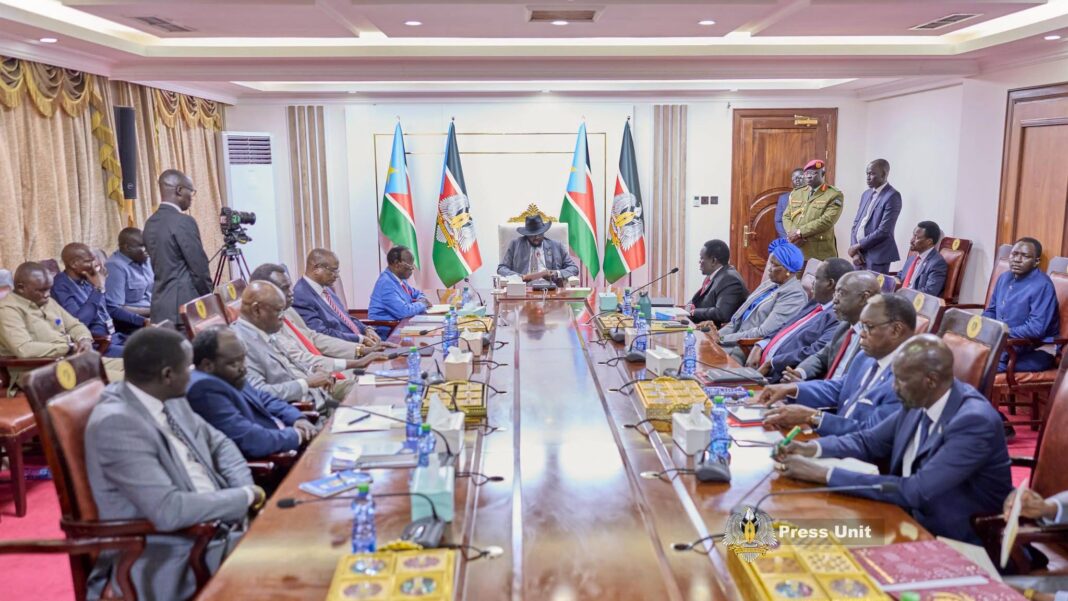

South Sudan has entered a critical three-month electoral phase after President Salva Kiir Mayardit dissolved the transitional government and appointed a caretaker administration to steer the country toward general elections scheduled for December 22, 2026.
The move ends the power-sharing government established under the 2018 peace agreement and comes a day after Kiir signed amendments to the National Elections Act that removed key legal obstacles to holding the long-delayed polls.
The new arrangement leaves Kiir as president during the electoral period, while the five vice-presidents, national ministers, parliamentarians and state-level political leadership have been relieved of their positions. The Transitional National Legislative Assembly and Council of States have also been dissolved.
The government says the caretaker structure is intended to prevent an administrative vacuum as South Sudan moves from its prolonged transitional period toward elections.
Government spokesperson Ateny Wek Ateny previously described the dissolution as necessary to maintain continuity of government as the mandate of the transitional administration expired three months before the scheduled vote.
Caretaker ministers take charge,Kiir has appointed 13 caretaker ministers to maintain the functioning of key government institutions during the electoral period.
They include:
- Africano Mande Gedime — Presidential Affairs
- Martin Elia Lomuro — Cabinet Affairs
- Cecilia Adut Manyok — Foreign Affairs and International Cooperation
- Ayor Akuoch Anok — Defence and Veteran Affairs
- Rizik Zachariah Hassan — Interior
- Dr Wek Mamer Kuol — Justice and Constitutional Affairs
- Obote Mamur Mete — National Security
- Athian Diing Athian — Finance and Planning
- Awow Daniel Chuang — Petroleum
- Dr Labanya Margret — Trade and Industry
- Ateny Wek Ateny — Information, Communication, Technology and Postal Services
- Michael Makuei Lueth — East African Community Affairs
- Stephen Par Kuol — Peace Building
The caretaker administration is expected to keep essential state functions running while the country prepares for the December vote. Under the presidential order, caretaker officials face restrictions on major long-term commitments, including substantial borrowing, strategic concessions and disposal of public assets without presidential authorisation. They are also required to remain politically neutral during the electoral period.
Election preparations accelerate
The dissolution comes as South Sudan’s electoral machinery moves into a more intensive phase.
The National Elections Commission has already begun training state-level election committees and officials from the three administrative areas on voter registration. The training covers all 10 states and is designed to prepare election officials for the pre-electoral process.
The commission had also declared 102 geographical constituencies, based on the constituencies used in the 2010 elections, after political parties agreed to separate the elections from the outstanding census and permanent constitution-making processes.
On September 21, Kiir signed amendments to the National Elections Act that formally delinked the elections from completion of a permanent constitution and a national population census. The amended law gives the National Elections Commission responsibility for organising elections at different levels of government and provides for a 270-member National Legislative Assembly.
These changes have significantly altered the timetable and legal framework for the December elections. South Sudan gained independence in 2011 but has yet to conduct a nationwide general election since independence, with elections repeatedly postponed during the country’s political and peace transitions.
Three months to deliver a national election .With December 22 now the scheduled polling date, the caretaker administration faces a compressed preparation period.
Key tasks include voter registration, finalising electoral logistics, preparing polling infrastructure, voter education, deployment of election personnel and ensuring that the political and security environment allows parties and candidates to campaign.
The electoral process has also faced institutional changes. Earlier this month, Kiir dismissed National Elections Commission chairperson Abednego Akok Kacuol and appointed Gabriel Bol Deng Majok to replace him, just months before the scheduled vote. The change prompted questions from some analysts about its timing and potential implications for electoral preparations.
At the same time, the dissolution of parliament and state governments means that the country is entering the final stretch of preparations without the political structures created under the 2018 peace agreement.
The caretaker government is therefore expected to serve as a bridge between the transitional political order and the institutions that will emerge from the December elections.
The government maintains that the restructuring is a constitutional and administrative step required to facilitate the vote. Critics, however, have raised concerns about the concentration of executive authority during the electoral period, particularly after the vice-presidential and legislative structures established under the peace agreement were dissolved.
For South Sudan, the immediate test is whether the new caretaker administration and electoral institutions can convert the legal and political changes of the past few days into practical preparations for polling across the country by December 22, 2026.



