
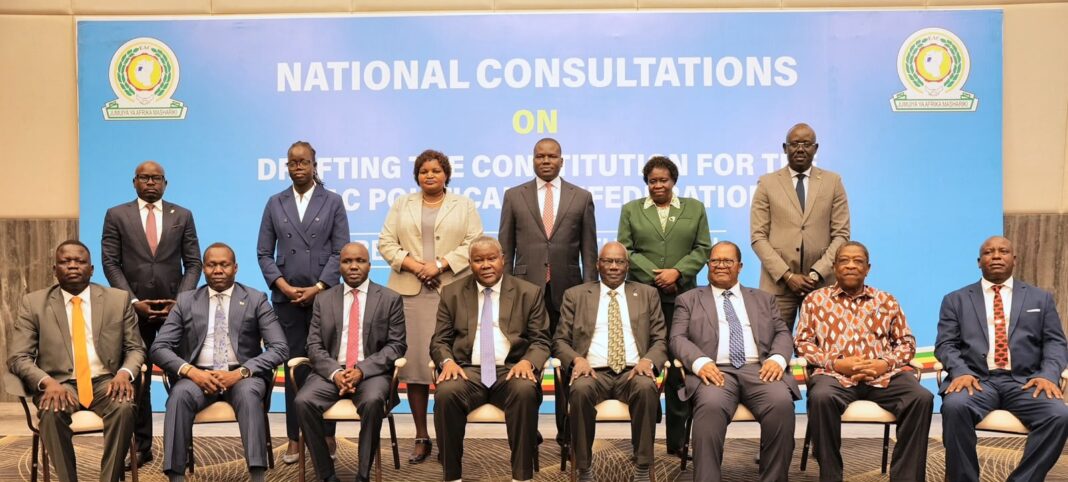

With South Sudan preparing for its first national elections since independence, the country has begun consultations on a proposed East African Community (EAC) Political Confederation, placing the region’s long-term political integration agenda against the backdrop of a critical national transition.
The EAC constitutional consultations, launched in Juba on September 24, will run until October 7, bringing together government institutions, political parties, Parliament, the Judiciary, civil society, academia, the private sector, youth, women, faith-based groups and the media.
The timing is significant for South Sudan, which is scheduled to hold general elections on December 22, 2026, following years of delays under the transitional arrangements established after the 2018 peace agreement. The elections are expected to mark the end of the transitional period and the beginning of a new political phase.
The National Elections Commission has been preparing for the polls, including training state election committees on voter registration. The commission has said registration preparations are under way, while urging political actors to support a peaceful and inclusive electoral process.
The electoral process has gained momentum following amendments to South Sudan’s elections law that removed the requirement for a permanent constitution and national census to be completed before elections could take place. President Salva Kiir signed the amended law on September 21, clearing a major legal obstacle to the December vote.
A day later, Kiir dissolved the Transitional Government of National Unity, while political parties and other stakeholders began an inter-party dialogue on election-related matters in Juba on September 24. The dialogue is intended to build consensus around the electoral process and the country’s transition out of the current political arrangement.
Against this backdrop, South Sudan’s participation in the EAC constitutional process carries both national and regional significance.
South Sudan’s Minister of East African Community Affairs, Michael Makuei Lueth, said the government was committed to ensuring that South Sudanese citizens contribute to the proposed Constitution of the EAC Political Confederation.
“As South Sudan, we are committed to participating actively in this consultation process and ensuring that the voices, aspirations and interests of our people contribute to shaping a Constitution that will guide the establishment of the EAC Political Confederation,” Makuei said.
The proposed political confederation is designed as a transitional framework towards the EAC’s longer-term objective of a Political Federation. It seeks to deepen political cooperation, coordination and governance among member states.
The EAC Secretary General, Stephen P. Mbundi, welcomed South Sudan’s participation while highlighting the importance of its political transition and democratisation process.
“The East African Community stands in solidarity with the people of the Republic of South Sudan and wishes them a successful and peaceful election,” Mbundi said.
His remarks link South Sudan’s domestic political transition with the wider regional integration project, at a time when the country is seeking to consolidate peace and establish an elected government.
The consultations will be conducted by constitutional experts coordinated by South Sudan’s Ministry of East African Community Affairs. Public hearings will take place in Juba, including consultations covering the Federal and Central Equatoria governments, as well as in Rumbek, Wau and Bor.
Chief Justice Emeritus of Uganda Benjamin Odoki, who chairs the Constitutional Experts Team, urged South Sudanese stakeholders to participate actively, saying the proposed Constitution should reflect the aspirations and interests of East Africans.
South Sudan is the fifth EAC Partner State to undertake national consultations on the proposed Constitution, following Uganda, Kenya, Burundi and Rwanda. The regional process dates back to 2004, when EAC leaders established the Wako Committee to examine ways of accelerating political integration.
In 2017, EAC Heads of State adopted the Political Confederation as a transitional model towards a Political Federation and directed the development of a constitutional framework. The constitution-making process was formally launched in Entebbe, Uganda, in 2018.
For South Sudan, however, the immediate political test remains the December election. The African Union has called for credible elections by December 2026 without another extension of the transitional period, while regional peace monitors continue to urge political parties to uphold the 2018 peace agreement.
The parallel processes of preparing for national elections while participating in the EAC’s constitutional project place South Sudan at a consequential point in both its domestic political transition and its integration into East Africa’s emerging political architecture.



