

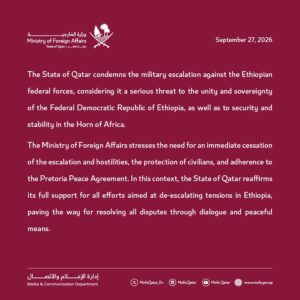
Qatar has called for an immediate halt to renewed fighting in northern Ethiopia, warning that the military escalation against federal forces threatens Ethiopia’s unity and sovereignty and risks further destabilising the wider Horn of Africa.
In a statement issued Sunday, Qatar’s Ministry of Foreign Affairs condemned what it described as the “military escalation against the Ethiopian federal forces” and urged all parties to end hostilities, protect civilians and comply with the November 2022 Pretoria Peace Agreement. )
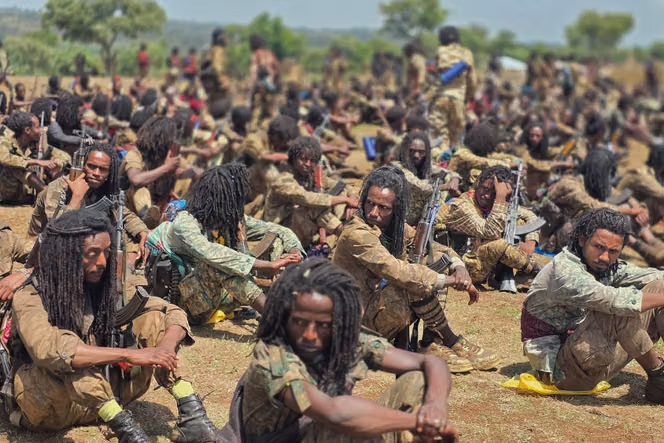
The Qatari intervention comes as fighting between Ethiopia’s federal forces and Tigrayan forces has intensified, raising fears that the country could slide back into a broader civil war less than four years after the Pretoria agreement ended the devastating 2020–2022 Tigray conflict.
Qatar said it supports efforts aimed at de-escalating tensions and resolving Ethiopia’s political and security disputes through dialogue and peaceful means. The statement also linked the deteriorating situation in Ethiopia to wider concerns over security and stability in the Horn of Africa.
Renewed fighting
The latest escalation has centred on Tigray but has spread into neighbouring Amhara and Afar regions. Ethiopia’s army chief, Field Marshal Berhanu Jula, said Sunday that federal forces were exercising restraint while accusing armed groups and external actors of contributing to the escalation. Eritrea has denied accusations from Addis Ababa that it is supporting armed groups inside Ethiopia.
The renewed confrontation follows months of deteriorating relations between the federal government and the Tigray People’s Liberation Front (TPLF). The TPLF was the dominant political and military force in Tigray during the previous war and has again become a central actor in the latest confrontation.
The crisis deepened earlier this month when the TPLF joined six other armed groups in forming the Ethiopian Peoples’ Forces Alliance for Survival, an alliance that says it seeks to remove Prime Minister Abiy Ahmed’s government. Reuters reported that the coalition brings together groups from several regions, including Tigray, Amhara, Oromia, Afar and Benishangul-Gumuz.
Fighting has subsequently been reported around areas including Raya Alamata, Sama and Soqota, while clashes have also been reported in Afar and Amhara. The Ethiopian military and Tigrayan forces have issued conflicting accounts of the intensity and direction of the fighting.
Pretoria agreement under pressure
The renewed conflict is placing the Pretoria Agreement under its most serious pressure since it was signed in South Africa in November 2022 under an African Union-led peace process.
The agreement provided for a permanent cessation of hostilities, disarmament of Tigrayan combatants, restoration of federal authority, humanitarian access, political dialogue and mechanisms for addressing disputed territories and transitional justice.
However, several of those issues remained unresolved. Human Rights Watch has cited continuing disputes over contested territories, the return of displaced people and disarmament as major sources of tension between Addis Ababa and Tigray.
The renewed fighting has therefore transformed what had been a fragile post-war settlement into a wider national security crisis.The conflict also carries implications beyond Ethiopia’s borders. Ethiopia is a major military, economic and diplomatic power in the Horn of Africa, and renewed large-scale fighting could affect neighbouring Eritrea, Sudan, Djibouti and Somalia.
The involvement or alleged involvement of regional actors is already becoming part of the political narrative surrounding the conflict. Addis Ababa has accused Eritrea of backing armed groups, while Asmara has rejected the allegations. The competing claims add another layer to an already complex regional security environment. )
Qatar’s call therefore places renewed emphasis on diplomacy at a moment when military confrontation is again threatening to overshadow Ethiopia’s efforts to consolidate the Pretoria peace process.
For Doha, the immediate priorities are clear: halt the fighting, protect civilians and return the parties to dialogue. The challenge now is whether Ethiopia’s competing political and military actors can prevent the latest escalation from developing into another prolonged national conflict.



