
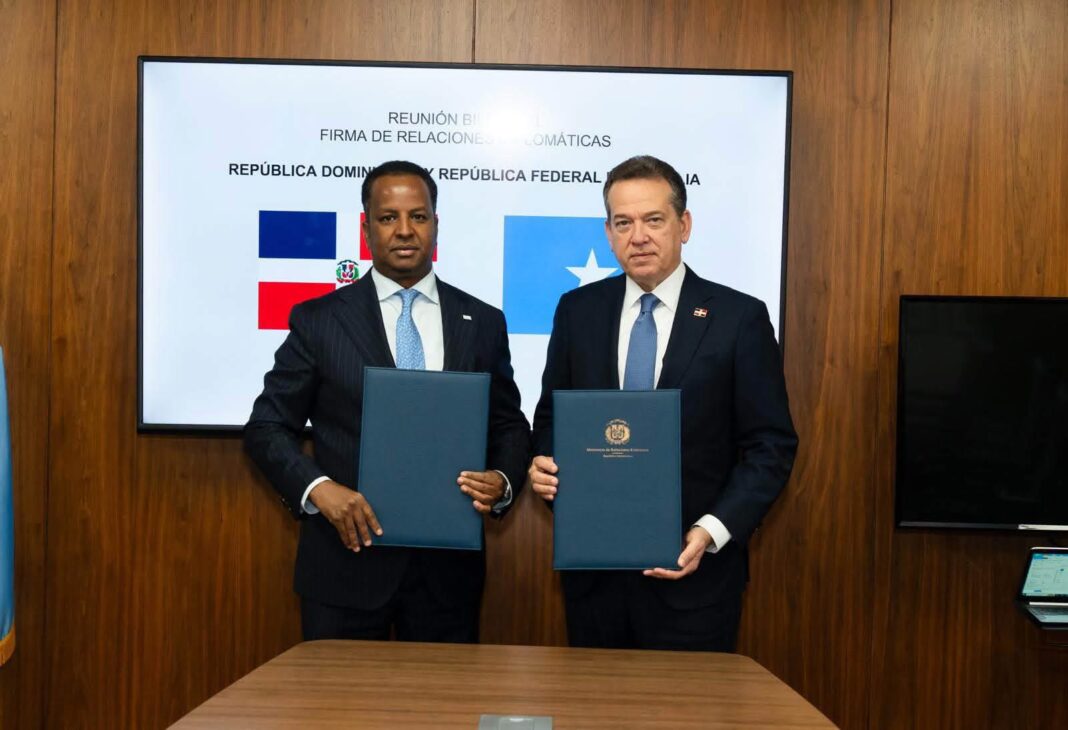

Somalia and the Dominican Republic have formally established diplomatic relations, opening a new channel of political, economic, and development cooperation between East Africa and the Caribbean.
The agreement, signed on the sidelines of the 81st United Nations General Assembly in New York, marks a significant expansion of Somalia’s diplomatic outreach into Latin America and the Caribbean and gives the Dominican Republic a new African partner as Santo Domingo seeks to broaden its international relationships.
Somalia’s Minister of Foreign Affairs and International Cooperation, Abdisalam Abdi Ali, and Dominican Foreign Minister Víctor “Ito” Bisonó signed a joint communiqué establishing diplomatic relations under the Vienna Convention. The agreement makes Somalia the 188th country with which the Dominican Republic has established diplomatic relations.
For Mogadishu, the move forms part of a wider effort to diversify Somalia’s international partnerships beyond its traditional diplomatic networks and strengthen engagement with countries in Latin America and the Caribbean.
The new relationship could create opportunities for cooperation in trade, investment, tourism, agriculture, education, maritime affairs, security, technology and diplomatic coordination in multilateral institutions.
Abdisalam Abdi Ali“The establishment of diplomatic relations with the Dominican Republic opens a new chapter in Somalia’s engagement with Latin America and the Caribbean. It reflects our commitment to broadening partnerships, creating new economic and diplomatic opportunities and building relationships based on mutual respect and shared interests.”
For the Dominican Republic, the relationship provides an avenue to deepen its presence and engagement in Africa while establishing a direct diplomatic channel with a strategically located country on the Horn of Africa.
Somalia occupies an important position along the Gulf of Aden and western Indian Ocean, close to major international maritime routes connecting the Middle East, Africa, and Asia. Its coastline also gives it potential relevance for cooperation in maritime security, fisheries, blue-economy initiatives, and port-related trade.
The Dominican Republic, meanwhile, is positioned in the Caribbean as a gateway between North America, Central America, South America and the wider Caribbean market. Its tourism, agriculture, manufacturing and logistics sectors could provide areas for future commercial engagement with Somalia and other African markets.
“Ito” Bisonó added that “The establishment of diplomatic relations with Somalia creates an opportunity to expand the Dominican Republic’s engagement with Africa and to identify practical areas of cooperation. We look forward to developing contacts between our governments, businesses and institutions in areas where our countries can generate mutual benefit.”
The agreement also gives the two countries a formal framework for developing political consultations and future bilateral agreements.
For Somalia, closer engagement with the Dominican Republic could provide another route into Caribbean and Latin American diplomatic and commercial networks. For Santo Domingo, relations with Somalia could strengthen its African outreach and create opportunities for dialogue on issues affecting both regions, including food security, climate change, maritime security, migration and sustainable development.
The diplomatic opening comes as Somalia continues to seek greater international partnerships to support its economic transformation and integration into regional and global markets.
The two countries could also use their new diplomatic relationship to promote South-South cooperation, particularly by exchanging expertise and experiences in areas such as agriculture, tourism, public administration, disaster management, education and small-business development.
The United Nations provides an immediate multilateral platform for the two countries to deepen their engagement. Their diplomatic ties could allow Mogadishu and Santo Domingo to coordinate on selected international issues while maintaining their respective foreign-policy priorities.
For Somalia, the relationship represents another step in its strategy of expanding diplomatic engagement beyond its immediate neighbourhood. For the Dominican Republic, it adds a new African partner to its increasingly broad network of international relations.
The immediate challenge will be to translate the diplomatic agreement into practical cooperation through reciprocal visits, the establishment of formal diplomatic missions or non-resident accreditation, business-to-business contacts and sector-specific agreements.
The establishment of relations therefore represents the beginning rather than the conclusion of Somalia-Dominican Republic engagement, with the potential gains ultimately depending on how effectively both governments convert diplomatic goodwill into trade, investment, institutional cooperation and people-to-people exchanges.



