
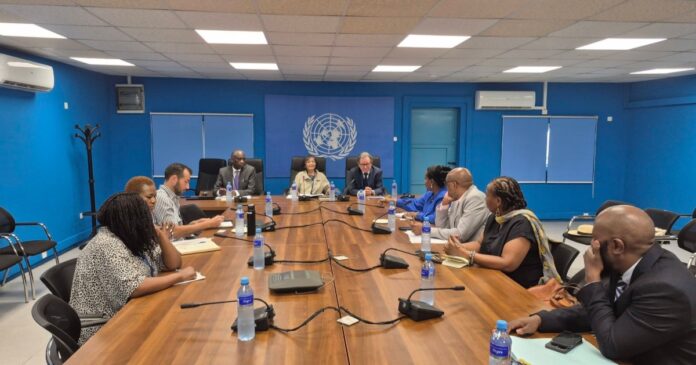

JUBA, South Sudan—To ensure accountability and promote transitional justice, the UN Commission on Human Rights in South Sudan, an independent, three-member body established by the UN Human Rights Council on March 23, 2016, has been looking into, gathering evidence for, and reporting on egregious human rights violations, such as ethnic violence, sexual violence related to conflicts, and systemic corruption, for the past ten years.
And now, as the youngest country in the world prepares to have elections on December 22, 2026, the UN Commission cautions that elections devoid of fundamental protections and sincere communication could lead to a resurgence of conflict and atrocity crimes.
Following the breakdown of the 2018 power-sharing deal between President Salva Kiir and former First Vice President Riek Machar, South Sudan’s civil war has resumed. The interim unity government was terminated by President Salva Kiir, who put Riek Machar under house arrest and accused him of treason and murder.
At least seven of the ten states in the country have seen fighting break out between the SPLM/A-IO and affiliated opposition organisations and the South Sudan People’s Defence Forces (SSPDF). Heavy warfare and government airstrikes continue to center on the Greater Upper Nile region, especially Jonglei State.
In this regard, the UN Commission on Human Rights in South Sudan issued a new advisory during its 14th visit to the nation in September 2026, warning that elections held without a plan for preventing national divisions and consolidating democracy could instead fuel new conflict and increase the likelihood of atrocity crimes.
The Commission concluded that several atrocity crime risk factors are coming together in its advisory, At the Brink: Preventing Atrocity Crimes and Safeguarding South Sudan’s Transition. In many regions of the nation, armed conflict has returned; inclusive politics has been abandoned; civic space and constitutional protections have been undermined; accountability systems are still mostly lacking; and sizable portions of the populace are still barred from meaningful political engagement.
Without a return to genuine and inclusive dialogue, the UN Commission observes that the political contest surrounding the elections risks deepening existing divisions rather than providing a peaceful means of resolving them.
https://twitter.com/UN_News_Centre/status/2096644598055751889
The Commission unequivocally supports the right of the people of South Sudan to participate freely in public affairs through genuine, peaceful, and democratic elections and to choose their government and representatives. Its concern is not whether elections should be held, but whether South Sudanese can exercise that right freely, safely, and without fear, and in a manner that consolidates the democratic transformation of South Sudan.
“South Sudanese have waited 15 years to cast their first ballots as citizens of an independent state. They have the right to choose their government through free, peaceful, and democratic elections. They deserve an election that gives them a voice, not one that puts their lives at risk,” said Yasmin Sooka, Chair of the Commission.
South Sudan enters a critical three-month electoral phase
The chairperson observed that a peaceful democracy cannot be built on a foundation of armed conflict, fear, and exclusion. “Yet the very safeguards designed to prevent a return to war are being dismantled as the country moves towards the ballot box.”
Early this week, South Sudan entered a critical three-month electoral phase after President Kiir dissolved the transitional government and appointed a caretaker administration to steer the country toward the general election.
The move ends the power-sharing government established under the 2018 peace agreement and comes a day after President Kiir signed amendments to the National Elections Act that removed key legal obstacles to holding the long-delayed polls.
The new arrangement leaves Kiir as president during the electoral period, while the five vice-presidents, national ministers, parliamentarians, and state-level political leadership have been relieved of their positions. The Transitional National Legislative Assembly and Council of States have also been dissolved.
The government says the caretaker structure is intended to prevent an administrative vacuum as South Sudan moves from its prolonged transitional period toward elections.
Government spokesperson Ateny Wek Ateny previously described the dissolution as necessary to maintain continuity of government as the mandate of the transitional administration expired three months before the scheduled vote.
Caretaker ministers take charge: Kiir has appointed 13 caretaker ministers to maintain the functioning of key government institutions during the electoral period.
The caretaker administration is expected to keep essential state functions running while the country prepares for the December vote. Under the presidential order, caretaker officials face restrictions on major long-term commitments, including substantial borrowing, strategic concessions, and disposal of public assets without presidential authorisation. They are also required to remain politically neutral during the electoral period.
https://twitter.com/UNCHRSS/status/2098328190515376552
Following the announced dissolution of South Sudan’s Revitalised Transitional Government of National Unity, Amnesty International’s Regional Director for East and Southern Africa, Tigere Chagutah, said:
“Ahead of these long-awaited and historic elections, South Sudanese authorities must ensure that a conducive environment exists for people to vote and stand in elections, including respect for and enjoyment of human rights and freedom from discrimination and arbitrary or unnecessary and disproportionate restrictions.
Amnesty International echoes the UN Commission’s sentiments
“The legitimacy of any election depends not only on whether it is held but also on whether people can exercise their rights freely, safely, and equally. For years, Amnesty International and other organisations have documented the repressive tactics deployed by the South Sudanese authorities to silence dissent, detain critics, and restrict freedom of expression and the right to protest.
Tigere emphasised that at this pivotal moment, Amnesty International calls on the South Sudanese authorities to immediately guarantee the rights to freedom of expression, association, and peaceful assembly; end the intimidation of journalists, civil society actors, and political opponents; and create conditions that enable all South Sudanese to participate in public affairs freely and without fear.”
While applying the UN Framework of Analysis for Atrocity Crimes, the Commission finds that these risk factors are not isolated but mutually reinforcing. Renewed armed conflict, weakened institutions, entrenched impunity, exclusionary governance, corruption, shrinking civic space, and inflammatory rhetoric are converging while mechanisms that could mitigate these risks—including ceasefire monitoring, independent justice institutions, and inclusive political dialogue—have been weakened or suspended.
“South Sudan is still in a transition intended to break cycles of violence and repression. Elections must not be allowed to create another violent battleground,” said Commissioner Barney Afako.
https://twitter.com/UNCHRSS/status/2098004457862607151
According to Commissioner Afako, the peace agreement was designed to take the guns out of political competition and to build systems to ensure the stability and prosperity of South Sudan.
Instead, Commissioner Afako indicated that the guns are returning while the safeguards for peaceful political competition are disappearing.
“That is a profoundly dangerous trajectory. South Sudan cannot build a democratic future by excluding those with whom it disagrees. The parties must return to genuine dialogue, rebuild consensus, and create the conditions in which political competition can take place without exclusion and violence,” explained Afako.
Under the Revitalised Agreement on the Resolution of the Conflict in South Sudan (R-ARCSS), security-sector reform, accountability, and constitutional reform were intended to establish the basis for credible elections.
Yet the Agreement’s agreed sequence has not been honoured: the Government’s latest assessment shows that 46.4% of the Agreement’s provisions remain outstanding, the unification of national forces remains incomplete, and armed conflict has resumed. Proceeding to elections without addressing these deficiencies risks producing an outcome that lacks the conditions required for peaceful competition, meaningful participation, and public confidence.
“An election cannot be credible simply because it is held on schedule,” said Commissioner Carlos Castresana Fernández.
The Commission identified solutions to a credible electoral process
Commissioner Fernández went on to state that it is credible when citizens can vote without fear, political opponents can participate freely, courts can resolve disputes independently, and institutions can constrain the exercise of power.
“These are not optional conditions. They are the safeguards that make an election a peaceful democratic process. Without those safeguards, the ballot risks becoming another arena for conflict rather than a pathway out of it,” added Commissioner Fernández.
The Commission identified essential conditions for a credible and non-violent electoral process: a genuine and monitored cessation of hostilities; unified national security forces under a non-partisan command; restored civic and political space; independent electoral institutions; effective and impartial electoral dispute resolution; protection for the participation of women, youth, persons with disabilities, internally displaced persons, and refugees; measures to prevent and respond to hate speech and incitement; and equal political participation by all parties.
The Commission also acknowledged the profound frustration of South Sudanese who have endured years of protracted political transition, insecurity, and economic hardship.
When reached for comment following the UN Commission’s visit to the country, Carlton Faris, a Kenyan truck driver operating in South Sudan, lauded the UN Commission for its concerted efforts in helping stabilise the country.
“We need this kind of help from the world. The military of South Sudan, along the Nimule-Juba highway, after destroying the forest, goes to hijack trucks and force the drivers to carry the firewood and charcoal. This is the kind of intervention we need addressed by the international community,” said Carlton.
On her part, Ruth Nyaleel Kai Thoat, a South Sudanese national, said, “When a people’s cries are heard by the world, they become a beacon of hope; let South Sudan not falter now. The United Nations saved us once as refugees; now, let us be saved by justice, by action, and by the courage to implement peace before it is too late.”
https://twitter.com/UNCHRSS/status/2097701573367570499
Riak Yul, another South Sudanese national, appealed to the UN Commission to help bring all the perpetrators of war and violence to book.
·
“All criminals must be brought to the book even if it means hanging them in front of innocent people of South Sudan, and all sycophants be sent to life in prison.”
The role of the African Union, IGAD, UN, and other international partners
For many, elections represent an important opportunity to shape the country’s political future peacefully; the UN Commission on Human Rights in South Sudan said this is a legitimate aspiration.
“In the context of a transition from conflict, South Sudan’s leaders and institutions have the responsibility not only to create the conditions in which citizens can exercise their rights safely and meaningfully but also to lay foundations for enduring stability,” the Advisory further reads.
In the Advisory, the Commission also called on the government and all parties to the R-ARCSS to cease hostilities immediately, restore the transitional security arrangements, end the mobilisation of armed actors, and urgently reconvene an inclusive political dialogue involving Dr. Machar’s SPLM-IO faction, holdout groups, civil society, and representatives of women and youth.
https://twitter.com/UNCHRSS/status/1983616168972947918
It also called for the release of detained opposition leaders, including Dr. Machar, unless they are promptly brought before an independent and impartial court in proceedings that comply fully with international human rights standards, including due process guarantees. An inclusive, consensus-based political process is essential to restoring the safeguards required for a peaceful and democratic transition.
The Commission urged the African Union, IGAD, the United Nations, and other international partners to intensify coordinated preventive diplomacy and support a return to an inclusive, consensus-based transition.
“The current trajectory is not irreversible. There is still time to restore the safeguards necessary for elections to become a pathway towards democratic transition rather than a trigger for renewed conflict—but this requires an immediate return to inclusive political dialogue, consensus-building, and implementation of the peace agreement,” the Advisory further reads.

“South Sudan does not lack peace agreements, frameworks, or roadmaps; it lacks their implementation and accountability for those who have chosen power over the protection of the people they govern,” the Commission states in its Advisory. “The window to prevent a return to the scale of atrocities and displacement South Sudan endured between 2013 and 2018 is closing, but it has not yet completely shut.”