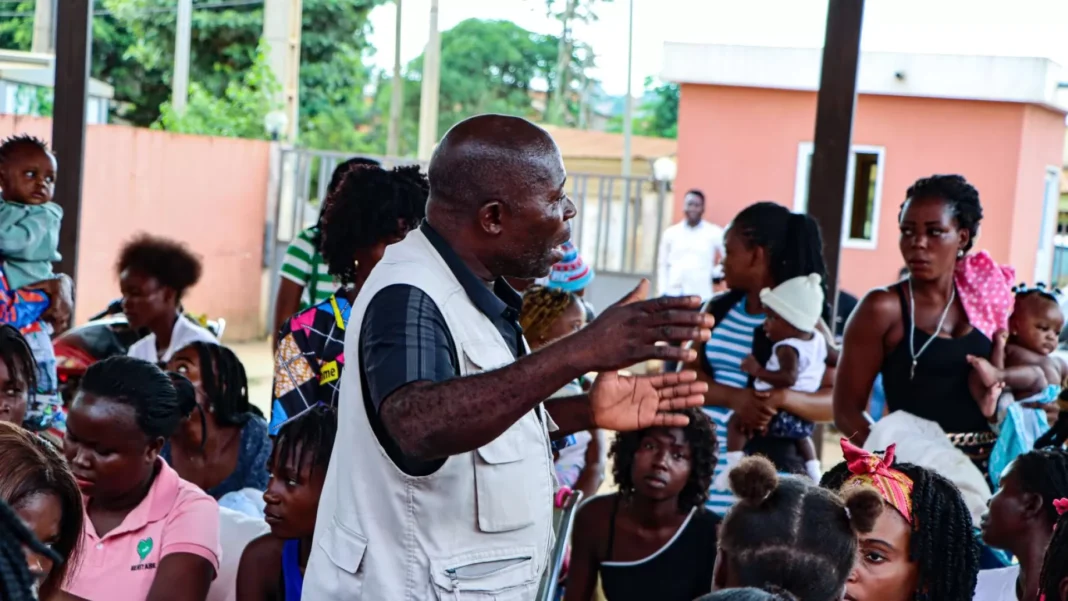

The loss of two children to measles left a mother in rural Angola with a tragedy no parent should have to experience. But behind the deaths was another painful reality: the decision to keep the children isolated at home instead of seeking medical attention had been influenced by advice widely accepted within her social circle.
It was a decision shaped not necessarily by a lack of concern for the children, but by the influence of people around her.
The account, shared by WHO Angola Communication Officer Olívio Gambo, raises a difficult question about public health: how many health decisions are made because people understand the risks, and how many are made because they fear going against what their communities believe?
Across societies, people rarely make decisions in isolation. Families, friends, religious leaders, neighbours and social networks influence how individuals interpret information, respond to illness and decide when to seek medical attention.
These relationships provide support, identity and a sense of belonging. But when accepted community practices contradict medical evidence, the same networks that sustain people can also reinforce decisions that put their health at risk.
The consequences can be particularly serious for children, whose health decisions are largely determined by adults.
In his reflection, Gambo draws on psychologist Albert Bandura’s social learning theory, which explains how people acquire behaviours by observing and imitating others. When a practice becomes common within a community, its popularity can be mistaken for proof that it is safe or beneficial.
This helps explain why health misinformation can persist even when medical guidance is available.
A parent may delay taking a sick child to hospital because others have recommended waiting. Someone may avoid a medical test because of the stigma attached to a possible diagnosis. Another person may interrupt treatment after receiving advice from relatives or friends who have had different experiences with illness.
In such situations, the challenge extends beyond whether people have access to health information. It becomes a question of whether they feel able to act on that information when doing so means disagreeing with the people they trust.
Social influence can be especially powerful during uncertainty. When people do not know what to do, they often look to those around them for reassurance. If the prevailing advice is inaccurate, collective confidence can give misinformation the appearance of credibility.
The public-health implications are significant. Vaccination decisions, treatment adherence, early diagnosis and timely healthcare seeking can all be influenced by social expectations.
For children, the consequences of delayed decisions can be especially serious because they depend on caregivers to recognise illness and obtain appropriate care.
The measles experience described by Gambo illustrates the importance of this distinction. Community advice may be offered with good intentions, but good intentions do not necessarily make medical guidance accurate.
The issue is not that communities should stop influencing one another. Rather, it is that trusted relationships should become channels through which reliable health information is shared, instead of spaces where harmful practices are protected from scrutiny.
This requires more than distributing information through posters, radio announcements or public health campaigns.
Communication strategies must understand why people trust certain voices, what fears shape their choices and which social expectations make it difficult to adopt healthier practices.
A message encouraging vaccination, for instance, may have limited influence if community members believe that accepting it signals rejection of their traditions or values. Similarly, advising parents to seek medical care early may not be enough if they face stigma, financial constraints or pressure from relatives who discourage hospital visits.
That is why community engagement matters.
Religious leaders, traditional authorities, teachers, community health workers and other trusted local figures can help create environments in which people feel supported when making evidence-informed decisions.
However, their involvement must be accompanied by accurate information and clear links to qualified health professionals. Community influence is most useful when it strengthens, rather than replaces, access to appropriate healthcare.
There is also an economic dimension to the problem.
Gambo argues that social pressure extends beyond health and influences how families spend their resources. Expectations surrounding ceremonies, celebrations and displays of status can encourage households to spend beyond their means, sometimes at the expense of education, healthcare and long-term financial security.
The connection is important because household decisions rarely exist independently of one another. Money spent to meet social expectations may reduce what is available for essential needs, while fear of criticism can influence whether families prioritise their own circumstances or the approval of others.
In this sense, social norms can shape human development in ways that are not always immediately visible.
The challenge, however, is not to portray communities as obstacles to progress. Social norms are not fixed, and collective influence can also encourage positive change.
Gambo points to Australia’s transformation of public attitudes towards smoking as an example of how communication campaigns, consistent public policies and scientific evidence can gradually change what society considers acceptable.
The broader lesson is that behaviour change requires more than telling people what is right. It involves changing the environment in which decisions are made.
When governments and health institutions engage communities, address misinformation and ensure that people can access reliable services, evidence-based choices become easier to make.
For Angola, Gambo argues that this approach has relevance across health, education, nutrition and civic participation. The country’s development depends not only on the availability of services but also on whether citizens have the information and freedom to make decisions that improve their lives.
His reflection draws on economist Amartya Sen’s understanding of development as the expansion of people’s freedoms and capabilities to pursue lives they value.
That perspective shifts the conversation from simply providing services to enabling people to use them. A health facility may exist, but its presence alone does not guarantee that a parent will seek care when a child becomes ill. Information may be available, but that does not mean people can act on it without social or economic pressure.
The real test of public health communication is therefore not how many messages reach an audience, but whether those messages help people make informed decisions.
The mother whose experience prompted Gambo’s reflection represents a wider challenge for health systems: ensuring that the advice people receive from their immediate social environments does not undermine the care they need.
No communication campaign can eliminate every influence on human behaviour. But societies can build stronger cultures of questioning, where people are encouraged to verify information, consult qualified health professionals and challenge practices that put lives at risk.
- Ultimately, community should be a source of protection, not a barrier to seeking it.
And when a child’s health is at stake, the ability to question popular advice may be just as important as the ability to access medical care.