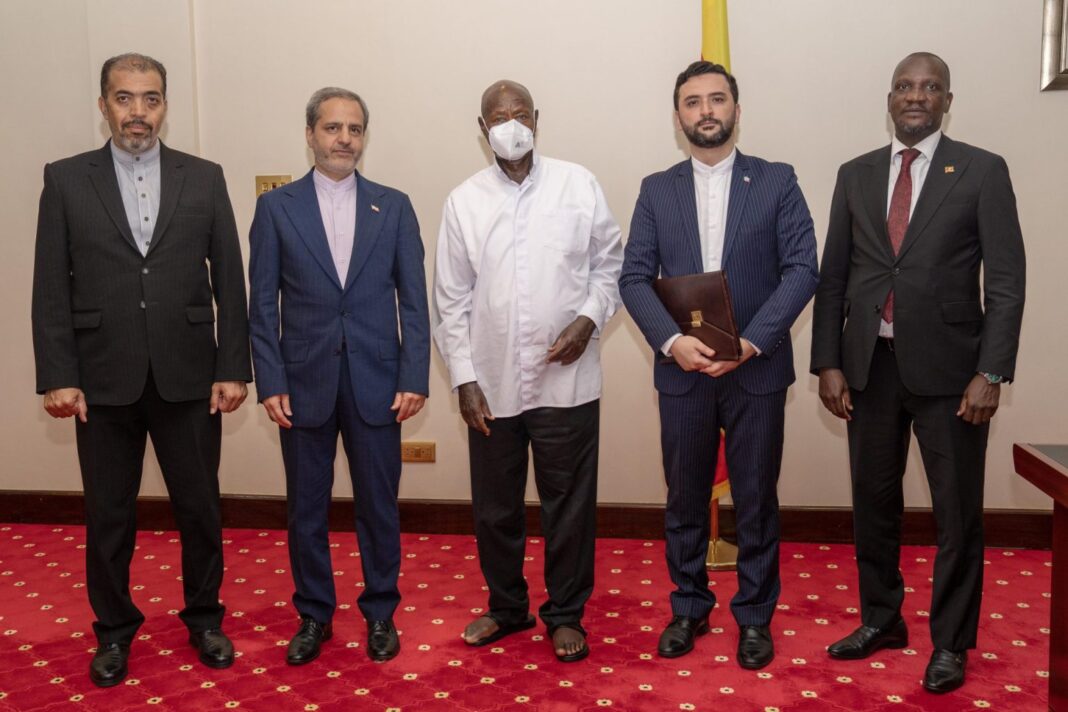

Uganda and Iran are seeking to deepen bilateral relations through agricultural investment, agro-processing, healthcare, education and trade, as Kampala calls on Iranian companies to establish factories that can add value to the country’s agricultural produce and create jobs.
President Yoweri Museveni made the appeal on October 26, 2026, during a meeting with outgoing Iranian Ambassador to Uganda, Majid Saffar, at State House in Entebbe. The discussions focused on expanding economic cooperation and translating existing bilateral ties into investment opportunities for businesses in both countries.
Museveni urged Iranian investors to establish processing industries in Uganda, arguing that local farmers could supply raw materials while foreign companies invest in facilities to produce higher-value goods for domestic and international markets.
“The best way is to build factories in Uganda to process agricultural products from our Ugandan farmers. Let the people here produce, and your companies process,” Museveni told the ambassador.
The proposal places agro-industrialisation at the centre of efforts to strengthen Uganda-Iran economic relations, with potential opportunities in coffee, cocoa and pineapple processing.
Saffar said Iranian companies had expressed interest in investing in Uganda’s agricultural sector, including establishing farms and processing locally produced commodities. He said Iran was prepared to support cooperation with agricultural cooperatives and farmers’ organisations to promote commercial production, trade and employment.
“You’re rich in agriculture, and there are a lot of Iranian companies interested in processing Ugandan agricultural products such as cocoa, coffee, pineapples, and we’re ready to support cooperatives and agriculture unions in that line to promote trade and job creation,” he said.
The discussions also covered the potential supply of seeds, fertilisers and agricultural machinery, areas that could support Uganda’s efforts to improve farm productivity and expand commercial agriculture.
For Uganda, attracting Iranian investment into processing could help reduce reliance on raw agricultural exports while creating opportunities for farmers, manufacturers and exporters. For Iranian companies, partnerships with Ugandan producers could provide a platform for expanding commercial operations and accessing agricultural supply chains in East Africa.
However, translating the proposed cooperation into tangible economic gains will depend on investment commitments, financing, infrastructure and the establishment of commercially viable projects.
Beyond agriculture, Museveni and Saffar discussed cooperation in healthcare and education, identifying the sectors as additional avenues for strengthening relations between Kampala and Tehran.
The engagement reflects the two countries’ interest in broadening bilateral cooperation beyond diplomatic exchanges towards practical economic partnerships. Agricultural technology, industrial processing and skills development could provide areas for further collaboration if both sides move forward with concrete programmes and business agreements.
Museveni thanked Saffar for his diplomatic service in Uganda as he concluded his tenure, wishing him success in his future assignments.
“Thank you for a successful tour of duty, and I wish you good luck in your future assignments,” the President said.
The meeting also addressed the security situation in Iran and wider tensions in the Middle East, highlighting the role of political dialogue and diplomatic recognition in regional relations.
Museveni called on countries in the region to move away from identity-based politics, arguing that political and religious differences should not become grounds for hostility between states and communities.
“My only advice to the Middle East is to stop the politics of identity. You have the wrong politics and wrong methods of solving problems,” he said.
He cited tensions between Iran and Israel, saying Iran should recognise Israel while Israel should recognise Palestinian statehood.
“Iran should recognise Israel. Israel should recognise Palestine,” Museveni said.
The exchange added a diplomatic dimension to discussions that were primarily focused on bilateral economic cooperation, underscoring how relations between Uganda and Iran also intersect with wider regional and international issues.
As Saffar’s tenure comes to an end, the two countries have identified agriculture, healthcare, education and trade as potential areas for closer engagement. The next step will be to turn the discussions into investment projects and sustained commercial partnerships that deliver measurable benefits to both countries.