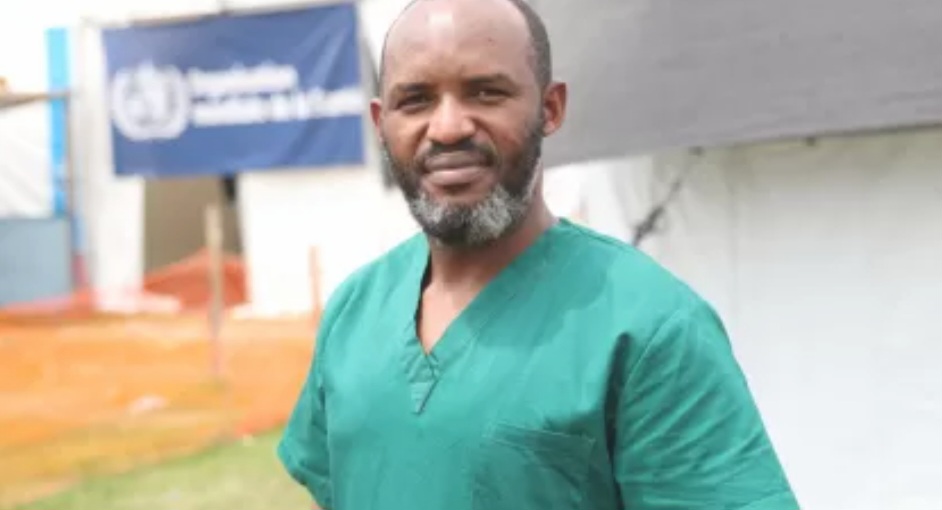

After his wife contracted Ebola, a doctor in the Democratic Republic of Congo gained a deeply personal understanding of the fear, uncertainty and emotional burden facing patients and families during an outbreak.
For Dr Elvis Mani Rodrigo, caring for people infected with Ebola was part of his daily responsibility. At the Ebola treatment centre in Bunia General Hospital, he spent his days attending to patients whose greatest fear was whether they would survive the disease.
But the outbreak became deeply personal when his wife, a laboratory technician involved in surveillance and sample collection at the same hospital, contracted the virus.
The doctor who had spent months reassuring frightened patients suddenly found himself watching someone he loved fight the same disease.
His experience exposed a dimension of epidemic response that often receives less attention: the emotional toll on healthcare workers who must continue caring for others while confronting fear and uncertainty in their own lives.
For nearly three weeks, his wife battled a severe form of Ebola.
It began with extreme fatigue, followed by fever and cough. Laboratory tests eventually confirmed what the family had feared: she was infected.
Rodrigo was classified as a high-risk contact, but he chose to remain by his wife’s side throughout her treatment.
“After living with my wife, I was already considered a high risk contact. I could not move away from her. I stayed by her side,” he recalls.
While trying to reassure her, he was also dealing with the uncertainty of his own possible infection.
Eventually, his wife recovered.
The experience changed how he understood the people arriving at the treatment centre. He was no longer looking at Ebola only through the responsibilities of a doctor. He had experienced the anxiety, helplessness and uncertainty that families face when someone close to them becomes infected.
At Bunia General Hospital, Rodrigo works with suspected and confirmed Ebola patients, providing medical care alongside psychological support.
He understands that patients arriving at the facility are often carrying more than physical symptoms. Many are frightened, worried about their families and uncertain whether treatment will bring them home.
“Ebola is very traumatic. Many patients arrive with fear of dying. We are here to treat them, but also to accompany them through this difficult ordeal,” he says.
For him, treatment cannot be reduced to medicines and clinical procedures. Patients also need someone willing to listen, reassure them and help them navigate the emotional strain of the illness.
“We try to be present, attentive and close to the patients. When they feel they are not alone, they regain confidence and hope,” he explains.
His wife’s recovery reinforced this belief.
Having experienced the emotional pressure of an Ebola infection within his own household, Rodrigo became more conscious of the fear and isolation patients experience and the importance of supporting those waiting for their loved ones to recover.
He also emphasises that care should not end when a patient is discharged from the treatment centre.
Families and relatives need psychological support to help them welcome survivors back into their communities and rebuild relationships that may have been strained by the outbreak.
“Psychological support for the family and loved ones is very important to properly welcome a person who has recovered,” he says.
This concern is particularly important in outbreaks where fear, misinformation and uncertainty can affect how communities receive survivors and interact with affected households.
For Rodrigo, the experience also highlights the vulnerability of healthcare workers themselves.
Doctors, nurses, laboratory personnel and other frontline responders are expected to maintain their responsibilities during emergencies, often while dealing with personal fears and the possibility of exposure to the same disease they are fighting.
Their emotional well-being is therefore an essential part of an effective outbreak response.
A healthcare worker struggling with the psychological consequences of an emergency also needs access to appropriate support, just as patients and their families do.
The experience of Rodrigo and his wife illustrates why mental health cannot be treated as an afterthought during epidemics. Psychological support must be considered throughout the illness, from diagnosis and treatment to recovery and reintegration into the community.
Beyond the hospital, the doctor’s message to people experiencing symptoms is straightforward: do not delay seeking medical attention.
“I would like to tell people going through difficult times not to give up and to come quickly to the hospital as soon as symptoms appear. The earlier you come, the greater the chances of receiving the care needed to recover,” he says.
LHis story offers a reminder that those who care for patients during an outbreak are not immune to its emotional consequences.
Behind the protective equipment, clinical responsibilities and emergency response structures are people with families, fears and personal struggles of their own.
For Rodrigo, his wife’s recovery brought relief, but it also left him with a deeper understanding of what patients experience when confronted with Ebola.
He continues to care for those arriving at the treatment centre, carrying with him a lesson learned not only from his medical work, but also from the experience of having the disease enter his own home.
In the fight against Ebola, saving lives requires more than treating the infection. It also means recognising the emotional needs of patients, supporting their families and ensuring that the people providing care are not left to carry the psychological burden alone.
Source: World Health Organization (WHO), Regional Office for Africa. Adapted from its feature story, “Taking care of others despite fear: a doctor facing Ebola”, published on 3 November 2026.