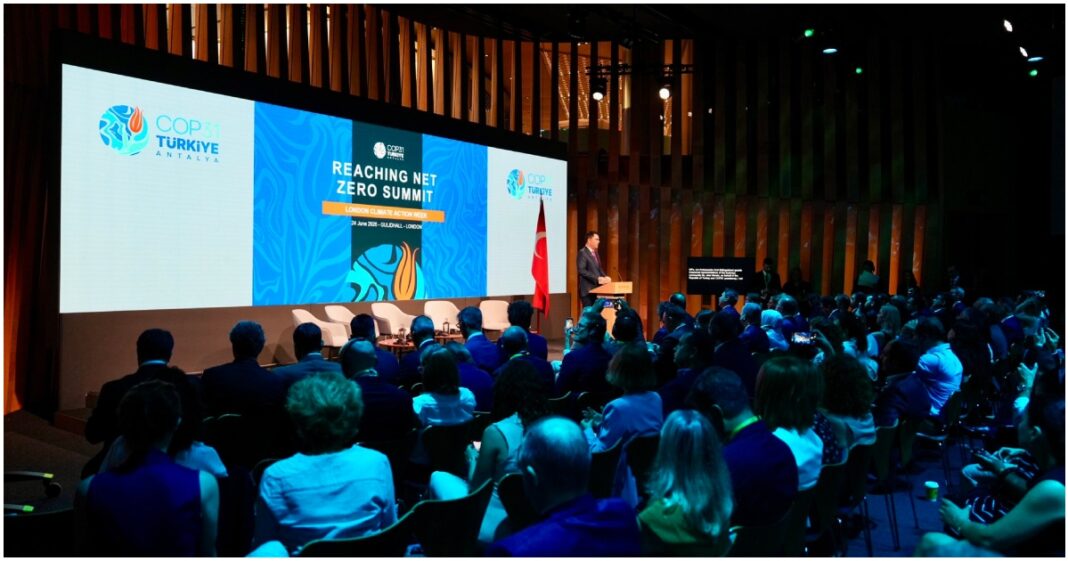

ANTALYA, Turkey – The 31st United Nations Climate Change Conference (COP31) has opened in Antalya, Türkiye, today, Monday, November 9, 2026, even as international public climate finance experiences notable declines.
UN Climate Executive Secretary, Simon Stiell, said that the mandates of the annual conference are multiplying while funds are decreasing.
“We have achieved significant efficiency gains. And we will continue to do so. But we need serious work with the Parties during our budget consultations over the next six months. We cannot continue to do more with less,” Stiell said in his opening speech.
Developing nations need roughly $305 billion annually by 2035 for adaptation, whereas wealthy nations provided only $28.2 billion to $31.7 billion in 2024. Pledges to triple adaptation finance by 2035 would still cover under 30% of projected needs.
Stiell indicated that in this new era of implementation, the UN is taking a different approach to this COP 31.
“Without rejecting what has been done before but building upon these achievements to improve them, to progress more quickly,” he added.
The role of COPs
- Send signals:
- Set global goals.
- Determine the path forward.
- Create momentum and strengthen resolve.
Stiell noted that since the conclusion of the Paris Agreement, they have sent signal after signal to global political systems and markets.
This has changed our world
Stiell disclosed that 90% of major renewable energy projects are now cheaper than alternatives to fossil fuels.
“And adaptation moves from a marginal approach to a generalised approach. But progress is far from being fast enough or equitable. That is why, beyond sending signals, COP 31 must accelerate solutions. It must break down existing global objectives and national plans into distinct problems,” explained Stiell.
And to implement concrete solutions:
- Solutions to triple the funding for adaptation, as agreed last year.
- Solutions to address the immense frustration countries face when trying to access committed and available funding.
- Solutions to triple global renewable energy capacity by 2030…
- To transport energy across networks and beyond borders, in order to power the electric age…
- And to drastically reduce highly polluting methane emissions, particularly in the oil and gas and waste sectors – by drawing inspiration in particular from the main energy producers.
Together, Stiell stated that the measures concerning methane and electrification constitute a planetary “block of ice”, capable of reducing the projected global warming by half a degree.
“This is the best way we can fight against ecological overshoot right now: by catching up with successive solutions. And now, the COPs will offer more space for countries to coordinate the implementation of these solutions,” he further said.
According to Stiell, changing ways of doing things involves, in particular, the unique partnership concluded this year between Turkey and Australia:
Promote solutions both within the framework of negotiations and the Action Agenda.
He also took the opportunity to thank the hosts, while commending Minister Murat Kurum, President of COP 31, in particular for “your clear calls in favour of the Action Agenda.”
“At the United Nations Climate Change Programme, we want to help countries take full advantage of everything the Action Agenda has to offer. We are preparing a highlight for the last day of the COP, which will allow us to take stock of the progress made over these two weeks,” he further explained.
Stiell emphasised that the UN wishes to explore ways to support government counterparts in strengthening collaboration with non-signatory stakeholders and mobilising action in support of common priorities.
“We also want to bring together more leading actors from all economies. This includes coordinating with other climate weeks around the world to mobilise around the six pillars of the action plan,” he said.
Negotiations remain at the heart of COP’s concerns
Stiell also said that consensus remains at the heart of the process under the leadership of Minister Chris Bowen, chairman of the COP 31 negotiations.
“It is essential to achieve solid results on the mandated negotiation points. The stronger these results are, the more they will help the parties to transform their objectives into concrete results, thereby enabling more people to benefit from these advances,” he indicated.
He observed that an agreement on the just transition mechanism will make it easier for countries to lead their entire societies towards the transition.
“The adaptation agreements will provide us with a framework for disbursing funds to countries and will allow indicators to drive progress at the national level. Mitigation agreements will help countries accelerate implementation across sectors and economies and send stronger signals to markets and societies regarding the reduction of pollution responsible for global warming,” explained Stiell.
The financing agreements will provide the UN with details on how to achieve the commitments of 300 billion and 1,300 billion without calling into question previous agreements. This will require greater mobilisation from the entire financial system.
The urgency of the moment
According to the UN Climate Executive Secretary, climate change is already taking a heavy toll on the Earth.
“A horrific tragedy has struck the Himalayas, adding to the ever-growing list of disasters affecting communities in all regions. An extreme El Niño phenomenon is adding fuel to the climate fire that is already ravaging communities and economies around the world,” Stiell lamented.
Everywhere, Stiell observed it is the most vulnerable who pay the heaviest price – as highlighted by the Pre-COP in Fiji, organised in partnership with Australia and the Pacific Islands.
“A profound injustice threatens our solidarity and our collective progress.”
The frustration is palpable
Stiell remarked that equity must be at the heart of a truly global transition to clean energy and resilience. “Because it’s the right thing to do.”
“And because it serves the interests of all countries: limiting global warming and protecting every community and every economy,” added Stiell.
Meanwhile, Stiell noted that the surge in fossil fuel prices this year has caused a global shockwave, hitting households hard and spreading inflation like a cancer.
“The repercussions were serious, both economically and politically, as we have just seen.”
But the solutions are clear
Stiell said renewable energy saved approximately half a trillion US dollars last year. And an additional 265 billion dollars in the first half of this year alone, according to IRENA.
Adaptation offers a proven return on investment
The UN official said it is through concrete solutions that they will be able to deploy these measures to a greater number of people, in more places, and much more quickly.
“Faced with these pressures that are being exerted all over the world. And in doing so, we will build a solid foundation for the second global assessment that will take place in two years,” he added.
He told the delegates that the United Nations Framework Convention on Climate Change is by their side during these two weeks and beyond.
“Your Excellencies, no COP is a miracle solution. No single conference can bridge the gap between science and reality. We must face the world as it is, not as we would like it to be. Each recent COP has led to significant progress. This one must do the same,” Stiell further said.
Stiell also said that an intensification of climate solutions offers a real opportunity to accelerate progress.
“We have a responsibility to seize it. This is what the implementation era looks like. Let’s get to work,” explained Stiell.